
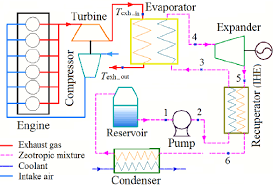
As we strive to reduce our carbon footprint and transition towards renewable energy sources, the concept of Organic Rankine Cycle (ORC) has gained significant attention in recent years. ORC is an innovative technology that harnesses waste heat from industrial processes, solar panels, and geothermal systems to generate electricity, offering a highly efficient solution for industries looking to reduce their environmental impact.
What is Organic Rankine Cycle?
Organic Rankine Cycle (ORC) stands for Organic Rankine Cycle, which refers to a system designed to capture waste heat from various sources and convert it into electricity. This technology has the potential to optimize energy efficiency in industrial settings by leveraging waste heat that would otherwise be lost. By doing so, ORC systems can produce electricity at a lower cost and with minimal environmental impact.
History of Organic Rankine Cycle
The concept of ORC was first introduced in the 1920s by British engineer William Rankine. However, it wasn’t until the 1990s that ORC technology began to gain traction as a viable alternative for waste heat recovery. Since then, there has been significant research and development in this area, leading to improved efficiency rates and reduced costs.
Key Characteristics of ORC Systems
The core characteristic of ORC systems lies in their use of organic materials with high molecular weights and low phase change temperatures. This allows ORC systems to generate electricity from a wide range of heat sources, including:
- Industrial processes
- Solar panels
- Geothermal systems
By employing these characteristics, ORC systems can produce electricity even from moderate-temperature heat sources.
Components of an ORC System
An ORC system typically consists of three main components:
- Primary Heat Exchanger: This component transfers heat from the exhaust gases to a thermal medium.
- Organic Rankine Cycle (ORC) Plant: This is the heart of the system, responsible for generating electricity from the recovered heat.
- Condenser System: This component dissipates the condensation heat produced by the ORC plant.
How an ORC System Works
The process involves the following steps:
- Waste heat is transferred to a thermal medium, typically a fluid or gas.
- The thermal medium enters the primary heat exchanger, where it absorbs heat from the exhaust gases.
- The thermal medium then passes through the ORC plant, where it drives a turbine to generate electricity.
- The condenser system dissipates the condensation heat produced by the ORC plant.
Applications and Advantages of ORC Systems
ORC systems have numerous applications across various industries, including:
- Industrial processes: waste heat recovery
- Solar energy: converting solar thermal energy into electricity
- Geothermal energy: harnessing geothermal heat for power generation
The benefits of ORC systems are multifaceted:
- High efficiency: ORC systems can achieve high efficiency rates by leveraging waste heat that would otherwise be lost.
- Low emissions: By utilizing organic materials, ORC systems reduce greenhouse gas emissions and minimize environmental impact.
- Flexibility: ORC systems can operate at various temperatures, making them suitable for a wide range of applications.
Real-World Applications in Italy
In Italy, the potential for ORC systems is vast. One notable example is the Zuccato Energia, a company based in Verona that produces energy modules utilizing organic Rankine cycle technology. These modules can generate electricity from 50 to 150 kW and are used in various applications, including:
- Waste heat recovery
- Industrial processes
- Small-scale renewable energy systems
Challenges and Limitations of ORC Systems
While ORC systems offer numerous benefits, there are also some challenges and limitations to consider:
- High initial costs: ORC systems can be expensive to install, although the long-term savings can offset these costs.
- Complexity: ORC systems require specialized knowledge and expertise to design and operate effectively.
- Materials: The use of organic materials in ORC systems requires careful selection to ensure optimal performance.
Conclusion
Organic Rankine Cycle is a revolutionary technology that offers a promising solution for industries seeking to reduce their environmental footprint while optimizing energy efficiency. By harnessing waste heat from various sources, ORC systems can generate electricity at a lower cost and with minimal emissions. As we continue to explore new ways to power our world sustainably, the potential of ORC technology is undeniable.
Future Directions and Research
To fully realize the potential of ORC technology, further research and development are needed:
- Improved materials: Developing more efficient organic materials that can withstand high temperatures and maintain optimal performance.
- System design: Optimizing system design to minimize costs and maximize efficiency.
- Integration with renewable energy sources: Integrating ORC systems with solar panels and geothermal energy to create hybrid power generation systems.
FAQs
- Q: What are the benefits of using an Organic Rankine Cycle system?
A: ORC systems offer high efficiency rates, low emissions, and flexibility in operating temperatures, making them suitable for various applications. - Q: Can ORC systems be used with solar panels or geothermal energy?
A: Yes, ORC systems can harness waste heat from solar panels and geothermal systems, converting it into electricity. - Q: How efficient are ORC systems compared to traditional power generation methods?
A: ORC systems can achieve higher efficiency rates than traditional methods by leveraging waste heat that would otherwise be lost. - Q: Can ORC systems operate at very low temperatures?
A: Yes, ORC systems can generate electricity from moderate-temperature heat sources, making them suitable for various applications. - Q: What is the potential environmental impact of using an ORC system?
A: ORC systems reduce greenhouse gas emissions and minimize environmental impact by utilizing organic materials.


