
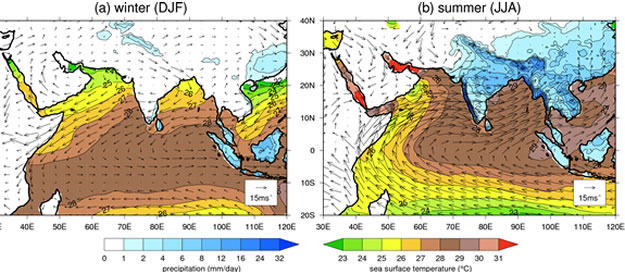
As the world grapples with the challenges of climate change, a significant shift in the Indian monsoon is underway. The Indian monsoon, also known as the Asian southwest monsoon, plays a crucial role in the country’s agriculture and economy. With approximately 70% of its annual rainfall coming during this season, it is essential to understand the reasons behind this phenomenon.
Understanding the Indian Monsoon
The term “monsoon” originates from the Arabic word for “season.” It describes a seasonal wind shift that brings much-needed rain to India during the summer months. The shift occurs due to the planet’s tilt and its position relative to the Sun, resulting in varying temperatures between the land and sea.
In 2017, researchers from the Indian Institute of Tropical Meteorology found evidence of increased evaporation over the Arabian Sea, leading to more intense rainfall events. However, these studies must be considered as speculative and require further investigation to confirm their findings.
Research on Climate Change and Monsoons
A study published in Nature Climate Change by Turner et al. (2012) concludes that there is no conclusive evidence of a change in the Indian monsoon due to climate change. This conclusion was based on the results from 27 different monsoon seasons during the 20th century.
However, other research suggests that the monsoon may be influenced by changes in atmospheric conditions and temperature. For example, a study published in Journal of Atmospheric Science found that global warming has led to an increase in atmospheric humidity over India during the summer months.
Possible Causes of Decreased Precipitation
One potential cause of decreased precipitation could be air pollution from India itself. The condensation of water vapor leads to rainfall, so reduced emissions might affect the amount of moisture available for rainfall. Studies on past climate changes suggest that changes in solar radiation may have led to shifts in monsoon patterns.
Research has also suggested that global warming may lead to an increase in atmospheric temperature over land, leading to a decrease in precipitation. This effect is more pronounced during the summer months when the monsoon begins.
IPCC Report on Climate Change and Monsoons
The Intergovernmental Panel on Climate Change (IPCC) report on global warming at 1.5°C concludes that there is a “low confidence” in any predicted changes to the Indian monsoon within this temperature range, but it is possible that the intensity of summer monsoon rains may increase due to rising temperatures.
The report also notes that there is a high likelihood that the area covered by monsoonal systems could expand globally over the 21st century. While there is a high likelihood that the Indian summer monsoon will weaken, the precipitation intensifies as atmospheric humidity increases with warmer temperatures.
Future Trends and Predictions
According to the latest IPCC report, the effects of climate change on the Indian monsoon are complex and difficult to predict. However, it is clear that global warming will have a significant impact on the country’s agriculture and economy.
The report suggests that there may be changes in precipitation patterns over India during the summer months, leading to droughts or floods. These changes could have significant impacts on the country’s agricultural productivity and food security.
Q&A: The Impact of Climate Change on the Indian Monsoon
- What is the Indian monsoon and why is it important?
The Indian monsoon plays a vital role in India’s agriculture, economy, and climate. It supplies most of its annual rainfall during this season. - How does climate change affect the Indian monsoon?
There is currently no conclusive evidence that climate change affects the Indian monsoon. However, some research suggests that changes in atmospheric conditions and temperature may impact the monsoon patterns. - What can we do to mitigate the effects of decreased precipitation on agriculture?
Sustainable agricultural practices, such as crop rotation, irrigation management, and soil conservation techniques can help farmers adapt to reduced rainfall. - Will climate change continue to affect India’s summer monsoon?
The latest IPCC report suggests that there is a high likelihood that the Indian summer monsoon will weaken due to rising temperatures.
Conclusion
The Indian monsoon plays a crucial role in the country’s agriculture and economy. While there is currently no conclusive evidence that climate change affects the monsoon, some research suggests that changes in atmospheric conditions and temperature may impact the monsoon patterns.
As global warming continues to rise, it is essential to monitor the effects of climate change on the Indian monsoon closely. This will help us better understand the potential impacts on agriculture and food security, and inform strategies for mitigating these effects.


