
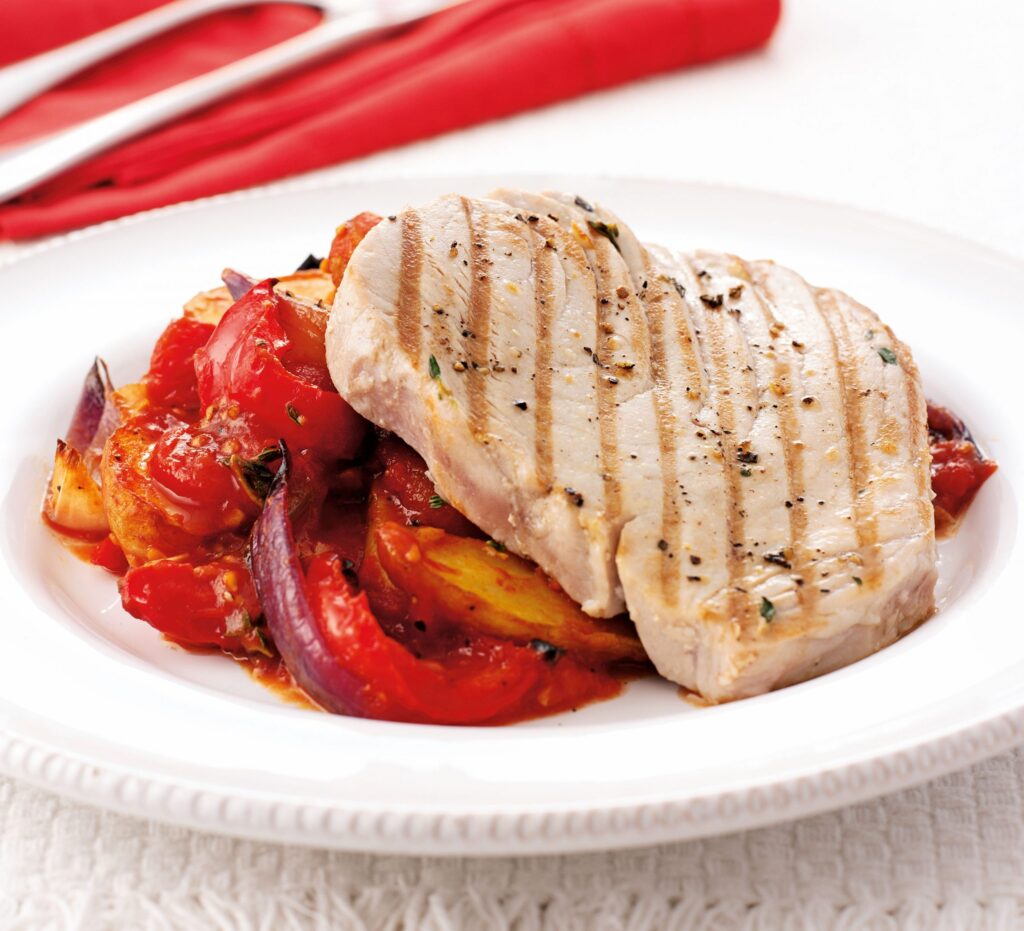
When you talk about “tonnetto,” you’re referring to many varieties and measurements. But what exactly is tonnetto? Talking about “red tonnetto” is difficult: all tonnettos have pink, firm flesh and are capable of delivering impressive recipes.
What’s the Difference between Tonnetto and Tuna?
Before we dive into the world of tonnetto, let’s talk about its relation to tuna. The red tuna is another type of fish: also known as bluefin tuna, it represents the species Thunnus thynnus. What’s the difference between the red tuna and the tonnetti? The size! The Mediterranean red tuna can reach over 3 meters in length and has been caught weighing around 725 kg! In short… not exactly tonnetto!
Meet the Tonnetto Family
Tonnetto is a type of fish that comes in several varieties. Let’s meet them one by one:
Red Tonnetto
The most common types of tonnetto are: alletterated, tombarello, palamita, and lanzardo. These fish are all red-toned, as they have reduced dimensions compared to the common tuna, and share the same coloration as their meat like the classic tuna.
Tombarello or Biso
It’s one of the most common types of tonnetto: it reaches a maximum length of about 50 cm with a weight of 2-3 kg. It is recognizable by its conical head shape and observing the mouth. The lower jaw protrudes slightly compared to the upper jaw.
Palamita
Among the tonnetti stands out for its long length. Dubbed “tonnetto striated” inappropriately, this fish can reach up to 90 cm in length with a weight of around 10 kg. We recommend buying the palamita caught in our Tyrhenian Sea. It’s recognizable by its silver-colored flanks, the presence of stripes on the upper body, and small eyes.
Tonnetto Striated
Note: The true striped tonnetto has stripes on its entire body and not just on the dorsal side. It can reach lengths of up to 100 cm, even though the ones found in markets are generally smaller.
Lanzardo
Very often used for preparing tonneto sott’olio. At the fish markets, you’ll usually find lanzardi with a body length of around 20 cm, although this fish actually grows much larger.
It has an elongated body and a pointed snout. On its dorsal side, it presents a “petroleum” coloration: a blue tending towards green. This fish can be sliced using flexible knives, just as I explained in the article “How to Slice Fish.”
Tonnetto Alletterato
Its scientific name is Euthynnus alletteratus; it’s commonly known as tonnetto alletterato and is heavily fished in the Mediterranean. The tonneto alletterato is very similar to the tombarello, distinguishing itself only by its contiguous dorsal fins, smaller eye, and thicker body.
Cooking Tonnetto: A Guide
Now that we’ve met the tonnetto family, it’s time to talk about cooking them! Recipes for cooking tonnetto are the same as those for young tuna red. To provide completeness, I suggest two excellent recipes: Tonnetto al Cartoccio and Tonnetto in Umido.
Recipe: Tonnetto al Cartoccio
Peel 2 potatoes and slice them into thin rounds (3-4 mm thick).
Scald the potatoes for 3-4 minutes in boiling water and salt.
Take the tonneto fillets and place them on a piece of parchment paper.
Add the scalded potatoes, black olives, pine nuts, and tomato slices cut to pieces.
Drizzle with oil and add a tablespoon of white wine per filet.
Add some garlic paste and a few herbs (prezzemolo or rosmarin)
Close the carton.
Cook in the preheated oven at 180°C for 20 minutes.
Recipe: Tonnetto al Forno
If you want to cook tonneto whole in the oven, you’ll need to perform longer cooking. If the fillets can be cooked easily in the oven, the whole tuna needs more attention.
If your tonneto is about 900-1,200 kg, make incisions cut deeply across both sides.
On each incision, add an alternating piece of lemon and orange slice.
Season with a drizzle of oil. Let it rest for 2 hours to infuse the meat.
Transfer the tuna onto a baking sheet lined with parchment paper.
Add potatoes, zucchini, cherry tomatoes, and a few olives. Season the vegetables with oil too.
Add half a glass of white wine and salt.
Cook the tonneto in the oven at 160°C for 30 minutes (preheated oven).
To prevent it from drying out and achieving a more moist texture, cover with aluminum foil only after the first 30 minutes, then continue cooking for another 10 minutes without foil.
Before serving, baste the tuna with the liquids found on the baking sheet.
Tips for Cooking Tonnetto
- Always handle tonnetto gently to avoid damaging its delicate flesh.
- Cook tonnetto until it reaches an internal temperature of at least 145°F (63°C) to ensure food safety.
- Use a meat thermometer to check the internal temperature of the tuna, especially when cooking whole tunas.
Conclusion
Tonnetto is an elusive fish that requires skill and patience to cook. But with these recipes and tips, you’ll be well on your way to becoming a tonnetto master! Remember to always handle the fish gently and cook it with love.
Frequently Asked Questions
Q: What is tonnetto?
A: Tonnetto is a type of fish that comes in several varieties, including red, tombarello, palamita, and lanzardo.
Q: How do I cook tonnetto?
A: Recipes for cooking tonnetto are similar to those for young tuna red. Try Tonnetto al Cartoccio or Tonnetto in Umido for a delicious start.
Q: What is the difference between tonnetto and tuna?
A: Tuna is generally larger than tonnetto, with some species reaching over 3 meters in length.
Q: How do I choose the best tonnetto?
A: Look for fish that are fresh, firm, and have a good coloration. Avoid fish that are too small or too large.
Q: Can I cook tonnetto whole?
A: Yes, but it requires longer cooking times. Make sure to follow the recipe carefully to avoid overcooking.
Q: How do I store tonnetto?
A: Store tonnetto in a cool, dry place, wrapped in plastic wrap or aluminum foil.
Q: Can I substitute tonnetto with other fish?
A: While tonnetto has a unique flavor and texture, you can substitute it with other fish like tuna or swordfish. However, keep in mind that the cooking times and methods may vary.


