
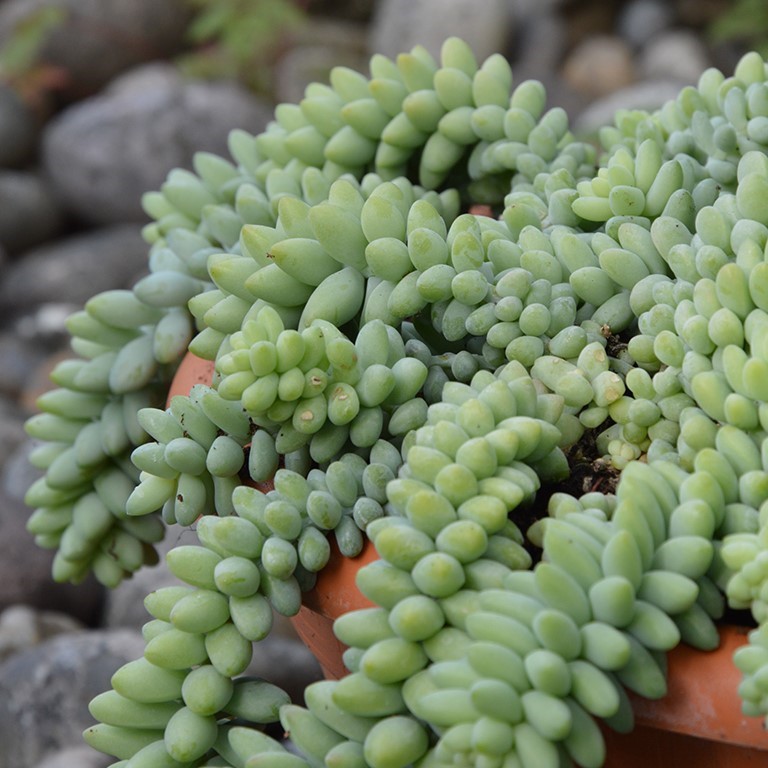
What is Sedum morganianum?
Sedum morganianum, also known as Sedum burrito, is a succulent plant that belongs to the genus Sedum. This perennial plant is part of the Crassulaceae family and is widely distributed across continents, except for Oceania and Antarctica.
Characteristics of Sedum morganianum
Sedum morganianum has distinctive characteristics that make it a popular choice among succulent enthusiasts. Its thick, fleshy leaves are tightly packed together and can store water, allowing the plant to survive in dry conditions. The plant’s drooping habit resembles a cascade.
How to Care for Sedum morganianum
To keep your Sedum morganianum happy and healthy, you’ll need to provide it with the right environment and care. Here are some key tips:
Lighting
Sedum morganianum requires full sun to partial shade, making it an ideal choice for outdoor spaces or indoor areas with plenty of natural light.
- In bright sunlight, keep your Sedum morganianum away from windows that receive direct sunlight to prevent burning.
- East- and west-facing windows are ideal for Sedum morganianum plants as they provide soft, indirect light.
Watering
Water your Sedum morganianum sparingly, allowing the soil to dry out completely between waterings. Overwatering can lead to root rot and other problems.
- Water your Sedum morganianum during its active growth period (spring and summer) when new leaves are developing.
- Reduce watering in autumn and winter months when the plant is dormant.
Temperature
Keep the temperature between 65°F (18°C) and 75°F (24°C), avoiding extreme temperatures that can damage the plant.
- Sedum morganianum is sensitive to frost, so keep it indoors during the winter months or in a protected area outdoors.
- Avoid placing your Sedum morganianum near heating vents or radiators as the dry air can cause moisture loss.
Soil
Use a well-draining potting mix specifically designed for succulents, with a ratio of 2 parts perlite or sand to 1 part soil.
- A mix that contains sand will help improve drainage and prevent waterlogging.
- Choose a potting mix that is low in organic matter as it can retain too much moisture.
Repotting
Repot your Sedum morganianum every spring, using a larger pot and fresh potting mix.
- Prune the roots of your Sedum morganianum before repotting to prevent root rot.
- Use a shallow pot as Sedum morganianum has a deep taproot that can outgrow containers quickly.
Common Problems and Pests
Despite its hardiness, Sedum morganianum can be susceptible to certain problems:
- Root rot: caused by overwatering or poor drainage
- Cocciniglia cotonosa (cottony cushion scale): a type of insect that can damage the plant
- Marciume delle radici (root rot): often caused by inadequate watering or excessive moisture
Propagation and Multiplication
Sedum morganianum can be propagated through:
- Talea: cuttings from mature plants, which can be planted in well-draining soil to create new specimens
- Division: separating the plant’s roots during the spring season, creating multiple new plants
Propagation Techniques
Here are some techniques for propagating Sedum morganianum:
- Talea Propagation: take cuttings from mature Sedum morganianum plants by cutting off a piece of stem and leaves.
- Division: separate the roots of your Sedum morganianum plant in spring to create multiple new plants.
Other Varieties of Sedum
Sedum morganianum is just one of many species within the Sedum genus. Some other popular varieties include:
- Sedum burrito
- Sedum brevifolium
- Sedum cauticum
- Sedum rubrotinctum
- Sedum palmeri
- Sedum spurium
- Sedum telephium
Frequently Asked Questions
Here are some common questions people have about Sedum morganianum:
- How often should I water my Sedum morganianum?
Water your Sedum morganianum sparingly, allowing the soil to dry out completely between waterings. - Can I grow Sedum morganianum indoors?
Yes, but make sure it receives plenty of natural light and maintains a temperature between 65°F (18°C) and 75°F (24°C). - How do I propagate Sedum morganianum?
Use talea or division to create new specimens. - What are some common pests that affect Sedum morganianum?
Cocciniglia cotonosa (cottony cushion scale) and root rot are two common problems. - Can I grow Sedum morganianum in partial shade?
While it can tolerate partial shade, Sedum morganianum prefers full sun to partial shade for optimal growth.
By following these guidelines and understanding the specific needs of your Sedum morganianum, you’ll be well on your way to creating a thriving succulent garden.


