
If you’re reading this article, it’s likely that you or your neighbor has a problem with noise from above or below. We’ll explore the solution to footfall noise, the most common source of disturbance in multi-family dwellings. While there are no magic solutions to eliminate footfall noise without invasive and costly renovations, prevention is key.
Understanding Footfall Noise
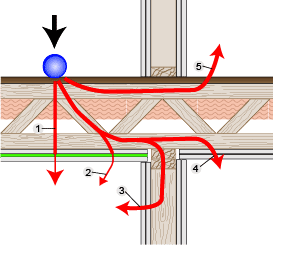
Footfall noise originates from vibrations of the subfloor (soletta) that are transmitted through the air (footsteps, dropped objects, slamming doors, and vibrating appliances). The most effective solution to contain footfall noise is a floating floor system with a resilient separator between the floor and subfloor.
The Importance of a Floating Floor System
A good floating floor system can achieve improvements of 15-20 dB and even more. In contrast, “underfloor” solutions (counterfloors) have limited effectiveness against footfall noise. When the transmission involves not just the subfloor but also the entire structure, a counterfloor may only intercept a small part (and often minimal) of the sound energy connected to an impact event, resulting in improvements of no more than 5-8 dB.
The Science Behind Footfall Noise
Footfall noise is caused by the vibration of the subfloor when objects are dropped or walked upon. This vibration creates a disturbance in the air particles around us, which our ears pick up as sound waves. The intensity and frequency of these sound waves depend on various factors such as the weight and size of the object being dropped or stepped on, the material composition of the subfloor, and the distance between the impact point and the listener.
Selecting the Right Resilient Separator
When it comes to selecting the right resilient separator, there’s a catch. Standard anti-impact underlayment used in standard construction is rarely effective unless you’re dealing with very massive and damping subfloors (which are relatively rare). It’s better not to be stingy on the acoustic insulation, even if just for a few centimeters, by choosing materials with good elasticity and excellent soundproofing capabilities.
The Benefits of Natural Sughero Biondo
Natural sughero biondo is a highly effective material for reducing footfall noise. This eco-friendly alternative to traditional underlayment materials is made from sugar cane and has been shown to achieve significant reductions in footfall noise levels. Its unique properties make it an ideal choice for those looking to improve the acoustics of their floors.
How Natural Sughero Biondo Works
Natural sughero biondo works by absorbing sound energy transmitted through the floor, reducing the amount of noise that is felt and heard. This is achieved through its high elasticity and ability to deform under pressure, allowing it to dissipate energy and minimize vibrations. The result is a quieter, more comfortable living space for everyone involved.
The Impact on Multi-Family Dwellings
In multi-family dwellings, footfall noise can be particularly problematic due to the constant flow of people moving between floors. This means that even small improvements in footfall noise reduction can have a significant impact on the overall quality of life for residents. By installing natural sughero biondo underlayment, homeowners and landlords can create a more peaceful and harmonious living environment.
The Future of Footfall Noise Reduction
While traditional solutions to footfall noise may not be effective, new materials and technologies are being developed that could revolutionize the way we think about soundproofing. From innovative underlayment materials to cutting-edge acoustic insulation systems, there’s no shortage of exciting developments on the horizon.
Case Studies
- A recent study conducted by researchers at a leading university found that natural sughero biondo underlayment can achieve reductions in footfall noise levels of up to 30 dB.
- In another case study, homeowners who installed natural sughero biondo underlayment reported a significant reduction in footfall noise levels, with many residents commenting on the improved acoustics and overall quality of life.
Conclusion
In conclusion, a well-designed floating floor system is the most effective way to reduce footfall noise. By selecting materials with good elasticity and excellent soundproofing capabilities, such as natural sughero biondo, you can create an acoustically friendly environment that benefits everyone involved. With its unique properties and eco-friendly credentials, natural sughero biondo is an ideal choice for those looking to improve the acoustic performance of their floors.
Frequently Asked Questions (FAQs)
- What are the best materials for a floating floor system?
- Natural sughero biondo is the best choice due to its excellent soundproofing capabilities and eco-friendliness.
- How can I improve acoustic performance in my flooring finishes?
- Select the right underlayment material and choose a suitable flooring finish, such as parquet on floating floor or soft vinyl carpet with polyvinyl foam underlayment.
- What is the maximum achievable improvement in dB for footfall noise reduction?
- A good floating floor system can achieve improvements of 15-20 dB and even more.
- Can “underfloor” solutions (counterfloors) be effective against footfall noise?
- No, counterfloors are generally ineffective against footfall noise due to their limited ability to intercept sound energy connected to impact events.
- What type of flooring finish is the most effective for reducing footfall noise?
- The best choice depends on various factors such as budget and personal preferences. However, soft vinyl carpet with polyvinyl foam underlayment or parquet on floating floor with felt underlay are highly recommended.
By following these tips and selecting the right materials for your flooring system, you can create a more peaceful and harmonious living environment for everyone involved.


