
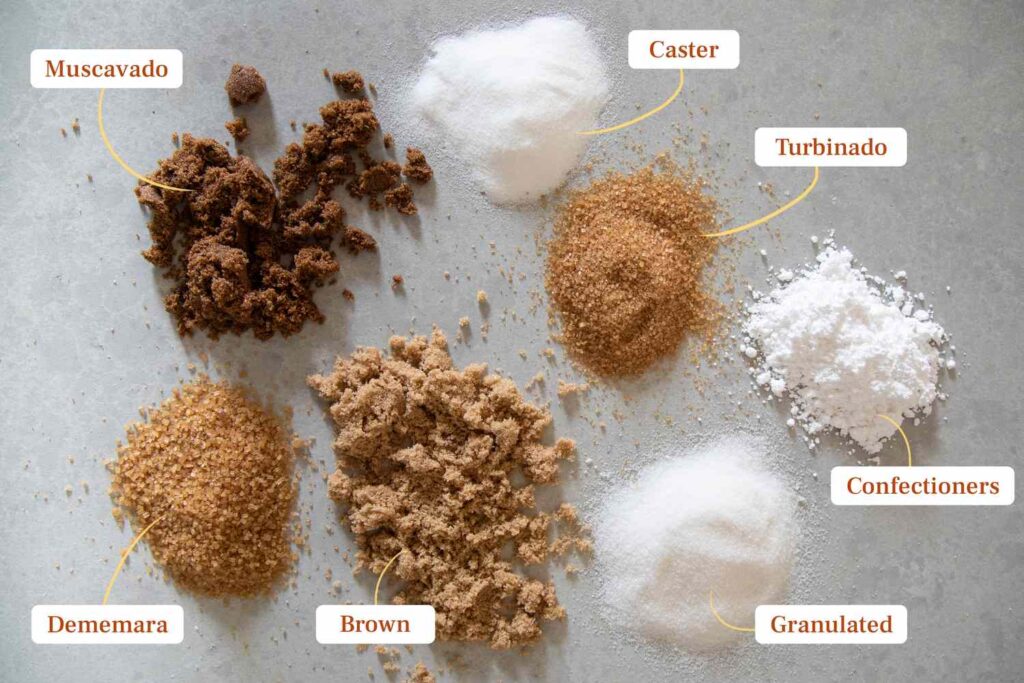
In the kitchen, sugar is the crystallized saccharose derived from sugarcane or sugar beets. But what are the common types of sugar we can find in stores? What sets them apart?
What is Sugar?
As mentioned earlier, sugar is a crystallized saccharose. Chemically speaking, saccharose is a disaccharide, just like maltosio (which comes from grains) and lattosio (which comes from milk).
Sugar provides sweetness to food and has several interesting functions in baking. For example, it slows down the formation of gluten in wheat flour. This means that baked goods tend to be more tender, with a finer texture, when containing sugar.
Additionally, due to its way of becoming brown (caramelization) when heated, sugar gives baked goods their color. Sugar also has an interesting property called hygroscopy, which means it attracts and retains moisture. This helps keep baked goods fresh for longer by preventing normal drying out.
Not only that, but sugar is also the food for yeast organisms that make bread rise.
Now that we’ve covered all these characteristics, although there isn’t a standard labeling system for sugars, aside from various producers’ ways of labeling their products, we can classify sugars based on the size of their grains and/or the level of raffination they have undergone.
This classification is obviously incomplete but could help improve your understanding of this beloved food!
Granulated White Sugar
White granulated sugar is the most common type of sugar and is used by most home bakers. It’s also produced from both sugarcane and sugar beets (the label might or might not specify its origin).
This type of sugar can satisfy any culinary need, whether it’s for cooking, baking, making desserts, preparing salads’ dressings, salamis, marinades, cocktails, or other drinks.
Both versions of sugarcane and sugar beets are made up to 99.95% saccharose.
One thing to note is that granulated sugar can form crystals if it’s stored for a long time due to its hygroscopic properties. However, breaking the sugar back into crystals is simple, which means it shouldn’t expire!
In baking, it’s often useful to work with finer-grained sugars because they dissolve more easily and help produce softer baked goods.
Here are some finely ground sugar types:
- Superfine Sugar: A product called superfine sugar can be also referred as “sugar for bakers” or “panettiere’s sugar.” It is a fine crystalline powder made from granulated sugar which has been further processed into even finer particles. Although it comes from the same source, the fact that it is finely ground means more of it will fit in the same amount of volume as the standard granulated sugar.
- Ultrafine Sugar: Some products are also referred to as “sugar da panettiere” or “fine sugar.” These are finer crystalline powders than superfine but still come from the same source.
A note about measuring sugars: Because finely ground sugars have more weight for their volume, you’ll need to measure them by weight instead of volume. For example, 200 grams will be equivalent to one cup of granulated sugar in any recipe.
Sugar Canne
Canne sugar is a type of sugar made only from sugarcane.
The color of canne sugar is darker due to the level of purification it has undergone. Since this process stops before whitening, the resulting product has a more intense color.
There are different types within the “canne” family, and one commonly found in stores is Demerara sugar. There’s also another type called Moscovado, which stands out from white canne sugar.
Other Types of Sugar
Apart from these common types, you can find other types of sugar available for baking.
For example, there’s a special type of sugar known as “zucchero velo,” meaning fine sugar. This is made by grinding semolato sugar into an extremely fine powder and preserving it in sealed containers to prevent moisture absorption.
We hope these brief explanations on sugars will be helpful to deepen your understanding and knowledge of this wonderful ingredient, commonly used in countless recipes!
While we recommend further researching the benefits and potential drawbacks of each major type of sugar before choosing one that suits your needs best, our advice is to choose the one best suited for the specific ingredients and type of recipe you’ll use.
Frequently Asked Questions
-
What’s the difference between granulated sugar and superfine sugar?
- Granulated sugar refers to the standard white sugar we all know, while superfine sugar is finer and has a more even texture.
-
Is canne sugar only made from sugarcane?
-
Yes, canne sugar comes exclusively from sugarcane.
-
Why should I use finely ground sugars in my recipes?
- Finely ground sugars dissolve more easily, and they also help create softer baked goods due to their larger surface area.
-
How do I measure superfine or ultrafine sugar correctly?
-
Measure by weight instead of volume since these finely ground sugars have a higher density.
-
What is the difference between zucchero velo and semolato sugar?
- Zucchero velo refers to fine, powdered sugar made from semolato, while semolato is simply a type of granulated sugar that has been partially refined.
-
Can canne sugar be used as a substitute for white canne sugar in most recipes?
-
Not always. Some recipes may require specific levels of purification to achieve the desired taste and color.
-
What are some common uses of Demerara sugar?
- It’s often used for its natural sweetness, flavor, and texture when making desserts or adding a caramelized finish.
-
Why is Demerara sugar considered more healthy than white granulated sugar?
- While it doesn’t have any additional health benefits over other types of sugars, Demerara sugar has been produced using fewer chemicals and processes, so some people believe that’s why they consider it healthier.
-
What are some common uses for Moscovado sugar?
- It can be used in baked goods where a rich flavor is desired due to its high molasses content, or in drinks like tea or coffee, as a natural sweetener.
-
Can I substitute zucchero velo for granulated sugar in most recipes?
- No, because finely ground sugars are much more hygroscopic than the coarse, crystalline particles of granulated sugar, which affect their behavior when mixed with other ingredients and exposed to moisture.


