
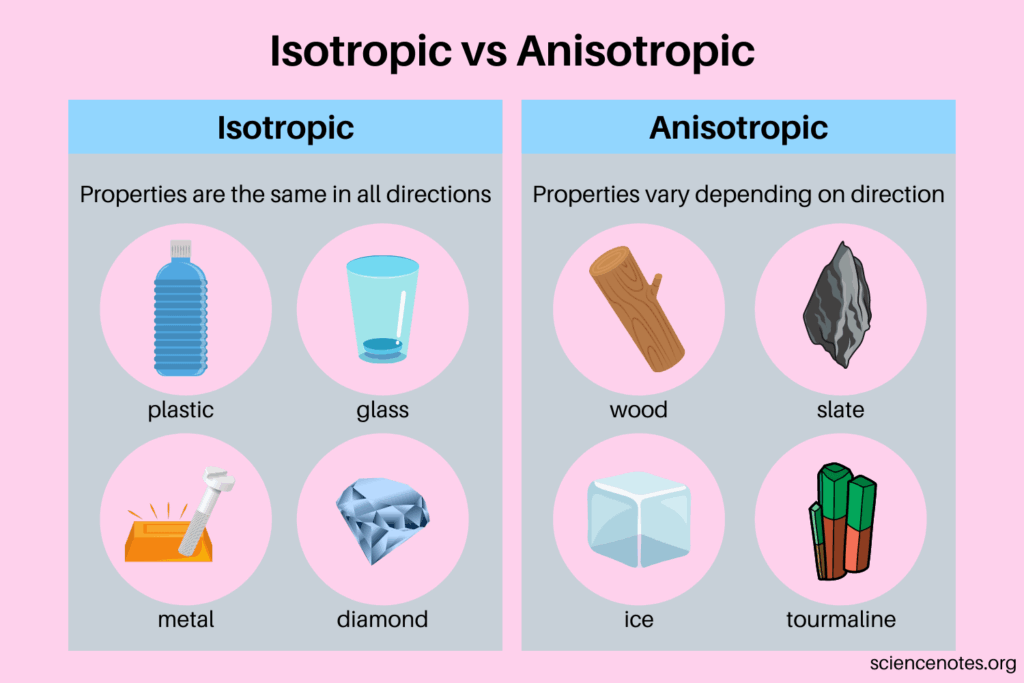
As we explore the world of materials science, we often come across a concept that seems complex and abstract: anisotropy. But what does it really mean? In this article, we’ll delve into the world of anisotropy, exploring its significance, types, and applications.
What is Anisotropia?
Anisotropia is the opposite of isotropia, a property that describes how a material behaves differently depending on the direction in which it’s observed. In other words, materials can exhibit unique characteristics along different axes or orientations. This phenomenon occurs when a material’s structure is anisotropic, meaning its properties vary in response to external forces or stimuli.
Types of Anisotropy
Anisotropy manifests itself in various forms, including:
- Conductivity: The ability of a material to conduct heat, electricity, or light. In some cases, conductivity varies depending on the direction.
- Mechanical properties: Rigidity, strength, and elasticity can differ depending on the orientation of the material.
- Optical properties: Refractive index, reflectivity, and transmissivity can vary with direction.
Historical Context: The Role of Atomic Structure
The atomic structure of a material plays a significant role in determining its anisotropic behavior. Crystalline structures, like those found in rocks and crystals, exhibit anisotropy due to the directional dependence of elastic fields. This is why many natural materials display unique properties along specific axes.
Anisotropia in Antennas and Radiation
Let’s consider a simple example: antennas. When an antenna radiates electromagnetic waves, its radiation pattern can be affected by anisotropy. The direction of irradiation influences the antenna’s performance, making it essential to understand the underlying physics.
Cosmic Microwave Background Radiation: Anisotropic Pattern
The cosmic microwave background radiation (CMB) is another example of anisotropy in action. Although it appears isotropic on large scales, the CMB exhibits tiny anisotropies, which have been instrumental in understanding the universe’s evolution.
Anisotropy Coefficient
In materials science, the anisotropic coefficient (r) is a crucial parameter used to describe plastic deformation behavior. It represents the ratio of deformations in width to those in thickness during uniaxial tensile loading. Calculating this coefficient helps engineers understand material response under different conditions.
Wood: A Material with Unique Anisotropy
Wood, with its complex cellular structure, is an excellent example of a material exhibiting anisotropic behavior. The wood’s dimensions can vary significantly depending on the direction of the fibers, affecting its mechanical properties and overall performance in various applications.
Environmental Factors Influencing Wood Properties
Environmental factors like humidity and temperature influence wood’s dimensional stability and anisotropy. Understanding these interactions is vital for designing and optimizing wood-based products.
Wood in Architecture: Anisotropic Applications
In architecture, wood is a popular choice due to its unique properties. However, it can also be challenging to work with, as its behavior varies depending on the orientation of the wood fibers. By understanding anisotropy, architects can design buildings that incorporate wood’s natural advantages and minimize potential drawbacks.
Designing for Anisotropic Wood
To optimize wood’s performance in various applications, designers must consider the material’s anisotropic nature. This involves selecting appropriate orientations, choosing suitable joints, and ensuring adequate support to compensate for any directional dependencies.
Anisotropy in Composite Materials
Composite materials are widely used in construction, aerospace, and other industries due to their unique properties. However, these materials can also exhibit anisotropic behavior, which must be taken into account when designing and manufacturing them.
Understanding Anisotropy in Composite Materials
To design composite materials that exhibit optimal performance, it’s essential to understand the anisotropic nature of individual components. This involves selecting materials with desired properties, optimizing fiber orientation, and ensuring adequate bonding between layers.
Applications of Anisotropic Materials
Anisotropic materials have numerous applications across various industries, including:
- Aerospace: Anisotropy affects aircraft performance, so understanding it is crucial for designing efficient and safe airframes.
- Electronics: Anisotropic behavior influences electronic device performance, making it essential to consider these properties when designing components.
- Biomedical Engineering: Understanding anisotropy helps develop implants and prosthetics with improved functionality and longevity.
Challenges and Opportunities
While understanding anisotropy offers numerous opportunities for innovation and improvement, there are also challenges to overcome. These include:
- Material selection: Choosing materials that exhibit the desired properties can be a daunting task.
- Design optimization: Anisotropic behavior requires designers to consider multiple orientations and potential drawbacks.
- Manufacturing complexities: Producing anisotropic materials often involves complex manufacturing processes.
Conclusion
Anisotropia is a fundamental concept in materials science, enabling us to understand the intricate behavior of various materials. By grasping the different types and mechanisms of anisotropy, researchers and engineers can develop innovative solutions, from antenna design to material processing.
Frequently Asked Questions (FAQs)
- What are some common applications of anisotropy?
Anisotropy is essential in fields like materials science, engineering, and physics. Its applications include antenna design, radiation patterns, and understanding the behavior of natural materials like wood.
- How does atomic structure influence material anisotropy?
The atomic structure of a material determines its anisotropic behavior by creating directional dependence in elastic fields, leading to unique properties along specific axes.
- Can all materials exhibit anisotropy?
Not all materials display anisotropy, but many do due to their inherent structure or composition. Understanding the types and mechanisms of anisotropy is crucial for developing new materials and applications.
- What are some factors that influence wood’s anisotropic behavior?
Environmental factors like humidity and temperature affect wood’s dimensional stability and anisotropy, making it essential to consider these interactions when designing and optimizing wood-based products.
- How can researchers and engineers utilize anisotropy to develop innovative solutions?
By understanding the different types and mechanisms of anisotropy, researchers and engineers can design new materials, optimize existing ones, and develop innovative applications that take into account the unique properties of anisotropic materials.
- Can anisotropy be measured or predicted?
Measuring and predicting anisotropy involve complex calculations and experiments. Researchers use various methods to quantify anisotropy, including computational modeling and experimental techniques like X-ray diffraction.
- How does anisotropy relate to other materials properties?
Anisotropy is closely linked to other material properties, such as conductivity, mechanical strength, and optical behavior. Understanding the relationships between these properties helps engineers design materials with specific characteristics for various applications.
- Can anisotropy be exploited in everyday life?
Anisotropy plays a significant role in many everyday objects, from wooden furniture to electronic devices. By recognizing and utilizing anisotropic behavior, we can create more efficient, sustainable, and innovative products.
Final Thoughts
Understanding anisotropia is essential for unlocking the full potential of materials science. By exploring its significance, types, and applications, researchers and engineers can develop innovative solutions that incorporate the unique properties of anisotropic materials. As we continue to push the boundaries of innovation, it’s crucial to grasp the intricacies of anisotropy and harness its power to create a better future for all.


