
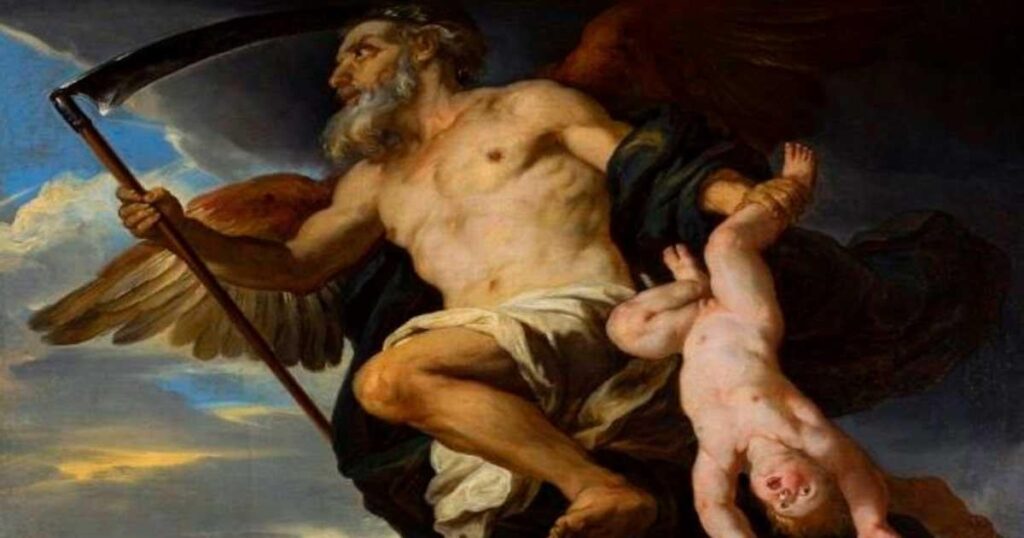
In Greek mythology, Cronus (Κρόνος, Krónos) is often associated with time, fertility, and agriculture. His name originates from the ancient Greek word for “time,” and he is considered a pre-Olympian deity in both mythology and religion. Unlike Chronos, the Titan of time in Orphism, our Cronus is the second ruler of the world and the father of Zeus and the first Olympians.
Cronus’ significance extends beyond his role as a father figure to his impact on the development of agriculture and civilization. His mythological narrative has captivated people for centuries, inspiring countless works of art, literature, and even modern science.
In this article, we will delve into the world of Cronus, exploring his origins, worship in ancient Greece, and his role as a symbol of time and fertility. We will also examine the Roman equivalent of Cronus, Saturn, and the various myths surrounding his story.
Who was Chronos? The Pre-Olympian Titan
Cronus’ story begins with his birth to Uranus (the Sky) and Gea (the Earth). According to myth, Uranus cast his offspring into the depths of the earth, fearing they would overthrow him. Gea encouraged her son to challenge his father.
With his mother’s guidance, Cronus castrated Uranus and took control of the universe. He then freed his brothers from their terrestrial prison but left the Cyclopes and Hecatonchires in captivity due to his suspicions about their loyalty.
Cronus married his sister Rhea, with whom he had several children, including Poseidon, Hades, Hestia, Demeter, and Hera (who would eventually become Zeus’ mother). However, a prophecy foretold that Cronus’ sons would overthrow him, prompting him to devour them at birth.
The Birth of Zeus: A Mother’s Gambit
Rea, Cronus’ wife, was not pleased with this decision. She found out about the prophecy and decided to save their youngest son, Zeus. Rea disguised Zeus as a swaddled baby and gave it to Amalthea, a goat who nursed him in secret.
Meanwhile, Cronus continued his cycle of devouring his children until he had none left. However, he soon discovered that Zeus was still alive when he ate the wrapped-up infant. The prophecy had been fulfilled, but Rea had saved her son.
Zeus’ Rise to Power: A Decade-Long Struggle
As Zeus grew up, he sought revenge against his father and overthrew Cronus with the help of the Cyclopes, who gave him lightning bolts. This war lasted for ten years, with both sides vying for control.
Gea intervened, advising Zeus to liberate the Cyclopes in exchange for their loyalty. Zeus succeeded, and together they defeated Cronus.
The End of the Myth: Multiple Twists
There are various endings to this myth. In some versions, Zeus allows his father to rule over the blessed islands at the edge of the world. Others depict Cronus being trapped in a magical sleep or bound in the underworld by Zeus.
One thing is certain: the Titans were imprisoned by Zeus and entrusted to the Hecatonchires.
The Cult of Cronus: Worship in Ancient Greece
Cronus was primarily worshiped in Athens, where his festivals were celebrated during the summer months. His cult also extended to other regions of ancient Greece, including Beozia, Rhodes, and Cyrene.
During these festivals, Cronus was often depicted as a powerful, bearded man holding a scythe or sickle. The Greeks believed that he was responsible for the changing seasons, and his festival celebrated the harvest.
Saturn: The Roman Counterpart
In Roman mythology, Saturn (Saturno) is the equivalent of Cronus, an old god of agriculture. Both deities share similarities in their mythological narratives.
Saturn’s story also begins with his birth to Caelus (the Sky) and Terra (the Earth). However, unlike Cronus, Saturn was not castrated by one of his brothers but rather defeated by Jupiter (Zeus’ Roman counterpart).
Despite these differences, both deities are associated with the cycles of nature and the changing seasons. In ancient Rome, Saturn’s festival celebrated the harvest and marked the beginning of winter.
The Significance of Cronus in Modern Times
Cronus’ mythological narrative has had a lasting impact on modern society. The concept of time and its measurement is closely tied to the Greek myth of Cronus, who was responsible for dividing the world into smaller, manageable units.
The idea of cycles and seasons also influences our understanding of agriculture and the natural world. By studying Cronus’ story, we can gain insights into the development of civilization and the role of mythology in shaping our perceptions of time and nature.
The Symbolism of Cronus
Cronus is often seen as a symbol of power, authority, and fertility. His association with time and agriculture makes him an important figure in ancient Greek mythology.
However, his story also serves as a cautionary tale about the dangers of unchecked power and the cyclical nature of history. By studying Cronus’ mythological narrative, we can gain a deeper understanding of the complexities of human nature and the importance of balance in our lives.
Conclusion
The myth of Cronus offers a fascinating glimpse into the world of ancient Greek mythology. His story has captivated people for centuries, inspiring countless works of art, literature, and even modern science.
By examining Cronus’ role as a pre-Olympian deity, his worship in ancient Greece, and his significance in modern times, we can gain a deeper understanding of this complex mythological figure.
Whether you are an aficionado of mythology or simply interested in exploring the rich cultural heritage of ancient Greece, the story of Cronus is sure to captivate and inspire.


