
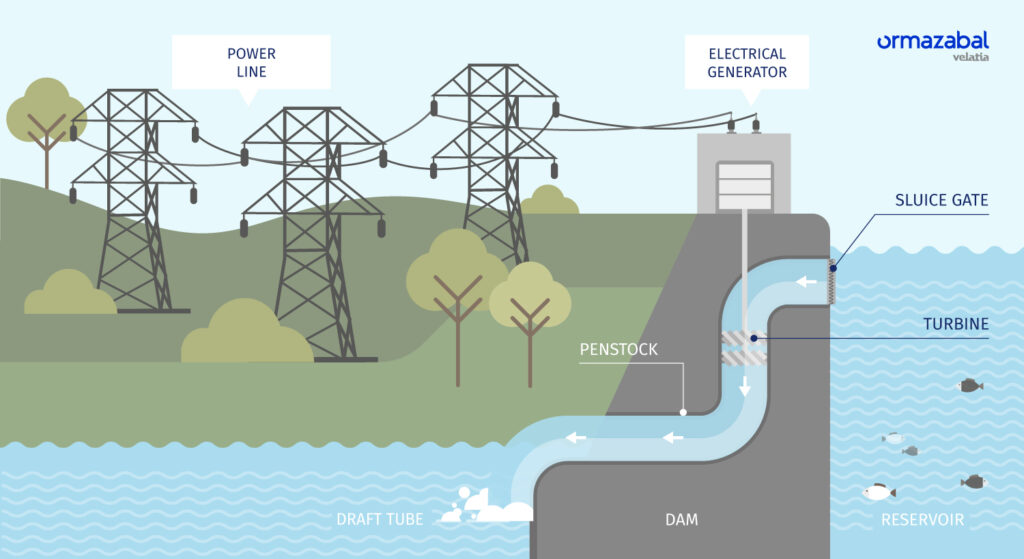
Hydraulic turbines transform energy from a fluid into electrical energy. Energy potential or kinetic of a fluid, in mechanics, and then, if needed, electricity. These devices are mechanical with high efficiency rates, estimated above 90%, and therefore are highly appreciated, even though their installation is not always very easy: they require numerous infrastructures.
Hydraulic turbines are generally composed of a fixed part, the distributor, and a mobile one: the girante. The distributor provides direction to the outlet that then arrives at the girante, regulating it as well and transforming the pressure energy of the outlet into kinetic energy. When this transformation occurs completely in the distributor, hydraulic turbines are said to be ad action, otherwise we can talk about hydraulic turbines at reaction. Passing from the distributor to the girante, where we observe the transformation of the potential and/or kinetic energy of water – that which arrives according to the type – into mechanical energy produced on the motor shaft.
The ancestor of electric turbines is the hydraulic wheel very used since the 17th century and based almost exclusively on the exploitation of potential energy. It did not fail but was improved when we went over with modern hydraulic turbines to the exploitation of kinetic energy.
In the 19th century, here are therefore the hydraulic turbines of type Pelton, with the inconvenience of artificial basins that are quite expensive due to the need for great drops even of hundreds of meters. The way forward was gradually approaching the turbines with fewer demands and adaptable also to high heights (2 – 3), the Kaplan, which seem like intubated screws.
Archived in museums the hydraulic wheels, or almost, today for energy production Pelton, Francis and Kaplan are the most used hydraulic turbines.
The general principle of functioning is the exploitation of a fluid’s fall and is therefore linked to the height at which it is placed the reservoir on top, compared to the reservoir on the bottom, both are parts of the hydraulic turbines and usually are at atmospheric pressure.
Hydraulic Turbines Pelton
Pelton turbines are ad action and equipped with one or more nozzles that transform totally the water’s pressure into kinetic energy. Usually we find them with jumps ranging from 50 to 1300 meters. Each nozzle of these devices creates a jet with regulated flow through a valve spout, there is then a deflecting tile that deviates the flow from the blades so as to avoid inconveniences in case of load detachment.
An inconvenience of Pelton turbines is the fact that they can only process a limited volume of water, for the risk of interference between the single flows coming from two nozzles adjacent. We find them both vertically and horizontally aligned, either in large installations or in micro-idroelectric plants.
Pelton turbines are commonly used in small-scale hydroelectric power plants, particularly those with low-head water sources (less than 50 meters). These systems typically use a single nozzle per turbine, which can be adjusted to optimize energy production. The Pelton turbine’s design allows for high efficiency and reliability, making it a popular choice for micro-hydroelectric projects.
Hydraulic Turbines Turgo
It’s an ad action hydraulic turbine also, but the jumps they can work with are very different: we’re between 15 and 300 meters. Compared to Pelton, this type previsions blades with shape and disposition diverse so that a jet hits simultaneously many blades. Thanks to this device, Turgo hydraulic turbines do not have limitations on the volume of water.
The Turgo turbine’s unique design allows it to handle a wide range of water flow rates and pressures, making it suitable for applications where the water supply is variable or uncertain. This versatility has led to widespread adoption in Europe, particularly in countries with strong hydropower traditions.
Turgo turbines are often used in larger hydroelectric projects, where the energy output needs to be maximized while minimizing costs. Their high efficiency and reliability have earned them a reputation as one of the most effective types of hydraulic turbines available.
Hydraulic Turbines Kaplan
Here are the hydraulic turbines of reaction, unlike the previous ones, and also at axial flow, perfect even for low drops, ranging from 2 to 20 meters. The blades of the wheel are always adjustable, while those of the distributor can be fixed or adjustable, so we have two different types of these turbines.
The true Kaplan is that with all the blades adjustable, whereas if only the wheels’ blades are adjustable, we have a semi-Kaplan, or single regulation.
The maximum power achieved by hydraulic turbines Kaplan is around 200,000 kW. From this “model” derive then the submerged hydraulic turbines in the water of impiants that exploit the motion of tides: they are called bulbed and contain the generator and multiplier in a waterproof box.
Kaplan turbines offer exceptional flexibility and adaptability, making them an excellent choice for a wide range of applications. Their adjustable blades allow for fine-tuning of energy production to suit changing water flow rates or pressures.
Hydraulic Turbines Francis
We stay among the reaction hydraulic turbines at radial flow, but Francis have for necessity the distributor with adjustable blades and the girante with fixed blades and are much used for jumps ranging from 10 to 350 meters. There is also the model “Francis veloci”, still with radially flow but axial discharge.
The peculiarity is that water passes from the distributor to the girante without entering any moment in contact with the atmosphere but Francis turbines do not have many advantages compared to others, we find them almost only in central pumpage plants.
Francis turbines are commonly used in large-scale hydroelectric projects, where high energy production requirements necessitate robust and reliable equipment. Their radial flow design allows for efficient energy conversion, while the adjustable blades provide flexibility in optimizing energy output.
Micro Hydraulic Turbines
It’s about hydraulic turbines that fully fit into the category of “micro idroelectric” therefore of electric power plants non exceeding 100 kW, with limited environmental impact.
In this scale of action the most used are without any doubt Pelton and Banki turbines, and are obviously ideal for low water flows.
We find these micro-implants both used with fluid flow as well as inside aqueducts, the conditions for their functioning are two and essential. There must be a sufficient drop of water, even of few meters, and a constant water flow, not seasonal, even just 0.5 liters per second but it’s good.
Regarding concrete applications of micro hydraulic turbines, we look at both connected to the grid as well as isolated ones without any preference whatsoever. I can only not remember that in the first context these special turbines can enjoy incentives dedicated to renewable sources also and are an opportunity to do the exchange on site.
Microturbines have their conveniences, therefore, and result ideal also for satisfying the electrical demand of private buildings without a connection to the grid, if there is sufficient water availability. Examples? Small isolated communities, farms, mountain refuges and agriturismos.
The advantages of micro-hydraulic turbines are numerous:
- Renewable Energy: Micro hydraulic turbines use renewable energy from water flows, reducing dependence on fossil fuels.
- Low Operating Costs: These turbines require minimal maintenance and have low operating costs.
- Environmental Impact: Their small size results in a lower environmental impact compared to larger turbines.
However, there are also some disadvantages:
- Limited Power Output: Micro hydraulic turbines typically produce less energy than larger turbines.
- Water Quality Issues: Poor water quality can affect the performance and lifespan of these turbines.
Despite these limitations, micro-hydraulic turbines continue to gain popularity as an innovative solution for providing clean energy in remote or off-grid areas.
Conclusion
In conclusion, hydraulic turbines play a crucial role in transforming fluid energy into electrical energy. Each type has its unique characteristics, advantages, and disadvantages. By understanding the principles of operation and applications of these devices, we can better appreciate their importance in our energy landscape.
From Pelton to Kaplan, Francis, and micro-hydraulic turbines, each design offers something distinct in terms of efficiency, reliability, and adaptability. Whether used for large-scale hydroelectric projects or small-scale micro-implants, hydraulic turbines are an essential component of our renewable energy mix.
As the world continues to seek innovative solutions to meet its growing energy demands, hydraulic turbines remain a vital part of this journey.


