
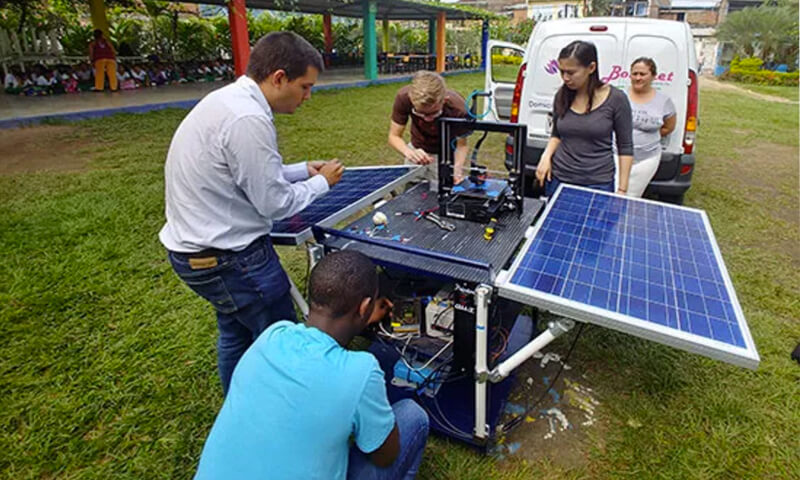
Understanding 3D Printing and Its Applications
As we go about our daily lives, it’s hard to ignore the buzz around 3D printing. From filling pages with newspapers to making appearances in music videos (think will.i.am – Scream & Shout ft. Britney Spears), this technology has become increasingly ubiquitous. Even the President of the United States, Barack Obama, has mentioned its potential to revolutionize our daily routines.
But what about its impact on the solar industry? Can 3D printing truly change the game?
The Evolution of Printing: From 2D to 3D
3D printing is often seen as the next evolution of traditional 2D printing. And it just might be the key to unlocking new possibilities in energy storage and photovoltaic technology.
In traditional 2D printing, materials are layered on top of each other to create a final product. This process can lead to waste, inefficiency, and high production costs. On the other hand, 3D printing allows for the creation of complex shapes and structures that cannot be produced using traditional methods.
How Does 3D Printing Work?
3D printing involves creating objects layer by layer using a variety of materials, including plastics, metals, and ceramics. The process typically begins with the design of the object being printed. Using computer-aided design (CAD) software or other tools, designers can create detailed models of their desired product.
Next, the 3D printer reads these designs and begins to build the object layer by layer. This is done using a variety of techniques, including extrusion, where melted plastic is pushed through a nozzle to create layers, and stereolithography (SLA), which uses a laser to solidify liquid resin.
Traditional Solar Panels: A Problematic Solution?
Current solar panels are made from materials like copper, tin, indium, silicon, and selenium. While these materials have their uses, they come with significant waste and inefficiency issues. Researchers at the Massachusetts Institute of Technology (MIT) believe that 3D-printed models could be up to 20% more efficient than traditional solar panels.
Economic Benefits: Cutting Costs by Half
The precision of 3D printing could significantly reduce production costs, with estimates suggesting a 50% decrease in manufacturing expenses. This would eliminate many of the inefficiencies associated with material waste and reduce the need for costly transportation.
Regional Production: A Game-Changer for Solar Energy
With 3D printing becoming more widespread, solar panels could be produced locally, reducing transportation costs and addressing labor shortages in countries like China. This could lead to a significant reduction in production costs and make solar energy more accessible to communities worldwide.
What Does the Future Hold?
As 3D printing continues to evolve, it’s clear that its impact on the solar industry will be substantial. By combining improved efficiency with reduced costs and increased regional production, 3D printing has the potential to revolutionize the way we generate and use energy.
Benefits of 3D Printing for Solar Energy Production
- Improved Efficiency: 3D-printed models could lead to more efficient solar panels, which would result in increased energy output and reduced energy costs.
- Reduced Material Waste: The precision of 3D printing allows for minimal material waste, reducing the environmental impact of solar energy production.
- Increased Regional Production: With 3D printing becoming more widespread, it’s possible that solar panels could be produced locally, addressing labor shortages and reducing production costs.
- Cost Savings: Reduced material waste and improved efficiency would lead to significant cost savings for manufacturers, making solar energy more accessible to communities worldwide.
Challenges and Limitations
While 3D printing has the potential to revolutionize the solar industry, there are still several challenges and limitations that need to be addressed:
- Material Compatibility: Different materials used in 3D printing may not be compatible with traditional solar panels, requiring new designs and testing procedures.
- Scalability: Currently, 3D printing is limited by its scalability, making it difficult to produce large quantities of solar panels efficiently.
- Cost: While the long-term cost savings of 3D printing are significant, there may be high upfront costs associated with investing in new equipment and training personnel.
Conclusion: Is 3D Printing the Key to a Sustainable Future?
While there are still many challenges to overcome, it’s clear that 3D printing is poised to have a significant impact on the solar industry. As researchers and innovators continue to push the boundaries of this technology, one thing is certain: the future of energy production will never be the same.
FAQs: Answering Your Questions About 3D Printing in Solar Energy
- Q: How does 3D printing improve the efficiency of solar panels?
A: Researchers believe that 3D-printed models could be up to 20% more efficient than traditional solar panels. - Q: What materials are used in 3D printing, and how do they impact production costs?
A: The precision of 3D printing reduces material waste and eliminates the need for costly transportation, resulting in a 50% decrease in manufacturing expenses. - Q: Can 3D printing be used to produce solar panels locally, reducing transportation costs?
A: Yes, with 3D printing becoming more widespread, it’s possible that solar panels could be produced locally, addressing labor shortages and reducing production costs. - Q: How does 3D printing impact the environmental sustainability of solar energy production?
A: By reducing material waste and improving efficiency, 3D printing has the potential to make solar energy production more environmentally friendly. - Q: Is 3D printing a viable solution for widespread adoption of solar energy?
A: While there are still challenges to overcome, it’s clear that 3D printing is poised to play a significant role in the future of solar energy production.
What Are Some Potential Applications of 3D Printing in Solar Energy Production Beyond Increased Efficiency and Reduced Costs?
Researchers are exploring various uses for 3D printing in solar energy production, including:
- Development of new materials: Researchers are working on developing new materials with improved properties for use in solar panels.
- Innovative manufacturing techniques: 3D printing could enable the creation of complex structures and geometries that cannot be produced using traditional methods.
- Increased durability: 3D-printed solar panels may be more durable and resistant to degradation than traditional panels.
How Can We Ensure That 3D Printing is Used Responsibly and Sustainably in the Solar Industry?
As the use of 3D printing becomes more widespread, it’s essential to prioritize responsible and sustainable practices in the production and deployment of solar energy systems. This includes:
- Material sourcing: Ensuring that materials used in 3D printing are sourced responsibly and sustainably.
- Waste reduction: Implementing strategies to reduce waste during the manufacturing process.
- Energy efficiency: Incorporating energy-efficient designs and technologies into 3D-printed solar panels.
What Are Some Potential Challenges or Limitations Associated with Using 3D Printing in Solar Energy Production?
Researchers are working to address various technical and practical challenges associated with using 3D printing in solar energy production, including:
- Material compatibility: Different materials used in 3D printing may not be compatible with traditional solar panels.
- Scalability: Currently, 3D printing is limited by its scalability, making it difficult to produce large quantities of solar panels efficiently.
- Cost: While the long-term cost savings of 3D printing are significant, there may be high upfront costs associated with investing in new equipment and training personnel.
Conclusion
While there are still many challenges to overcome, it’s clear that 3D printing is poised to have a significant impact on the solar industry. As researchers and innovators continue to push the boundaries of this technology, one thing is certain: the future of energy production will never be the same.


