
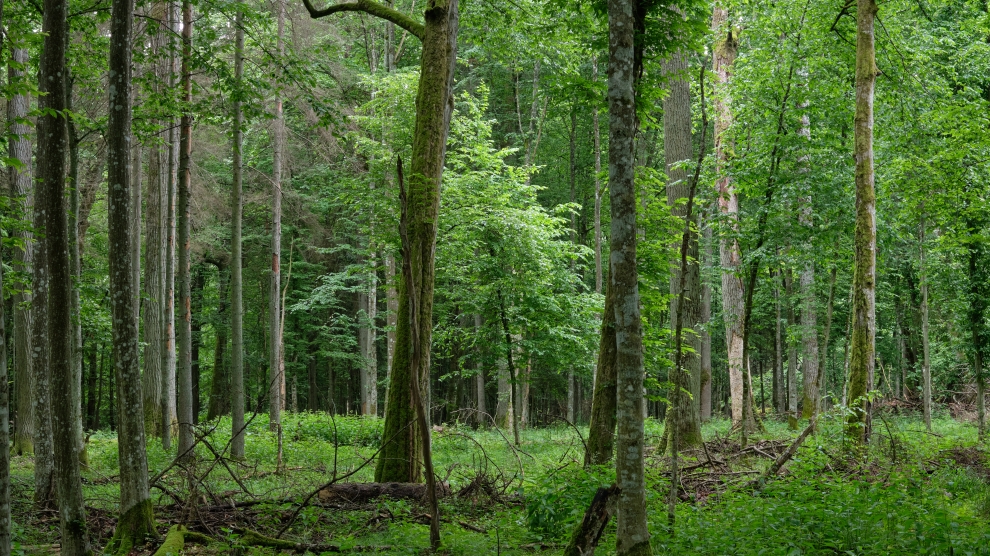
European primordial forests are few and far between, countable on the tip of one’s fingers, and must be defended at all costs because there is still someone who has not understood the gift of biodiversity they represent.
In this article, we will examine two emblematic cases of threatened primeval forests in our continent, trying to assess their presence and general situation. We’ll delve into the importance of these forests, explore specific examples from Poland and Romania, and discuss ways to protect them.
Contents
- Why are primordial forests important in Europe?
- The Polish case: a forest on the brink of disaster
- Entering the European scene with ancient forests
- The Romanian case: a threat to the last remnants of primeval forests
- The precarious situation of ancient forests
Why are primordial forests important in Europe?
Before reaching Poland and Romania, it is necessary to describe these green treasures that we host on our territory. They are old forests of beech trees that not only present centuries-old trees but also host a large number of animals that would not know where else to live. I am particularly thinking of bears, wolves, lynxes, and even the almost extinct European bison.
The presence of silent undergrowth, with fungi and insects, is also precious. These lungs of green constitute only 4% of the total forest cover on the continent and despite 90% being in protected areas, according to the mapping done by the University of Humboldt in Berlin, only 46% is effectively protected from deforestation.
The risk falls not only on plants but also on animals and the entire ecosystem, including humans, although it’s not even realized. This loss of biodiversity is not only a matter of ecological interest but also has significant economic implications. The preservation of primeval forests can help maintain water quality, prevent soil erosion, and even support sustainable agriculture.
The Polish case: a forest on the brink of disaster
Among all European forests, the most ancient and well-known one can be found in Poland, and that is the Białowieża Forest, a UNESCO World Heritage site since 1979. After millennia of quiet life, where it was used as a hunting reserve for kings and tsars, this forest is now in danger because humans want to erase it from the face of the earth.
The problem dates back to a decade ago when the government of Warsaw wanted to expand the protection area to all Polish part of Białowieża, guaranteeing the protection of 20% but inhabitants and forest guards opposed. The dispute continued with acts of non-violent activism but the government seemed not to have taken care of the matter.
The felling of trees was continued and even increased, degrading the situation until in April 2018 the European Court of Justice decided to order Poland to stop logging timber, with little results. Yes because the government after a fake stop started again telling that the forest was infested with a cockroach. A true excuse because this cockroach, although present, attacked only weak specimens maintaining the environment clean and in balance.
The struggle continues seeing enter into play not only forest rangers and activists but also citizens often favorable to felling. What is suspected without much flight of fancy is that behind this impending disaster there are powerful political interests and little awareness among citizens of the wealth at hand.
Entering the European scene with ancient forests
As we have mentioned before on the question, even Europe has intervened in the shape of the European Court of Justice, highlighting in 2018 with an official sentence, that Poland had violated community law by favoring large-scale logging in the primeval forest of Białowieża, protected as a Biosphere Reserve since 1993.
This label is an official qualification from UNESCO reserved for those ecosystems considered worthy of conservation for their biodiversity. The government has claimed to have understood the lesson but there would be little to trust given precedents, and yet this country should be the first to want to protect its own green treasure being also the main source of renewable energy in Europe, substituting coal on which still Poland relies.
The Romanian case: a threat to the last remnants of primeval forests
Another example comes from neighboring Romania, which hosts half of the remaining primordial forests in Europe. The complaint arrives from trade unions of forest rangers who do not have funds for investigations into illicit logging activities, and are joined by citizens and activists opposing deforestation.
The dispute has also become violent and dangerous in this territory with gunshots suspected and victims. The state-owned company that manages and preserves about half of Romania’s primeval forests denies 16 attacks on forest rangers in one year, with six deaths in the past few years. Meanwhile, the forest is being destroyed both legally and illegally.
According to Greenpeace, at a rate of three hectares every hour. A good signal we can perceive however, as that of citizen reports through the app Inspectorul Padurii which in 2016 allowed identifying 26 cases of illegal logging per day, for a total of 9 million euros in damages for the State.
The precarious situation of ancient forests
To tell the deforestation story of European primordial forests there is an extensive research from the University of Plymouth published on Scientific Reports and based on the analysis of pollen from over 1000 sites. From this document, it emerges that more than half of Europe’s forests have been lost in the past 6,000 years due to agriculture and timber harvesting.
The worst period would be the Bronze Age, parallel to the current one. Going back 8,000 years we can imagine an all-European forest from Portugal to Russia today we must defend strenuously what remains, which is only a third of original forest, in some countries just 10%.
How? By avoiding logging but also planting as many trees as possible even in our cities, as it’s happening in some cases, to combat climate change. To remember in this sense the campaign of the United Nations Trillion Tree initiative to plant one trillion trees that would be useful for absorbing 25% of the carbon dioxide emitted every year worldwide.
Frequently Asked Questions
- Why are primordial forests important?
Primordial forests play a crucial role in maintaining biodiversity, supporting ecosystem health, and providing essential ecological services such as water filtration, soil conservation, and climate regulation.
- What is being done to protect ancient forests?
Several organizations, governments, and individuals are working to protect ancient forests through initiatives such as habitat restoration, sustainable forestry practices, and advocacy campaigns. However, more needs to be done to address the scale of deforestation and habitat destruction.
- Can we stop deforestation in Europe?
Stopping deforestation in Europe will require concerted efforts from governments, NGOs, local communities, and individuals. This can include policies that promote sustainable land-use planning, protected areas expansion, and reforestation programs.
- How can we help preserve primeval forests?
There are several ways to help preserve primeval forests:
– Support organizations working on forest conservation
– Spread awareness about the importance of these ecosystems
– Encourage sustainable forestry practices
– Participate in citizen science projects that monitor forest health and biodiversity
- What role do humans play in the destruction of primordial forests?
Humans have played a significant role in destroying primordial forests through activities such as agriculture, logging, urbanization, and infrastructure development.
- Can ancient forests still be saved?
While it is uncertain whether all remaining primeval forests can be saved, concerted efforts to protect and restore them can help preserve some areas of high biodiversity and ecological value.
- How does climate change affect primordial forests?
Climate change affects primordial forests in various ways, including:
– Changes in temperature and precipitation patterns
– Increased frequency of extreme weather events
– Shifts in species distribution and abundance
– Increased risk of forest fires
- What can we do to reduce our impact on ancient forests?
Reducing our impact on ancient forests can be achieved through actions such as:
– Reducing energy consumption
– Using renewable energy sources
– Implementing sustainable land-use practices
– Supporting reforestation and habitat restoration efforts


