
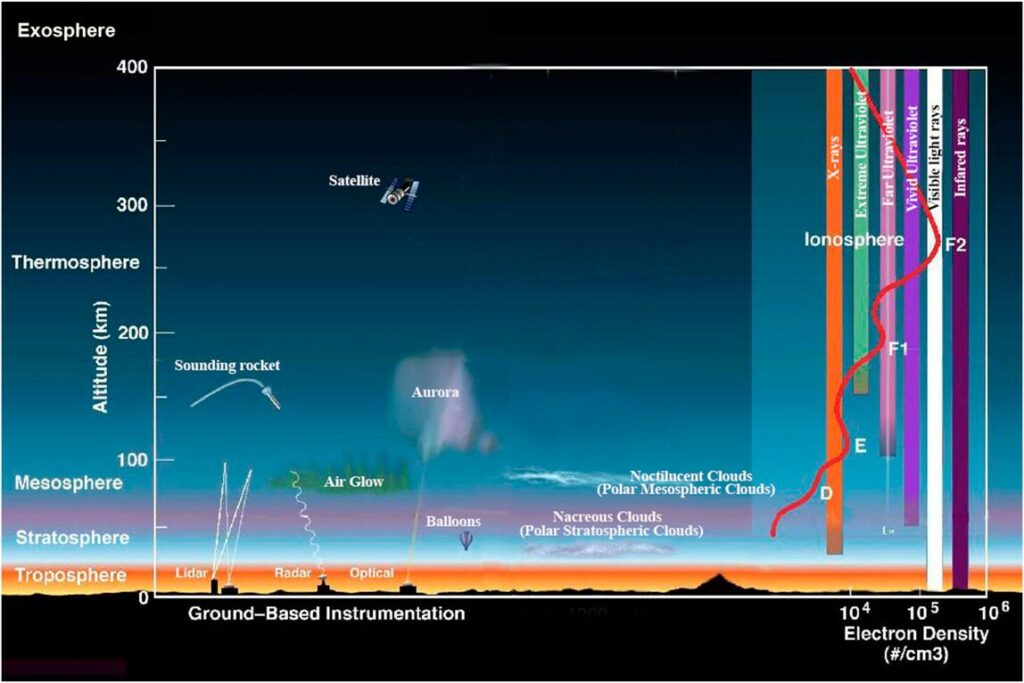
The ionosphere is a crucial layer of the Earth’s atmosphere that plays a vital role in maintaining our planet’s balance. However, its unique characteristics make it challenging to understand, especially for those without a background in physics or astronomy. In this article, we’ll delve into the ionosphere, exploring its temperature, significance, and other essential aspects.
What is the Ionosphere?
The ionosphere is a rarefied region of the atmosphere that extends from about 60 km to 450 km above the Earth’s surface. Despite not being one of the traditional layers of the atmosphere (such as the stratosphere or mesosphere), it has a significant impact on our planet.
History of Ionospheric Research
The ionosphere has been studied for centuries, with ancient civilizations recognizing its importance in navigation and communication. However, modern research began in the early 20th century, when scientists started to investigate the ionosphere’s role in radio wave propagation. The first satellite to study the ionosphere was Sputnik 1, launched by the Soviet Union in 1957.
Temperature in the Ionosphere
The ionosphere is characterized by extreme temperature fluctuations, ranging from 200 K near the core to 1500 K at the outer boundaries. This variation is largely influenced by solar activity and radiation exposure. When sunlight interacts with atmospheric gases, it causes ionization, leading to changes in temperature and energy distribution.
The Significance of Ionization
The ionosphere gets its name from the process of ionization that occurs within this region. Solar radiation and cosmic rays also contribute to ionization, albeit to a lesser extent. The resulting ionized particles play a crucial role in maintaining Earth’s magnetic field and protecting our planet from harmful solar winds.
Energy and the Ionosphere
The ionosphere is divided into two main regions: the mesosphere and thermosphere. These sub-layers exhibit unique properties due to varying levels of ionization and radiation exposure. The ionospheric energy can be influenced by changes in atmospheric composition, solar activity, and other external factors.
Ionospheric Propagation
When radio waves encounter an ionized layer, they can interact with the charged particles, resulting in reflected signals. This phenomenon has practical applications in various fields, such as communication and navigation. Understanding ionospheric propagation is essential for optimizing signal transmission and reception.
Types of Ionospheric Propagation
There are two main types of ionospheric propagation: D-region and E-region propagation. The D-region propagates radio waves at lower frequencies (up to 10 MHz), while the E-region propagates at higher frequencies (above 10 MHz).
D-Region Propagation
The D-region is characterized by high electron densities, typically above 1000 electrons/cm^3. This region is sensitive to solar activity and can exhibit significant variations in ionization levels.
E-Region Propagation
The E-region is less dense than the D-region, with electron densities ranging from 10^-4 to 10^5 electrons/cm^3. This region exhibits more stable ionization levels and is used for long-distance radio communication.
Ionospheric Propagation Models
Several models have been developed to predict ionospheric propagation, including:
- The International Commission on Radiowaves (ICR) Model: This model provides a comprehensive description of ionospheric propagation for frequencies up to 100 MHz.
- The International Telecommunication Union (ITU) Model: This model is used for predicting ionospheric propagation at higher frequencies (above 10 MHz).
Terremoti e Ionosfera (Earthquakes and Ionosphere)
Recent studies have investigated how earthquakes affect the ionosphere. Seismic activity can disturb electron distributions within the ionosphere, potentially impacting Earth’s magnetic field and climate patterns. Research has explored this phenomenon using GPS satellites and advanced modeling techniques.
Aurora e Ionosfera (Aurora and Ionosphere)
Auroras are breathtaking displays of light that occur when charged particles interact with the ionosphere. The resulting energy releases electromagnetic radiation, producing spectacular effects in the night sky. Aurora sightings can vary depending on solar activity, atmospheric conditions, and geographical location.
Auroral Activity
Auroral activity is influenced by solar wind and magnetic field variations. The Northern Lights (Aurora Borealis) are more frequent in high-latitude regions, while the Southern Lights (Aurora Australis) are less common due to lower solar activity.
Ionospheric Effects on Climate
Research suggests that ionospheric changes can impact Earth’s climate patterns. Ionization levels and atmospheric circulation can influence global temperature and precipitation patterns.
GPS and Ionosphere Interactions
GPS satellites use atomic clocks to maintain precise navigation and timing. However, the ionosphere can affect these clocks by introducing errors in signal reception. Research has shown that GPS signals interact with the ionosphere, resulting in ionospheric-related errors in navigation.
Conclusion
In conclusion, the ionosphere is a fascinating region of our atmosphere, playing a vital role in maintaining Earth’s balance. Understanding its temperature fluctuations, significance, and other unique properties is crucial for advancing scientific knowledge and practical applications.
Frequently Asked Questions (FAQs)
- What is the main cause of temperature variations in the ionosphere?
Solar activity and radiation exposure are the primary factors influencing ionospheric temperature fluctuations.
2. How does ionization affect the Earth’s magnetic field?
Ionization contributes to maintaining Earth’s magnetic field by interacting with solar winds and charged particles.
3. What role do GPS satellites play in studying earthquakes and ionosphere interactions?
GPS satellites provide valuable data on electron distributions within the ionosphere, helping scientists understand earthquake effects on our planet.
4. Can auroras affect global climate patterns?
While the relationship between auroras and climate is still being researched, it’s clear that solar activity plays a significant role in shaping Earth’s magnetic field and atmospheric conditions.
5. What are the main applications of ionospheric propagation studies?
Understanding ionospheric propagation has practical implications for communication, navigation, and satellite technology, ensuring efficient signal transmission and reception.
6. How does the ionosphere protect our planet from solar winds?
The ionosphere acts as a shield, deflecting solar winds and charged particles that could potentially harm Earth’s magnetic field and atmosphere.
7. What is the current state of research on earthquake-ionosphere interactions?
Research on earthquake-ionosphere interactions is ongoing, with scientists exploring new methods to study this phenomenon using GPS satellites and advanced modeling techniques.
8. Can auroras be used for navigation or communication purposes?
While auroras can affect radio wave propagation, their primary use is still as a natural spectacle, providing insights into our planet’s dynamic atmosphere.
By exploring the fascinating world of the ionosphere, we’ve gained a deeper understanding of this crucial layer of our atmosphere. As scientists continue to study and research the ionosphere, we’ll uncover more secrets about our planet and its place in the universe.


