
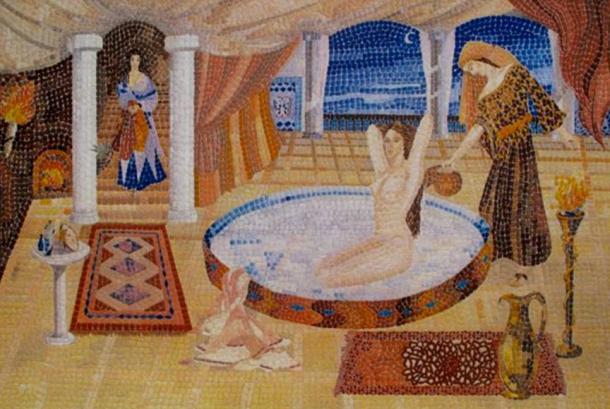
Introduction to Poppea and the Magic of Asinian Milk
In the realm of ancient history, there exist few figures as captivating as Poppea, a woman whose beauty and allure have been shrouded in mystery for centuries. But what’s less known is that her name is forever linked with an extraordinary cure – the asinine milk, or latte di asina. This milk has been prized for its exceptional qualities, used not only in cosmetics but also in medicine and breastfeeding. In this article, we’ll delve into Poppea’s fascinating story, exploring how she came to be associated with this magical liquid.
The Misunderstood Legend of Poppea
While historians often portray Poppea as a cunning and ambitious woman, her reputation has taken a beating over the centuries. She was undoubtedly a stunning individual, admired by many for her beauty and allure. Her life was marked by drama, romance, and tragedy – including a tumultuous marriage with Emperor Nero, who would eventually kill her in 65 AD.
Poppea’s story is often overshadowed by her association with Nero, but it’s essential to remember that she was a product of her time. A woman of incredible beauty and intelligence, Poppea navigated the treacherous waters of ancient Rome with finesse and determination.
The Bagno di Poppea: A Legendary Treatment
At the heart of Poppea’s legend lies her famous Bagno di Poppea, a treatment that utilized asinine milk to maintain youthful beauty. The recipe called for 500 liters of milk from five hundred female asses, a staggering amount that would be impossible to replicate today. While this method may seem far-fetched, it highlights the reverence in which ancient civilizations held asinine milk.
The Bagno di Poppea was more than just a beauty treatment – it represented a symbol of power and status. Those who could afford such luxury were considered part of the elite, and possessing such exotic and rare ingredients signified their wealth and sophistication.
Poppea and Cleopatra: Fellow Beauty Enthusiasts
It’s not just Poppea who was enamored with asinine milk – even the legendary Cleopatra of Egypt was known to indulge in its benefits. Pliny the Elder, a Roman historian, wrote about this practice, noting that seven hundred female asses were required to produce enough milk for Cleopatra’s daily baths.
This shared interest in asinine milk highlights the cultural exchange and admiration between ancient civilizations. The Roman Empire’s fascination with Egypt was well-documented, and it’s likely that Cleopatra’s affinity for asinine milk influenced Poppea’s adoption of this luxurious treatment.
The Modern Significance of Asinian Milk
While we may not be able to replicate the original recipe today, asinine milk continues to hold value in modern times. Used in cosmetics and dermatology, it retains its reputation for skin softening and rejuvenation. Moreover, it has proven itself a suitable alternative for infants with allergies or intolerance issues.
As research into natural ingredients continues to grow, the use of asinine milk may see a resurgence in popularity. With its unique properties and potential benefits, this ancient liquid may once again become a staple in modern medicine and skincare routines.
The Rarity of Asinian Milk
Contrary to popular belief, asinian milk is not as abundant as one might assume. The production of this milk is limited by the characteristics of the animal itself – female asses are only fertile for six months out of the year and can produce up to 1.3 liters of milk per day.
This rarity has led many to question the feasibility of using asinine milk in modern applications. However, researchers have discovered that even small amounts of this milk can provide significant benefits, making it a potentially valuable resource in the field of natural medicine.
A Brief History of Asinine Milk
The use of asinian milk dates back to ancient times, even predating Ippocrate’s writings in 400 BC. Georges-Louis Leclerc, a renowned naturalist, further highlighted its medicinal benefits in the 18th century.
Ippocrate, known as the “father of medicine,” documented various treatments and remedies using natural ingredients, including asinine milk. His works served as a foundation for modern herbalism, demonstrating the value of this ancient liquid in treating a range of ailments.
Conclusion: Poppea – A Woman Ahead of Her Time
As we conclude our journey into the world of asinian milk, it becomes clear that Poppea was more than just a historical figure. She embodied an unwavering commitment to her beauty, using asinine milk to achieve unparalleled results. While the original recipe may be lost in time, its legacy lives on, inspiring us to explore the untapped potential of this extraordinary liquid.
Poppea’s story serves as a testament to the power of human ingenuity and determination. In an age where natural ingredients were prized above all else, she rose to prominence using her intelligence, beauty, and charm. Her association with asinine milk will forever be linked in history books, ensuring that her legacy lives on.
Frequently Asked Questions
-
What is the significance of Poppea and her Bagno di Poppea?
Poppea’s association with asinine milk represents a fascinating intersection of history, beauty, and mythology. -
Can I use asinine milk in my skincare routine?
While it may not be readily available today, asinine milk is occasionally used in cosmetics for its skin softening properties. -
What are the benefits of using asinine milk for breastfeeding?
Asinine milk has proven itself a suitable alternative to traditional formulas for infants with allergies or intolerance issues. -
How does asinine milk compare to other types of milk?
In terms of production, asinine milk is relatively rare due to the characteristics of the female ass. -
Can I substitute lactic acid in products containing lactic acid with lactic acid from asinine milk?
Yes, asinine milk can be used as a substitute for lactic acid in some products. -
What is the history behind the use of asinine milk in ancient civilizations?
The use of asinine milk dates back to ancient times, including references by Ippocrate and Georges-Louis Leclerc. -
Can people with lactose intolerance consume asinine milk?
No, asinine milk contains a significant amount of lactic acid, making it unsuitable for individuals with lactose intolerance. -
Is there any evidence supporting the use of asinine milk in modern medicine?
While more research is needed, some studies suggest potential benefits of using asinine milk in dermatology and skincare.


