
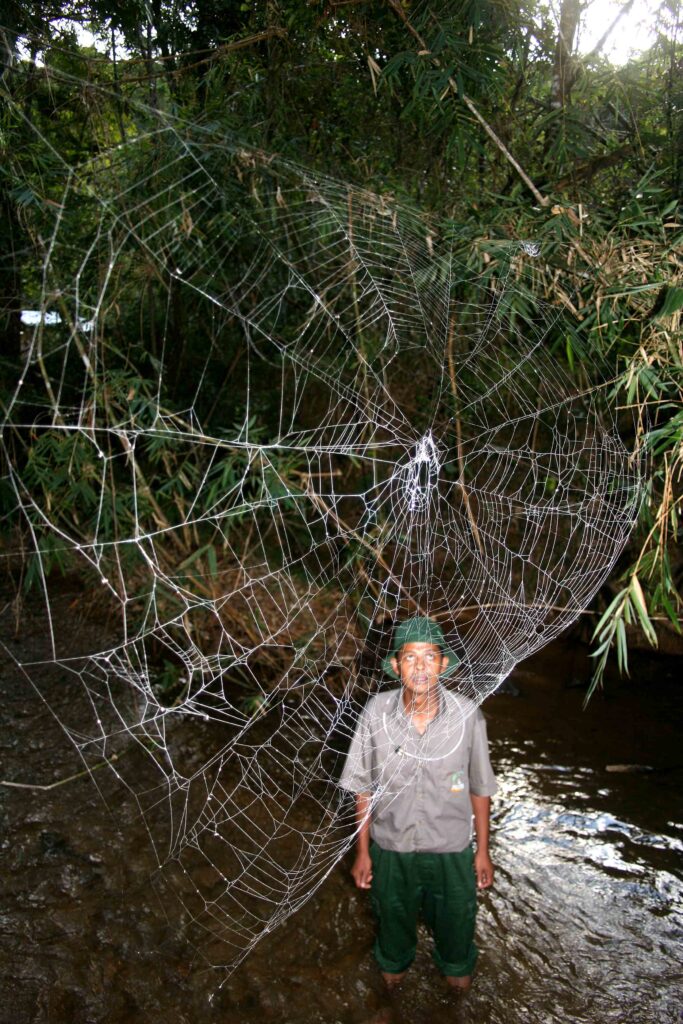
Imagine a spider that can create one of the largest orb webs in the world, measuring up to 25 meters in diameter. Welcome to the fascinating world of Caerostris Darwini, a species of spider that has captivated scientists and enthusiasts alike with its incredible abilities. In this article, we’ll delve into the world of this remarkable spider, exploring its habits, characteristics, and unique features.
Introduction
The natural world is full of mysteries waiting to be unraveled. From the tiniest microorganisms to the largest mammals, every creature plays a vital role in the intricate web of life. One such creature that has piqued our interest is the Caerostris Darwini, a species of orb weaver spider that has left scientists and enthusiasts alike in awe of its remarkable abilities.
The Discovery
Caerostris Darwini was named in honor of Charles Darwin, who passed away 200 years ago. The discovery of this species was a significant milestone, not only because of its impressive web-building abilities but also due to the fact that it had been largely unknown until then. The spider’s large size and unique characteristics have made it a subject of interest among scientists and enthusiasts.
The Web
Caerostris Darwini’s webs are truly remarkable. Measuring up to 25 meters in diameter, they are some of the largest orb webs known to date. But what makes these webs so special? The spider produces a unique type of silk that is incredibly strong and elastic. This silk has been found to be up to three times more resistant to breakage than any other known type of silk.
Imagine trying to spin a web with a material that is both incredibly strong and flexible. It’s like building a skyscraper out of rubber bands! The Caerostris Darwini’s silk is truly remarkable, and its unique properties have led scientists to study this spider in depth.
The Silk
The silk produced by Caerostris Darwini is unlike anything else in the natural world. It’s made up of a complex protein structure, composed mainly of amino acids. When exposed to air, this liquid-like substance transforms into an insoluble fiber that is incredibly strong and elastic. In fact, it has been found to be even stronger than nylon.
But what makes Caerostris Darwini’s silk so special? The answer lies in its unique molecular structure. The spider’s silk contains a high concentration of glycosaminoglycans (GAGs), which are long chains of sugar molecules that provide strength and elasticity to the silk. This unique combination of amino acids and GAGs makes Caerostris Darwini’s silk truly one-of-a-kind.
Habitat
Caerostris Darwini can be found in the southern regions of Madagascar, where it inhabits areas with fast-flowing water. The spider’s webs are often suspended between riverbanks and lake shores, providing a safe haven for it to spin its impressive webs.
Imagine living in a world where you have to constantly battle against strong winds and currents. That’s exactly what Caerostris Darwini faces every day, but its incredible web-building abilities allow it to thrive in even the most challenging environments.
Size and Sex
One of the most interesting aspects of Caerostris Darwini is its size and sex determination. Male spiders are significantly smaller than females, with the males reaching only 3-4 millimeters in length compared to the females’ 6-8 millimeters. Before mating, male spiders must perform a special ritual to ensure successful breeding.
This unique behavior has led scientists to study the mating habits of Caerostris Darwini in depth. By understanding how this spider ensures successful breeding, we can gain valuable insights into the reproductive strategies of other species.
Dimensions
To put Caerostris Darwini’s size into perspective, consider its web-building abilities. The spider’s first pair of legs measures around 35 millimeters in length, while the females have a cefalotorax (head and thorax) that is 6-8 millimeters long and wide.
Imagine building a giant web with legs as thin as pencils! It’s mind-boggling to think about how Caerostris Darwini manages to create such an impressive structure using its tiny legs.
Imagery
Some images of Caerostris Darwini’s webs may appear to be created using Photoshop. However, they are indeed real-life examples of the spider’s incredible web-building abilities. The high-quality images show just how massive these webs can be, and the intricate details that go into their construction.
Conclusion
Caerostris Darwini is a remarkable species that continues to fascinate scientists and enthusiasts alike. Its impressive web-building abilities, unique silk production, and fascinating habits make it one of the most interesting spiders in the world.
As we continue to learn more about this incredible spider, we are reminded of just how much we still have to discover about the natural world. From the tiniest microorganisms to the largest mammals, every creature plays a vital role in the intricate web of life.
FAQs
- Q: Where can I find Caerostris Darwini?
A: This spider is found in the southern regions of Madagascar. - Q: How big are Caerostris Darwini’s webs?
A: The largest orb webs can measure up to 25 meters in diameter. - Q: What makes Caerostris Darwini’s silk so special?
A: It is incredibly strong and elastic, with a resistance that is up to three times higher than any other known type of silk. - Q: How do male spiders determine their sex?
A: Before mating, male spiders must perform a special ritual to ensure successful breeding. - Q: Can I keep Caerostris Darwini as a pet?
A: Unfortunately, this spider is not suitable for domestication due to its specialized habitat and web-building requirements. - Q: What can I learn from studying Caerostris Darwini’s silk?
A: The unique properties of its silk may lead to new discoveries in materials science and engineering. - Q: How does Caerostris Darwini produce its silk?
A: The spider emits a liquid-like substance that transforms into an insoluble fiber when exposed to air. - Q: Can I see images of Caerostris Darwini’s webs online?
A: Yes, many websites and scientific publications feature high-quality images of this remarkable spider’s web-building abilities.
Further Reading
If you’re fascinated by the world of spiders and their incredible web-building abilities, there are plenty of resources available for further reading. From books to documentaries, there’s a wealth of information out there waiting to be explored.
Some recommended readings include:
- “The Spiders” by Charles Darwin
- “Spider Silk: A Review of its Properties and Potential Applications”
- “Caerostris Darwini: The Largest Orb Weaver Spider in the World”
Conclusion
In conclusion, Caerostris Darwini is a remarkable species that continues to fascinate scientists and enthusiasts alike. Its impressive web-building abilities, unique silk production, and fascinating habits make it one of the most interesting spiders in the world.
As we continue to learn more about this incredible spider, we are reminded of just how much we still have to discover about the natural world. From the tiniest microorganisms to the largest mammals, every creature plays a vital role in the intricate web of life.
So next time you’re out exploring the great outdoors, keep an eye out for Caerostris Darwini’s webs. Who knows what secrets they might hold?


