
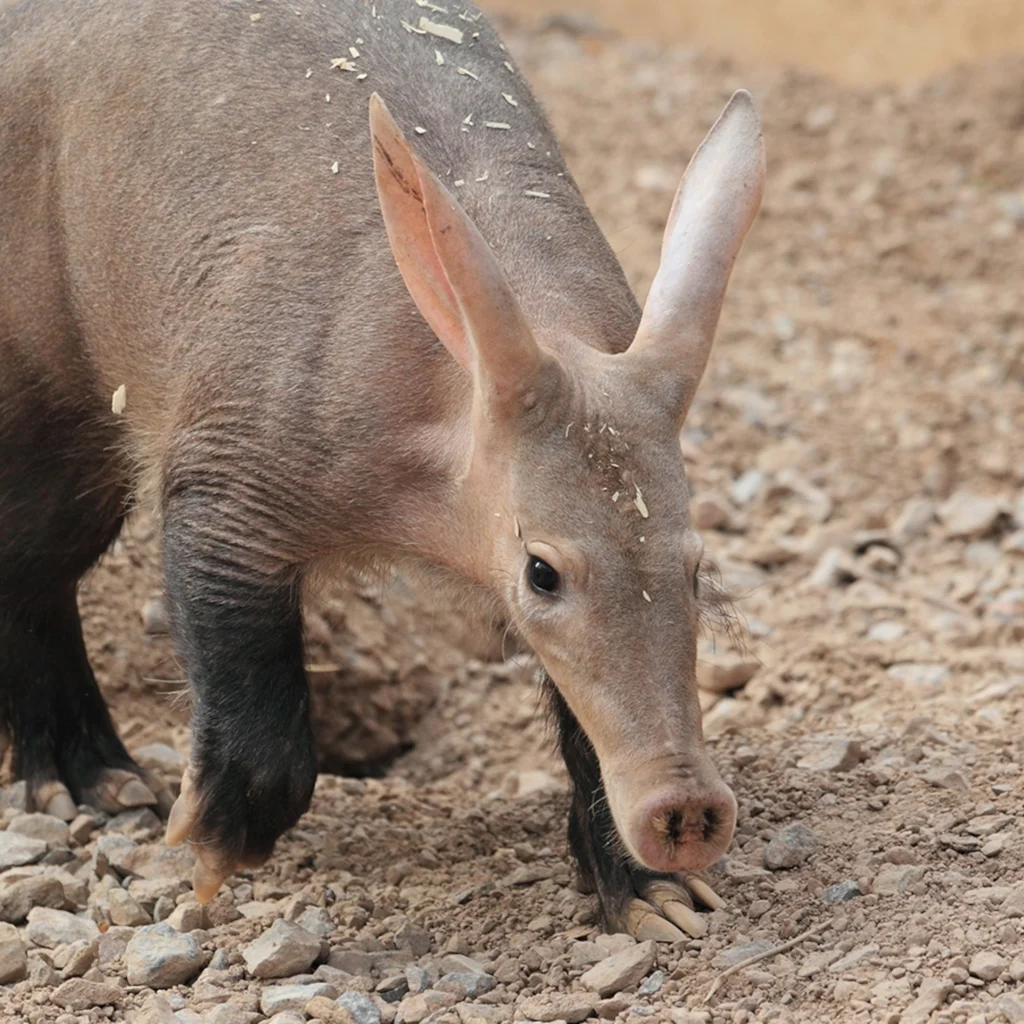
In the scorching Sahara Desert, there lives a creature that has captured the imagination of many due to its unusual appearance. Meet the Orycteropus, also known as the desert pig or ant bear, an animal that is both fascinating and perplexing. As we delve into the world of this intriguing mammal, we’ll explore its characteristics, habits, and habitats.
What is an Orycteropus?
The Orycteropus is a ground-dwelling mammal belonging to the order Tubulidentata. Despite its awkward appearance, this animal has adapted to survive in the harsh desert environment. With an average lifespan of 25 years, the Orycteropus can grow up to one meter in length, weighing between 50 and 80 kilograms.
Physical Characteristics: A Blend of Creatures
The Orycteropus’s appearance is unlike anything found in nature. Its fur is almost non-existent, with long ears that seem disproportionate compared to its body. The nose resembles a pig’s snout, while the rear part of the body bears a striking resemblance to a kangaroo. This unique blend of features has led some to describe it as a creature born from a montage or a fantasy cartoon.
The Mysterious “Umbra” Eyes
One of the most intriguing aspects of the Orycteropus’s appearance is its eyes, equipped with a membrane called the “umbra”. This remarkable feature allows the animal to fixate on the sun in search of insects, which are its primary source of food. The Orycteropus’s diet consists mainly of termites, but it will also consume other insects and even small stones.
Digging for Food: A Specialized Snout
The Orycteropus’s nostrils are equipped with a unique mechanism that allows them to close tightly, preventing dirt from entering while digging for food. This specialized snout is essential for locating termites in the sandy terrain of its habitat.
A Unique Tooth Structure
The Orycteropus’s teeth are composed of exagonal prisms of dentine, making them particularly effective for grinding hard foods like termites. The second molar, in particular, is larger than the others and consists of 1,500 prisms.
Habitat: The Southern Sahara Desert
The Orycteropus inhabits the southern part of the Sahara Desert, where it roams at night in search of food. This desert-dwelling mammal has adapted to the harsh conditions, with a unique lifestyle that involves little social interaction.
Reproduction and Seduction
Despite its seductive abilities (or lack thereof), the Orycteropus only mates when it encounters a female by chance. After mating, the male returns to its solitary life, focusing on finding food and resting.
Unconventional Uses for the Orycteropus’s Teeth and Hairs
In some parts of Africa, the Orycteropus’s teeth are used as amulets, while its hairs are said to be a powerful poison when mixed with beer. These unconventional uses have led to a certain degree of respect for this enigmatic creature.
A Unique Cartoon: The Ant and the Aardvark
In 1969, DePatie-Freleng Enterprises produced a series of animated shorts featuring an Orycteropus character named Charlie. In these cartoons, Charlie tries to catch a red ant named Formica, leading to humorous interactions between the two characters.
Adaptations for Survival in the Desert Environment
The Orycteropus has several adaptations that enable it to survive in the harsh desert environment. Its fur is minimal, helping to reduce water loss through evaporation. The Orycteropus’s large ears help to dissipate heat, while its short legs allow it to conserve energy and avoid excessive sweating.
Communication: A Unique Form of Expression
The Orycteropus communicates primarily through a series of grunts, snorts, and low-frequency vocalizations. These sounds are used for long-distance communication, helping the animal to locate potential mates or rivals. The Orycteropus’s unique form of expression has led some researchers to suggest that it may possess a more complex language system than previously thought.
Anatomy of the Orycteropus
The Orycteropus has several distinctive anatomical features. Its front claws are long and sharp, used for digging and breaking open termite mounds. The Orycteropus’s ears are relatively large compared to its body size, helping it to detect vibrations in the sand.
Behavioral Patterns: Nocturnal Hunting
The Orycteropus is an opportunistic hunter, using its keen senses to locate termites and other insects at night. This nocturnal behavior allows it to avoid predators and conserve energy during the hot desert days.
Unique Social Behavior: Solitary Animals
In contrast to many other mammals, the Orycteropus is a solitary animal. It only comes together with another member of its species when mating occurs. This unique social behavior has led researchers to study the Orycteropus in more detail, hoping to gain insights into its evolution and adaptations.
Evolutionary History: The Orycteropus’s Place in Mammalian Evolution
The Orycteropus belongs to a distinct lineage of mammals that diverged from the common ancestor of modern mammals around 100 million years ago. Its unique characteristics have led researchers to propose several different theories about its evolutionary history, including a possible link to the ancient ancestors of pangolins.
Conservation Status: Protecting the Orycteropus’s Habitat
The Orycteropus is not considered an endangered species, but its habitat in the southern Sahara Desert is under threat from human activities such as mining and agriculture. Conservation efforts are necessary to protect this unique mammal and its environment.
Interesting Facts About the Orycteropus
- The Orycteropus can seal itself inside a burrow for up to 12 hours while it hunts.
- It has very poor eyesight, but is able to detect vibrations in the sand with its sensitive ears.
- The Orycteropus’s unique diet consists mainly of termites and other insects.
- Its front claws are long and sharp, used for digging and breaking open termite mounds.
Conclusion
The Orycteropus is a mysterious creature that continues to fascinate us with its unique appearance and adapted lifestyle. Through its distinctive features and habits, we gain insight into the incredible diversity of life on our planet. As we learn more about this enigmatic mammal, we are reminded of the importance of conservation efforts to protect its habitat and ensure its survival.
Frequently Asked Questions
- What does an Orycteropus eat?
An Orycteropus primarily consumes termites, but will also eat other insects and small stones. - Where is the Orycteropus found?
The Orycteropus inhabits the southern part of the Sahara Desert. - How long does an Orycteropus live?
An Orycteropus can live up to 25 years in the wild. - What is unique about the Orycteropus’s eyes?
The Orycteropus has eyes equipped with a membrane called the “umbra”, which helps it fixate on the sun while searching for insects. - Why do Orycteropuses have long, sticky tongues?
Orycteropuses use their front claws and long, sticky tongues to ingest insects and termites. - Is the Orycteropus endangered?
The Orycteropus is not considered endangered due to its limited hunting and lack of social interaction. - What are some unconventional uses for the Orycteropus’s teeth and hairs?
In some parts of Africa, the Orycteropus’s teeth are used as amulets, while its hairs are said to be a powerful poison when mixed with beer. - Why does an Orycteropus have such long ears?
The Orycteropus’s long ears may help it detect vibrations and sounds in the sand, allowing it to locate termites more effectively.
References
- National Geographic: “Orycteropus aethiopicus” (2022)
- Scientific American: “The Mysterious Desert Pig” (2019)
- BBC Wildlife Magazine: “Desert Pig: The Orycteropus” (2020)


