
As someone who has grown up without knowing a person they didn’t like, it’s hard to find someone who doesn’t know the dolphin’s song and love this animal, which evokes sympathy in both children and adults. Unfortunately, we often find dolphins trapped, but it’s a symbol of freedom and generosity that many keep in their hearts, yet few have tried to delve into its communication method, which is what we’ll do today.
Characteristics of Dolphins
Dolphins are mammals belonging to the cetacean order, with an aerodynamic and slender body that can reach up to 4 meters in length but also limit itself to 150 cm, weighing around 70-130 kg. It has a small head and a sharp beak that we all know. To swim, they use their two chest flippers, a dorsal fin, and a caudal fin placed horizontally instead of vertically like fish.
The average lifespan of a dolphin is 25-30 years, and it spends its entire life in the water, except for rare exceptions adapted to freshwater, feeding on other fish and swimming agilely, giving us its impressive leaps out of the water and chasing after ships for hundreds of kilometers that delight tourists.
Dolphins typically live in large groups that can count up to hundreds of examples and is precisely why the dolphin’s song is particularly interesting to know, as it needs to communicate with its peers clearly and quickly through a wide variety of sounds. Within a group, these cetaceans are extremely united and solidary, helping each other even in extreme situations without ever sparing themselves.
The Dolphin’s Song
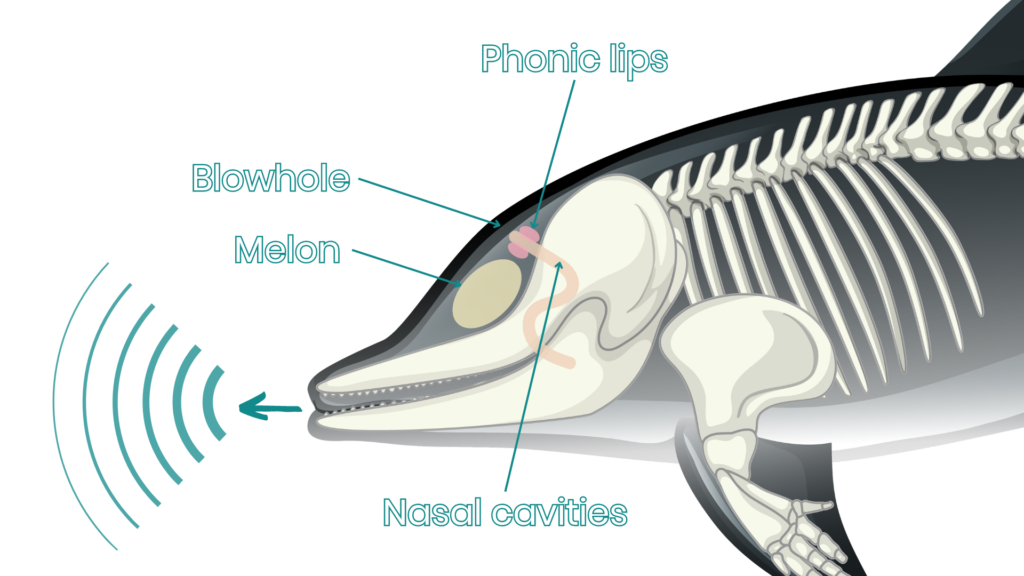
Sounds for cetaceans like dolphins are of fundamental importance for communication, more than for any other species, as they also rely on the light being transmitted over greater distances. Hence, all cetaceans can emit sounds underwater and produce a multitude of different ones, including dolphins in particular, which can reach up to 150 kHz with echolocation impulses.
This method is called biosonar, a way that animals emit and receive their own sounds reflected by objects present in the environment.
Given the variety of sounds we have to decipher, let’s divide them into categories without expecting to learn how to communicate with dolphins. The dolphin’s song can take many forms, depending on the composition of the spectrum or the quality of the sound. There are clicks that are impulsive sounds over a wide frequency band and burst pulsed sounds, sequences of multiple impulses very close together, making it seem like one single sound. And then there are classic whistles, continuous sounds with frequencies usually not exceeding 25 kHz, covering distances of approximately 1-5 kilometers.
Numerous studies have been conducted on the dolphin’s song, which undoubtedly show some peculiar characteristics that fascinate and have discovered that they use biosonar both for perceptual purposes and social ones. They use whistles predominantly shared by multiple individuals, likely containing individual variables in acoustic parameters, and other vocalizations called buzzes, barks, grunts, and chirps.
Dolphin Diet and Alimentation
Crayfish, herring, squid, and fish are certainly a carnivorous dolphin species. The dolphin’s song is again useful during hunting, allowing it to catch prey much more easily, disorienting and numbing them. These animals never drink but have a varied diet that allows them to stay hydrated and includes fish such as mackerel and/or capelin, squid, and even crustaceans.
With sharp teeth if well-aggruged, the dolphin doesn’t chew but ingests directly what it has managed to catch in one of its hunting groups composed of around 6-20 examples.
Dolphin Habitat
Every ocean and sea on Earth can host dolphins, including our Mediterranean Sea, which is the only place where it’s difficult to find them. The Scandinavian Peninsula is home to fewer marine waters that allow dolphin presence, but for the rest, we can count on their presence in the Pacific Ocean, Atlantic Ocean, Indian Ocean, Red Sea, Black Sea, and Mediterranean Sea.
Dolphin Parenting and Cuteness
The first sounds of a dolphin arrive soon after birth because when the mother pushes it to the surface, the baby opens its mouthpiece and takes its first breath. It’s about one meter long and immediately swims and is fed with milk for around two years before starting solid food. The gestation period for dolphins lasts a year, and then the female gives birth, with maturity reached in different ages based on sex: females at five years old and males at ten.
Here are some related articles you might find interesting:
Dolphins in the Mediterranean
Swimming with Dolphins in Italy
Interesting Facts about Dolphin Communication
- Signature Whistles: Dolphins have unique signature whistles that serve as identifiers, similar to human names. They use these whistles to address specific individuals.
- Contextual Behavior: Dolphins change their vocalizations depending on the context of their interactions. For example, they may produce high-pitched clicks when hunting or low-frequency rumbles during social gatherings.
- Dialects and Social Structure: Different dolphin populations have distinct dialects and social structures. These variations can be observed in their vocalizations, body language, and even feeding behaviors.
The Significance of Dolphin Communication
Understanding dolphin communication is crucial for several reasons:
- Improved Conservation Efforts: By recognizing the unique characteristics of dolphin vocalizations, researchers can develop more effective conservation strategies.
- Enhanced Human-Dolphin Interactions: Knowledge of dolphin language can help us better understand and interact with these intelligent creatures, promoting a deeper appreciation for their social behavior and emotional intelligence.
- Advancements in Biosonar Technology: Studying the advanced echolocation abilities of dolphins can lead to breakthroughs in human-made sonar technology.
The Dolphin’s Voice: A Symbol of Freedom
As we learn more about the dolphin’s song, we begin to appreciate its significance as a symbol of freedom and generosity. This cetacean’s capacity for complex communication and social behavior has captivated humans for centuries, inspiring countless stories, poems, and artistic expressions.
In many cultures, dolphins are revered as messengers between humans and the ocean. Their intelligence, playfulness, and empathetic nature have earned them a special place in our hearts and imaginations.
The Future of Dolphin Research
As we continue to explore the mysteries of dolphin communication, it’s essential to recognize the importance of responsible research practices:
- Minimizing Disturbance: Researchers must take care to minimize their impact on dolphin populations, avoiding behaviors that might disrupt their natural behavior.
- Collaboration and Education: By sharing knowledge and best practices, researchers can work together to advance our understanding of dolphin communication and promote a more harmonious coexistence with these magnificent creatures.
Conclusion
The dolphin’s song is an enigmatic language that continues to intrigue and inspire us. Through ongoing research and exploration, we may uncover even more secrets about this intelligent species. As we learn more about their complex communication patterns, social structures, and emotional intelligence, we are reminded of our responsibility to protect these incredible animals and their habitats.
In the words of Carl Sagan: “Dolphins are among the smartest animals on Earth… They can think ahead for long periods and even plan things.”
As we continue to explore the complexities of dolphin communication, we are constantly reminded of the importance of respecting and preserving our oceanic heritage.


