
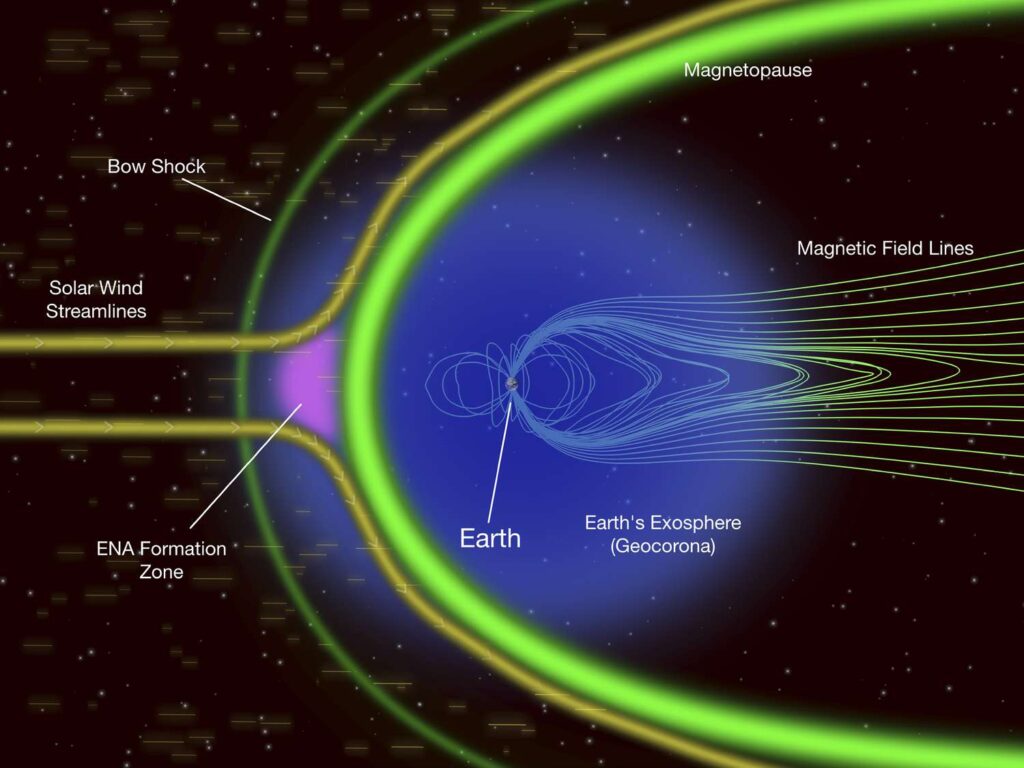
As we gaze up at the night sky, it’s easy to get lost in thoughts about the vast expanse of space beyond our planet. But what lies between us and the stars? The exosphere, the outermost layer of Earth’s atmosphere, is often misunderstood or overlooked. It’s time to shed some light on this fascinating region and explore its characteristics, boundaries, and significance.
Introduction to the Exosphere
The exosphere marks the transition zone between our planet’s atmosphere and space. Located at a distance of over 500 kilometers (310 miles) from Earth’s surface, it’s a realm where atmospheric pressure and gravity are significantly reduced. While we can’t pinpoint an exact boundary, we can estimate its limits based on the behavior of particles as they move away from the surface.
Defining the Exosphere
The exosphere is often described as the “outer atmosphere” or the “atmosphere in space.” It’s a transitional zone where atmospheric gases interact with space and form a complex boundary. The exosphere is not a well-defined layer, but rather an area where the properties of the atmosphere change dramatically.
Characteristics of the Exosphere
The exosphere plays a crucial role in defining our planet’s spatial presence within the universe. It serves as a demarcation line between what affects our atmosphere and what doesn’t. The exosphere is composed primarily of hydrogen and helium, with minor amounts of oxygen and carbon dioxide. These gases are essential for maintaining atmospheric balance but become increasingly rare at these distances from Earth.
As we venture closer to the surface, we find the esobase, a layer near the thermosphere that’s closely tied to the troposphere. This region is critical in understanding the interactions between our atmosphere and the surrounding space environment.
The exosphere also exhibits unique features, such as:
- Low pressure: The atmospheric pressure decreases significantly at these distances from Earth, making it challenging for particles to remain bound to the planet.
- Temperature fluctuations: Temperatures in the exosphere can vary greatly depending on solar activity, cosmic rays, and other factors.
- Gas loss: The exosphere is responsible for gas loss into space, which affects the Earth’s atmospheric balance.
The Exosphere and Space
Exploring the boundary between our atmosphere and space is an intriguing topic. Unlike other environments, where clear demarcations exist, the exosphere presents a fuzzy line, making it challenging to establish precise boundaries. The transition from atmospheric influence to extraterrestrial conditions occurs when particles surpass the escape velocity of 11.2 kilometers per second (km/s). At this point, they leave Earth’s gravitational pull and enter space.
The Exosphere and Atmosphere: A Complex Relationship
Consider our atmosphere as a large “bowl” filled with various gases, with Earth at its center. The exosphere is just one component of this complex system, playing a vital role in shaping our planet’s spatial presence within the universe. Changes to the exosphere can have far-reaching consequences for our climate and environment.
To better comprehend the intricate relationships between atmospheric layers, let’s examine the neighboring strata: troposphere, stratosphere, mesosphere, termosfera, and ionosphere. Each plays a unique role in maintaining Earth’s atmospheric balance and interacting with space.
The Troposphere, Stratosphere, Mesosphere, Termosfera, and Ionosphere
- Troposphere: The layer closest to us, where weather patterns and climate phenomena occur.
- Stratosphere: Contains the ozone layer that filters ultraviolet radiation from the sun.
- Mesosphere: A high frequency of meteorites burn up or vaporize in the atmosphere.
- Termosfera: Houses the ionosphere, a region critical for space communication and technology.
Conclusion
The exosphere is an enigmatic region that holds significant importance for our understanding of Earth’s place within the universe. Its unique characteristics, including its distance from the surface and composition, make it an intriguing area to explore. As we continue to study and learn about this outermost layer of our atmosphere, we’ll uncover more secrets about the intricate relationships between our planet and space.
Frequently Asked Questions
- What is the exosphere?
The exosphere marks the transition zone between Earth’s atmosphere and space. - How far from Earth does the exosphere begin?
Approximately 500 kilometers (310 miles) from the surface, where atmospheric pressure and gravity are significantly reduced. - What gases make up the exosphere?
Primarily hydrogen and helium with minor amounts of oxygen and carbon dioxide. - Can we pinpoint an exact boundary between the exosphere and space?
No; due to the gradual nature of this transition zone, clear boundaries are difficult to establish. - Why is the exosphere important for our planet’s spatial presence within the universe?
It serves as a demarcation line between atmospheric influence and extraterrestrial conditions, defining Earth’s place in space. - What role does the esobase play?
The esobase, near the thermosphere, interacts closely with the troposphere and plays a vital role in maintaining Earth’s spatial presence within the universe. - How do changes to the exosphere affect our climate and environment?
Alterations can have far-reaching consequences, emphasizing the importance of continued research into this layer of our atmosphere. - What is the relationship between the exosphere and other atmospheric layers?
The exosphere serves as one component of a complex “bowl” filled with various gases, interacting closely with neighboring strata to maintain Earth’s atmospheric balance.
Understanding the Exosphere
The exosphere is an essential area for space research and exploration. By gaining a deeper understanding of this layer, scientists can better comprehend our planet’s place within the universe and make predictions about future events.
Challenges and Limitations
Despite significant progress in studying the exosphere, there are still challenges to overcome:
- Limited data collection: The exosphere is a remote and inaccessible region, making it difficult to gather accurate data.
- Technological limitations: Current technology has limitations in measuring the properties of particles at these distances from Earth.
- Complexity: The interplay between atmospheric gases and space conditions makes it challenging to model and predict behavior.
Future Research Directions
To overcome the challenges and limitations, future research should focus on:
- Improving data collection methods: Developing new techniques for measuring particle properties in the exosphere.
- Advancing modeling capabilities: Creating more accurate models of atmospheric behavior using advanced computational tools.
- Investigating the exosphere’s role in climate change: Studying how changes to the exosphere may impact our planet’s climate and environment.
Conclusion
The exosphere is a vital component of our understanding of Earth’s place within the universe. By continuing to study this region, scientists can gain valuable insights into our planet’s dynamics and make predictions about future events. As we push the boundaries of space exploration, it’s essential to stay informed about the complex relationships between atmospheric layers.
Additional Resources
- NASA’s Exosphere Research
www.nasa.gov/exosphere - European Space Agency’s Exosphere Mission
www.esa.int/exosphere-mission


