
Introduction
In the world of birds, there are many fascinating species that have adapted to thrive in various environments. One such bird is the Rondone (Apus Apus), a small migratory bird that has captured our attention with its unique characteristics and remarkable abilities. In this article, we will delve into the world of the Rondone, exploring its characteristics, speed, migration patterns, and other interesting facts about this extraordinary bird.
Physical Characteristics
The Rondone is a tiny bird, measuring between 17-18 cm in length, with a wingspan of 38-44 cm. It weighs a mere 50 grams, making it one of the smallest birds in the world. Its plumage is entirely black, except for the white throat patch, which gives it a distinctive appearance.
Despite its small size, the Rondone has some impressive physical features. Its wings are falciform (curved) and long, allowing it to cover great distances with ease. The tail is slightly forked, while the beak is short and straight. These characteristics make the Rondone look like a mini falcon, but don’t let its size fool you – this bird packs a punch when it comes to speed.
Speed and Agility
The Rondone’s speed is truly remarkable. It can reach velocities of up to 160 km/h in level flight, making it one of the fastest birds on record. But that’s not all – when diving, or stooping, the Rondone can reach speeds of over 220 km/h, making it a formidable hunter.
The Rondone’s agility is another remarkable feature. Its wings allow it to make sharp turns and quick changes in direction, making it an expert at catching insects in mid-air. But that’s not all – the Rondone can also sleep while flying, using a unique form of unihemispheric slow-wave sleep (USWS), where one half of the brain is asleep while the other half remains awake and alert to its surroundings.
Migration Patterns
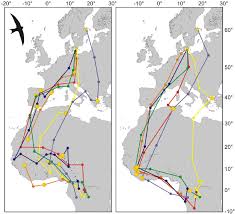
The Rondone is a migratory bird, but unlike many others, it continues to migrate even while sleeping. Its long-distance flights take it across entire continents, from Europe to Africa, Asia, and beyond.
During the summer months, the Rondone can be found in large flocks, soaring through the skies with ease. These flocks are often seen at dawn or dusk, when the birds emit a distinctive call that echoes across vast distances.
Diet and Hunting
The Rondone is primarily an insectivorous bird, feeding on a variety of flying insects, including mosquitoes, flies, and beetles. Its speed and agility make it an expert hunter, able to catch its prey in mid-air with ease.
But the Rondone’s diet doesn’t stop there – it also consumes small vertebrates, such as lizards and frogs, when opportunities arise. This adaptability is key to the Rondone’s survival, allowing it to thrive in a wide range of environments.
Comparison with Rondines
The Rondine (Hirundo Rustica) is another migratory bird that shares some similarities with the Rondone. While both birds are insectivorous and have impressive migration patterns, there are key differences between the two species.
The Rondine is a larger bird, measuring up to 17-19 cm in length, with a wingspan of up to 34 cm. Its plumage is dark brown on top and grayish-brown on below, with a distinctive white throat patch.
Despite these similarities, the Rondone and Rondine are not closely related species. In fact, they belong to different families (Apodidae and Hirundinidae, respectively) and have distinct physical characteristics.
The Rondone in Cities
While the Rondone is often found in rural areas, it can also thrive in urban environments. In fact, this bird has adapted to living in cities, where it can be seen nesting in cavities of old buildings and eating insects from streetlights and parks.
In some parts of Europe, the Rondone has become a common sight in city centers, where its distinctive call echoes off skyscrapers and buildings.
Conservation Status
The Rondone is listed as a species of “Least Concern” on the International Union for Conservation of Nature (IUCN) Red List. However, its population is declining in some parts of Europe due to habitat loss and fragmentation.
To address this issue, conservation efforts are underway to protect and restore natural habitats that support the Rondone’s migration patterns. This includes the creation of bird-friendly corridors and the restoration of wetlands and forests.
Breeding and Nesting
The Rondone breeds in a variety of locations, including urban areas, parks, and rural landscapes. The birds form monogamous pairs, with males engaging in elaborate courtship displays to attract females.
Nests are typically built in cavities or crevices, where the female lays two eggs that both parents incubate for approximately 25 days. Both parents take turns feeding their young, teaching them essential skills such as hunting and flying.
Interesting Facts
- The Rondone can live up to 10 years in the wild.
- In captivity, the Rondone has been known to live up to 15 years.
- The Rondone’s wings are so thin that they allow the bird to generate lift without flapping its wings.
- The Rondone is one of the few birds that can see in low light conditions.
Conclusion
The Rondone is an extraordinary bird that has captured our attention with its unique characteristics and remarkable abilities. From its speed and agility to its migration patterns and diet, this bird is truly one of the most fascinating species on the planet.
Whether you’re a seasoned birdwatcher or just starting out, the Rondone is definitely worth learning more about. With its striking appearance and impressive abilities, this bird is sure to delight and inspire anyone who encounters it.
Frequently Asked Questions
Q: How fast can the Rondone fly?
A: The Rondone can reach speeds of up to 160 km/h in level flight and over 220 km/h when diving (stooping).
Q: Can the Rondone sleep while flying?
A: Yes, the Rondone has a unique form of unihemispheric slow-wave sleep (USWS), where one half of the brain is asleep while the other half remains awake and alert to its surroundings.
Q: What is the Rondone’s diet?
A: The Rondone primarily eats flying insects, including mosquitoes, flies, and beetles. It also consumes small vertebrates, such as lizards and frogs, when opportunities arise.
Q: Where can I see the Rondone in cities?
A: In some parts of Europe, the Rondone can be seen nesting in cavities of old buildings and eating insects from streetlights and parks.
A: No, the Rondone (Apus Apus) and Rondine (Hirundo Rustica) belong to different families (Apodidae and Hirundinidae, respectively) and have distinct physical characteristics.
Q: How long do Rondones live?
A: Unfortunately, there is no reliable information available on the lifespan of Rondones.


