
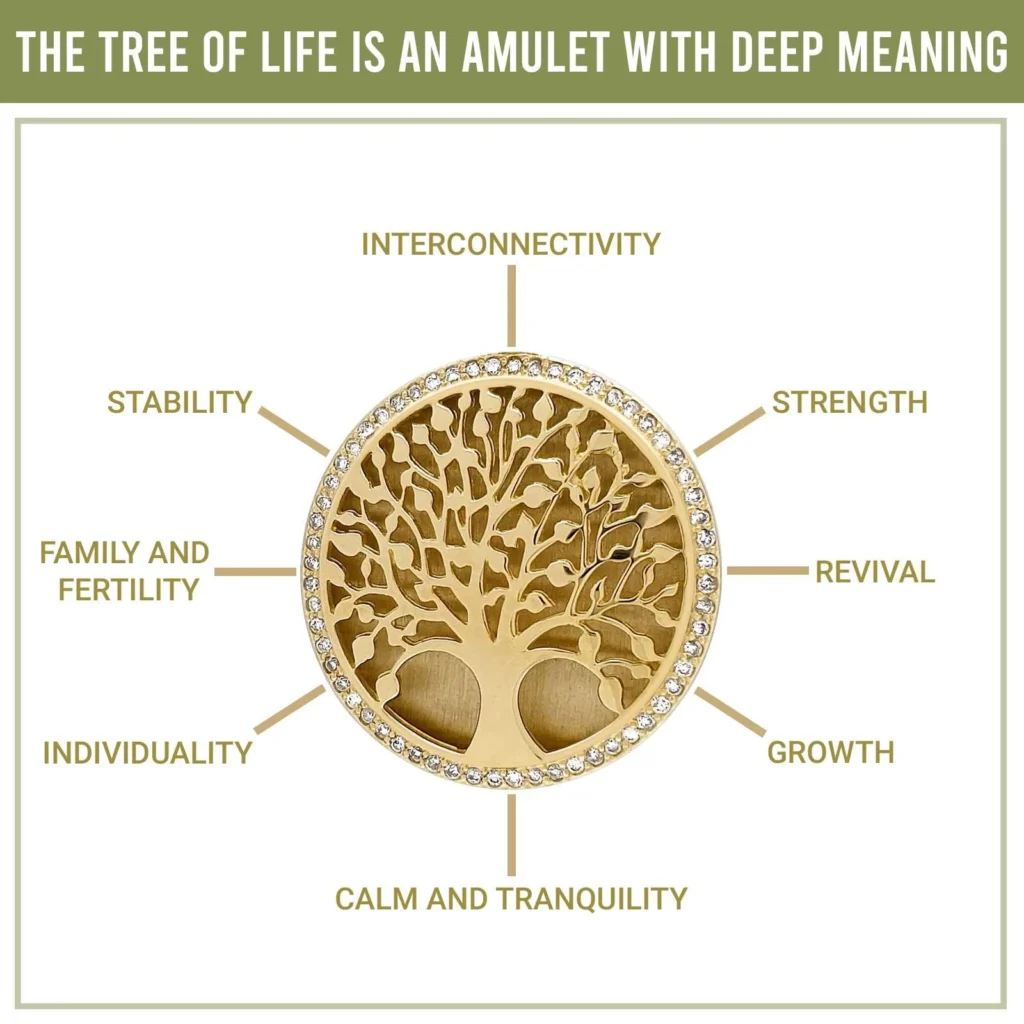
The tree of life is not an actual tree but grows in various parts of the world and carries a message that can be universally relatable across many cultures and religions. It’s fascinating how this symbolic tree unites and is appreciated to some extent everywhere.
What is the Tree of Life?
We find this tree in ancient religious stories where it tells the tale of God planting it in the Garden of Eden, alongside the tree of knowledge of good and evil. This symbolic tree has crossed over many beliefs and religions throughout history. Let’s see how.
In Jewish tradition, the tree was formed by two trees that were united and then Adam separated them. The Torah describes a strong connection between our tree of life and the melon fruit, another natural symbol. Another passage in scripture even tells us that Adam broke the roots of this tree.
“Thus the Lord God made grow out of the ground every tree beautiful to look at and a place to live—a fig tree giving its sweet fruit, and an oak giving its tallow. And the man had to eat from it, but he also had to not reach for it, lest he die.” (Genesis 2:9)
“Look, you are going to be like God, knowing good and evil!” (Genesis 3:22)
In Christianity, this tree is mentioned in the Apocalypse where it’s associated with paradise and linked to Christ’s cross. There are numerous iconographic representations of the Tree of Life, which can be found in various works of art and sculpture. In the Battistero di Parma, Basilica di Santa Croce a Firenze, and Basilica di Santa Maria Maggiore di Bergamo. The Rastafarianism movement refers to this tree as the cannabis plant with its fruit being marijuana.
The Significance of the Tree of Life
Every religion or nearly every one assigns a different significance to this tree, which can be discovered by going on a journey through diverse beliefs. In Jewish tradition, it was formed by two trees that were united and then Adam separated them. The Torah describes a strong connection between our tree of life and the melon fruit, another natural symbol.
In Christianity, the Tree of Life is associated with paradise and linked to Christ’s cross. There are numerous iconographic representations of the Tree of Life, which can be found in various works of art and sculpture.
The Rastafarianism movement refers to this tree as the cannabis plant with its fruit being marijuana. The ancient Greeks also knew a symbol that resembles our modern tree of life, the tree of knowledge from Pandora’s box.
The Roots of the Tree
Roots represent connections to the Earth, sturdy and deep without which the tree would not be stable on the ground and even less able to grow and rise as much as it wants. Next up is the trunk that’s actually the first part exposed to the air and connects the roots with branches that sprout and reach for the sky, pushing towards the future while also marking time by showing strong changes in seasons, adorned with leaves and flowers, then shedding them again.
The Trunk of the Tree
The trunk represents stability, a symbol of growth and renewal. It’s the first part exposed to the air and connects the roots with branches that sprout and reach for the sky. It’s also a reminder of time and how it keeps us fixed in our daily lives.
The Leaves of the Tree
Leaves are associated with breath and life, reminding us of the connection between our existence and nature. They remind us of change and renewal, as they grow, bloom, and then fall off again. This cycle is a metaphor for our own lives, reminding us to let go of things that no longer serve us.
The Fruits of the Tree
Fruits are associated with nourishment and growth. They represent abundance and fertility, reminding us of the importance of gratitude and appreciation for what we have in life. The fruits also remind us of the cycle of birth, growth, and death, as well as the importance of letting go of things that no longer serve us.
Why Give Away the Tree of Life?
Considering that it’s not an actual tree to be cultivated in a garden, but rather the idea behind it, we find various representations of it that are often given away along with a hidden message. The shape of the tree is a strong call to life but if we remain faithful to the concept of an actual tree, we must also consider its different seasons and this opens up numerous interpretations.
Before seeing what each season brings, let’s first see what message the tree carries when it appears as a tree or when we cross paths with it. We can find symbolic representations in various objects like pendants, pens, posters, prints on wood panels, etc.
Autumn: A Season of Change
Autumn is associated with water, source, and guardian of life. It’s a time of change and evolution, where trees prepare for winter by changing color and appearance. In this season, the tree of life reminds us of being determined and gives us calmness and temperance.
Water Reminders Us to Let Go
Water reminds us of fluidity and suggests that we should let go, not cling to patterns but allow our thoughts and emotions to flow like water, dissolving energy blocks and muscle tension. We can think of the tree as a reminder to relax and trust in the natural flow of life.
Winter: A Season of Patience
Winter is associated with earth because it’s often beneath the earth in its roots where important things happen during the coldest days. Winter is a point of arrival and contemplation of beautiful landscapes of fog, snow, clouds, and animal tracks in the snow. In this period we train ourselves to be patient and trust in a better world.
Earth Reminds Us to Be Patient
The earth reminds us to be patient and trust in a better world. We can think of the tree as a reminder to stay grounded and connected to our roots.
Spring: A Season of Renewal
Spring is associated with air because it’s particularly fresh during these days. Spring is lush and fertile where new leaves sprout out and many flowers bloom but also brings us unexpected storms. In the spring, the tree helps us to renew but also like air, to detach from reality on earth and experience life.
Air Reminds Us to Detach
The air reminds us to detach from reality on earth and experience life. We can think of the tree as a reminder to breathe deeply and let go of things that no longer serve us.
Summer: A Season of Abundance
Summer is associated with fire showing off its full power in trees during this season. This season can bring radical changes, growth, and abundance. The summer reminds us to be open-minded and receptive to new experiences.
Fire Reminds Us to Be Open-Minded
The fire reminds us to be open-minded and receptive to new experiences. We can think of the tree as a reminder to stay curious and adaptable in our lives.
Tree of Life Images
We find various representations of the Tree of Life that are often given away along with a hidden message. The shape of the tree is a strong call to life but if we remain faithful to the concept of an actual tree, we must also consider its different seasons and this opens up numerous interpretations.
Where to Buy the Tree of Life?
The tree of life is not something that can be bought, but rather an idea that can be found in objects that help us remember it whenever we need it or want it. We can find pendants with the tree of life symbol, prints on wood panels, posters, and more.
Tree of Life Foundation
There’s also a foundation called Tree of Life that works towards improving human relationships. It was born in Assisi on Christmas Eve, 1996, by a group of men and women who wanted to play their role in making life better through research for a higher sense of living.
The organization is dedicated to promoting services for the protection of minors in difficult situations: communities of welcome, networks of adoptive families, support services for mothers, support from a distance of children from poor countries and campaigns of awareness on child rights worldwide.
Today, Tree of Life works throughout Italy and even outside its borders, in some countries undergoing development. Its commitment is to promote services for the protection of minors in difficult situations: communities of welcome, networks of adoptive families, support services for mothers, support from a distance of children from poor countries and campaigns of awareness on child rights worldwide.
Tree of Life received the Targa d’Argento from the President of the Italian Republic in 2002 and 2007 for its commendable activities and the National Campaign for Children’s Rights.


