
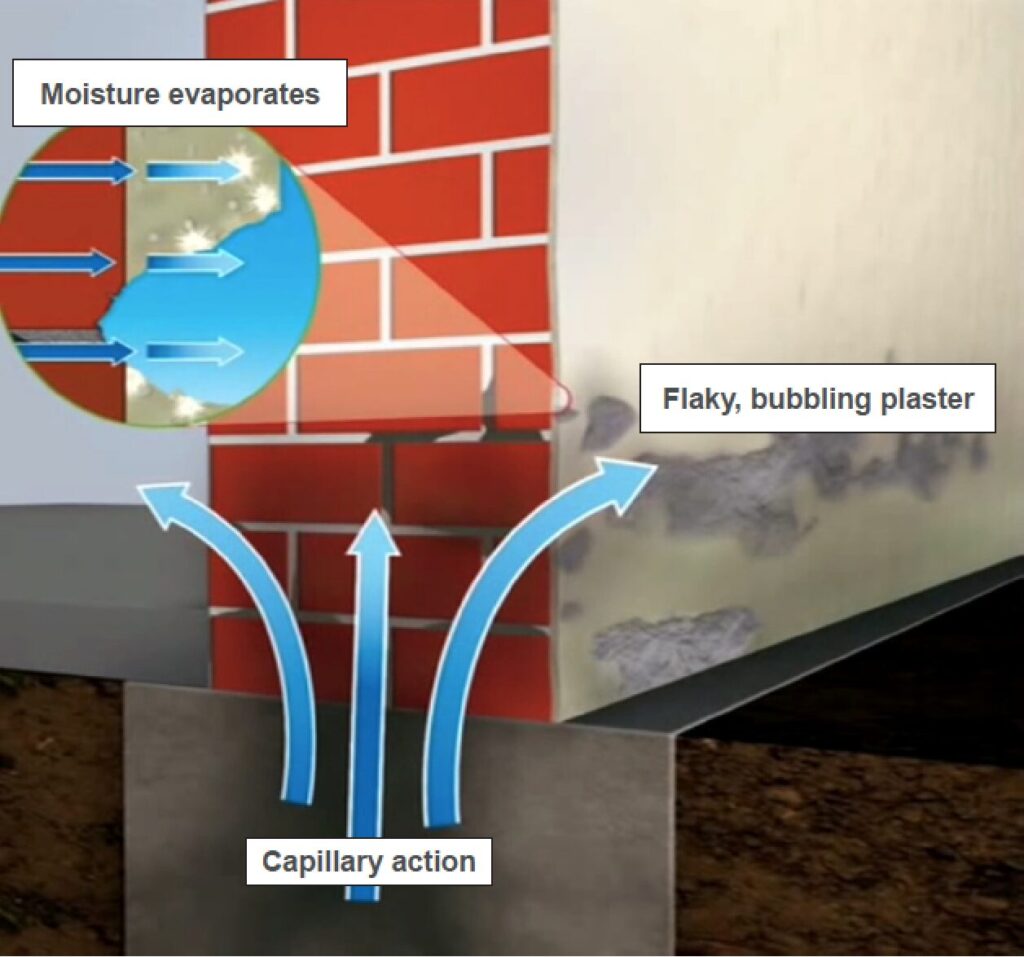
Capillary humidity, also known as capillary rise or moisture vapor transmission, is a common issue in many buildings. It manifests itself with the appearance of mold at ground level, basement walls, and crawl spaces due to a lack of insulation between the soil and the building’s foundation. The humidity can rise up to several meters, even exceeding 2 meters, and make the environment unhealthy.
This problem seems difficult to solve, as conventional solutions such as sealing, coatings, or chemical additives may only provide a temporary fix. Even creating an insulating barrier is not a foolproof solution, as it does not address the root cause of the issue.
The underlying reason for capillary humidity lies in chemistry. In a humid wall, an electric potential difference develops between the lower and upper parts of the structure, increasing the moisture migration process within the building material.
This electric potential can be caused by various factors:
- Electrical currents
- Electromagnetic interference from nearby radio antennas
- Electrical discharges from household appliances
- Static electricity
These electromagnetic disturbances create a flow of current that runs in the opposite direction to the ground, towards the walls. When this flow is detected and measured using specialized equipment, it becomes clear that the voltage values vary between 20 mV and over 300 mV.
The discovery of these physical phenomena led to the development of Biodry Technology, which aims to invert the current flow caused by various disturbances. The principle is simple: inverting the direction of the current allows the water in the wall to change direction, causing the moisture to return to the ground. Without additives, electromagnetic waves, or electricity usage.
The Science Behind Capillary Humidity
Capillary humidity occurs when there is a lack of insulation between the soil and the building’s foundation. This leads to an electric potential difference developing between the lower and upper parts of the structure, causing moisture migration within the building material. The process can be broken down into several stages:
- Moisture absorption: The first stage involves the absorption of moisture from the ground by the building material.
- Capillary rise: The absorbed moisture rises up through the wall due to capillary action, which is the ability of a liquid to flow through a narrow space without the need for pressure.
- Condensation: As the moisture reaches the upper part of the wall, it condenses into droplets, forming mold and mildew.
Biodry Technology: A Breakthrough Solution
The Biodry system developed by Swiss company Wall & Wall Sagl is a small device (24 x 11 x 6 cm) that can remove moisture from all affected walls, eliminate mold odors, reduce relative humidity in the air, and increase thermal insulation capacity. The benefits of Biodry in an affected building can lead to a 5% reduction in total heating costs.
Moreover, without considering any additional measures, capillary humidity can cause damage to structures due to water leakage, which alters the pH of cement and leads to deterioration of metal reinforcement.
Measuring Humidity: Understanding the Issue
To measure the humidity level accurately, you will need an hygrometer. You can also purchase one online if you don’t have one already.
If you want a more comprehensive monitoring system that tracks temperature, air pressure, and other environmental factors, consider investing in a weather station with barometer, hygrometer, and thermometer.
Alternatively, a digital termohygrometer is an excellent choice for its accuracy and ease of use.
Identifying the Source of Humidity
To identify the source of capillary humidity, you will need to investigate several factors:
- Electromagnetic interference: This can be caused by nearby radio antennas, electrical discharges from household appliances, or static electricity.
- Electrical currents: These can cause an electric potential difference between the lower and upper parts of the structure, leading to moisture migration within the building material.
- Insulation: A lack of insulation between the soil and the building’s foundation allows moisture to rise up through the wall.
Eliminating Capillary Humidity
To eliminate capillary humidity, you will need to address the root cause of the issue. This can be achieved by:
- Inverting the current flow: The Biodry system inverts the direction of the current flow caused by various disturbances, allowing the water in the wall to change direction and return to the ground.
- Creating an insulating barrier: This can be achieved by installing insulation between the soil and the building’s foundation, reducing moisture migration within the building material.
- Sealing cracks and gaps: Sealing cracks and gaps in the wall can prevent moisture from entering or escaping the structure.
Conclusion
Capillary humidity is a common issue in many buildings, causing damage to structures due to water leakage and altering the pH of cement. The Biodry system developed by Swiss company Wall & Wall Sagl is a small device that can remove moisture from all affected walls, eliminate mold odors, reduce relative humidity in the air, and increase thermal insulation capacity. By understanding the science behind capillary humidity and identifying the source of the issue, you can eliminate this problem and ensure your building remains safe and healthy.
Additional Resources
If you want to learn more about Biodry Technology or would like to purchase a Biodry device, please visit the Wall & Wall Sagl website. You may also be interested in reading our related articles:
- Pittura antimuffa per interni: A guide to painting anti-mold walls for interior spaces.
- Umidità ideale in casa: An article on ideal humidity levels in homes.
References
- Wall & Wall Sagl. (2022). Biodry Technology: A Breakthrough Solution for Capillary Humidity. Retrieved from https://www.wallandsagl.com/en/biodry-technology
- Swiss Federal Institute of Building Technology. (2019). Electromagnetic Interference and Its Effects on Buildings. Retrieved from https://www.bauhaus-ch.ch/de/interferenzen/emf-emr/
- International Association of Electrical Inspectors. (2020). Electrical Currents and Capillary Humidity. Retrieved from https://www.iaeinet.org/currents-and-issues/electrical-currents-and-capillary-humidity/


