
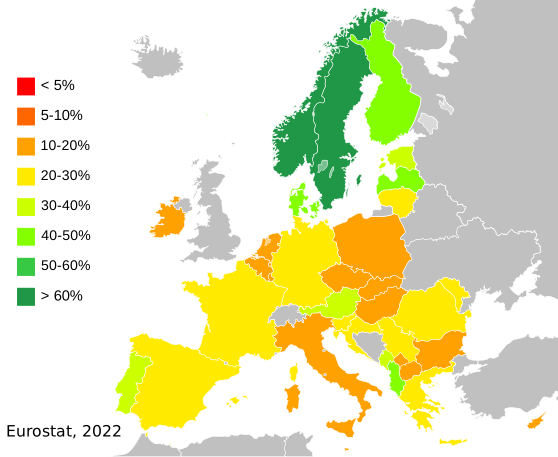
As the world transitions to a more sustainable future, the European Union has set ambitious targets for renewable energy. However, some countries are struggling to keep up with the pace. In this article, we’ll explore the EU’s renewable energy directives, examine which countries are least compliant, and discuss the consequences of non-compliance.
Introduction
The European Union has made significant strides in promoting renewable energy, but there is still much work to be done. The EU’s commitment to reducing greenhouse gas emissions and mitigating climate change is well-documented. As a result, the European Commission has set various targets for member states to achieve in terms of renewable energy production.
The EU’s Renewable Energy Directives
In 2010, the European Union set a goal to cover at least 20% of its energy consumption with renewable sources by 2020. This directive covers not only production from renewable sources but also access to electricity grids, biofuels for transportation, and efficiency standards.
However, as we will explore later in this article, some member states are struggling to meet their targets. In fact, the Commission has identified several countries that require improvement in order to reach their renewable energy goals.
Country Review: The Bottom Performers
Cypriot energy production accounted for just 4.8% of its total consumption in 2010. Ireland was slightly better off at 5.5%, while Malta’s demand for electricity remained largely unchanged at just 0.4%. Slovenia, on the other hand, showed significant improvement with 19.8% of its energy coming from renewable sources.
It is worth noting that these figures are not necessarily indicative of the country as a whole, but rather a snapshot of their current energy production. Furthermore, there may be variations within each country depending on factors such as regional development and economic conditions.
The Consequences of Non-Compliance
If countries fail to meet their targets, they risk facing penalties and potential deferral to the European Court of Justice. The Commission has given Malta and Cyprus two months to comply, while Ireland and Slovenia have been warned but are not yet subject to formal action.
It is essential for member states to take these warnings seriously and work towards meeting their renewable energy targets. Non-compliance can lead to a range of negative consequences, including financial penalties, reputational damage, and loss of public trust in the EU’s ability to regulate and enforce environmental standards.
Italy’s Water Management Debacle
In contrast, Italy has faced disciplinary action from the European Court of Justice for failing to implement proper water management practices. This highlights the importance of adhering to EU guidelines on resource conservation.
Italy’s lack of effective water management policies has led to significant issues with water scarcity and pollution in some regions. The country has been criticized by environmental groups and policymakers alike for its failure to prioritize water conservation and sustainable use of this vital resource.
Why Italy’s Water Management Debacle Matters
The EU’s water management directives are aimed at reducing waste and increasing efficiency in the use of this precious resource. By failing to implement proper water management practices, countries like Italy risk facing severe consequences, including fines and reputational damage.
Furthermore, the lack of effective water management policies can have far-reaching consequences for both human health and the environment. Water scarcity can lead to increased competition for this limited resource, resulting in higher prices and reduced access to clean drinking water.
Conclusion
The European Union’s renewable energy directives aim to drive growth and sustainability across the continent. However, some countries are struggling to meet their targets. As we move forward, it will be essential to support those that are lagging behind while pushing all member states toward a cleaner, greener future.
By working together and prioritizing renewable energy production, we can reduce our reliance on fossil fuels, decrease greenhouse gas emissions, and create a more sustainable future for generations to come.
FAQs
-
What is the EU’s target for renewable energy by 2020?
The European Union aims to cover at least 20% of its total energy consumption with renewable sources by 2020. -
Which countries are facing penalties for non-compliance?
Malta and Cyprus have been given two months to comply, while Ireland and Slovenia are still under warning but not yet subject to formal action. -
Why is Italy facing disciplinary action from the EU over water management?
Italy has failed to implement proper water conservation practices, leading to a directive by the European Court of Justice. -
What are some of the benefits of renewable energy?
Renewable energy offers numerous advantages, including reduced greenhouse gas emissions and increased energy security. By transitioning to cleaner sources of power, we can create jobs, stimulate economic growth, and mitigate climate change.
-
How do the EU’s directives impact transportation and agriculture?
The EU’s directives on biofuels for transportation require countries to increase their use of renewable fuels in the sector by 2020. In agriculture, guidelines focus on resource efficiency and sustainable practices. -
What role can governments play in promoting renewable energy adoption?
Governments can incentivize renewable energy production through tax breaks or subsidies, implement policies supporting cleaner energy sources, and ensure fair competition among energy providers.
- Can individuals make a difference in the transition to renewable energy?
Absolutely! By investing in solar panels, using public transportation, and choosing products with lower carbon footprints, individuals can contribute significantly to reducing our collective environmental impact.
- What is the future of renewable energy in Europe?
The European Union remains committed to its goal of 80% renewable energy by 2050. As new technologies emerge and costs decrease, we expect to see even greater adoption of clean energy sources across the continent.
Case Studies
- Denmark: Denmark has made significant strides in promoting renewable energy, with wind power accounting for over 40% of its electricity production. The country’s success can serve as a model for other member states.
- Germany: Germany’s Energiewende (Energy Transition) program aims to reduce greenhouse gas emissions by 80% by 2050. While the program has faced significant challenges, it serves as an example of how countries can prioritize renewable energy production and create a more sustainable future.
Conclusion
In conclusion, while some countries are struggling to meet their renewable energy targets, there is still much work to be done across the EU. By prioritizing clean energy sources, reducing greenhouse gas emissions, and promoting sustainable practices, we can create a more environmentally conscious future for generations to come.


