
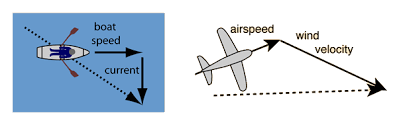
As we go about our daily lives, we often take for granted the concept of motion. We assume that objects move in straight lines, and that their speed and direction can be accurately measured using a fixed reference frame. However, this assumption is not always valid, and it’s essential to understand why.
What is Relative Motion?
Relative motion is a fundamental concept in physics that describes how an object’s motion appears different when observed from two or more distinct reference frames. This concept was first introduced by Galileo Galilei, who demonstrated that the same physical phenomenon can be described using different systems of reference.
Imagine you’re standing on a train platform, watching as a friend, Marco, boards a train heading to Milan. From your perspective, Marco is moving towards the front of the train at a certain speed. However, if you ask him how fast he’s moving relative to you (standing still), he’ll tell you that he’s actually moving more slowly than the train itself.
This apparent discrepancy highlights the concept of relative motion: when we observe an object from different reference frames, its motion appears different due to the difference in our perspectives. This idea has far-reaching implications for our understanding of space and time.
The Role of Reference Frames
Reference frames play a crucial role in defining relative motion. A reference frame is any system that serves as a benchmark for measuring physical quantities like position, velocity, and acceleration. In physics, we often use inertial reference frames, which are frames that move at a constant velocity with respect to an external observer.
For instance, when we measure the speed of an object on Earth, we typically assume that the planet is stationary, serving as our fixed reference frame. However, if we were to consider the Earth’s motion around the Sun, our reference frame would need to change, and the speed of the object would appear different relative to this new frame.
Moto Relativo: A Concept in Physics
In physics, the concept of relative motion is closely tied to the idea of relativity. Specifically, we refer to it as “moto relativo” (relative motion). This term encompasses not only the change in perspective but also the mathematical representation of this phenomenon using equations and formulas.
To grasp the significance of relative motion, let’s consider an analogy: imagine two travelers on a road trip, where one is moving faster than the other. Each traveler might measure their own speed differently, depending on their reference frame. This illustrates how relative motion affects our understanding of physical phenomena.
Moto Relativo in Everyday Life
Relative motion is not limited to scientific theories or abstract concepts. It’s an essential aspect of our daily lives, where we encounter it in various forms:
- Trains and highways: When observing the speed of a train or car from different vantage points, you’re experiencing relative motion.
- Sports and games: In sports like football or basketball, players’ movements can be affected by their teammates’ or opponents’ positions, illustrating relative motion in action.
- Space exploration: As spacecraft travel through space, they must account for the changing reference frames of both Earth and other celestial bodies.
Moto Relativo Bidimensionale vs. Tridimensionale
While most physical phenomena occur in three dimensions (length, width, and height), we can simplify these complexities by considering two-dimensional cases.
For example, when observing a train passing on a straight track, we might view this as a bidimensional scenario. However, when considering the train’s motion in space, we must take into account its three-dimensional trajectory, which includes x, y, and z coordinates.
Moto Relativo Assoluto vs. Moto Relativo
The terms “moto relativo assoluto” (absolute relative motion) and “moto relativo” (relative motion) are often used interchangeably, but they convey distinct meanings:
- Absolute relative motion refers to the perspective from which an object’s motion is observed.
- Relative motion, on the other hand, describes the change in perspective itself.
To illustrate this difference, consider two observers: one standing still on a train platform and another friend inside the train. The friend might measure their own motion differently than the stationary observer.
Formule di Base per il Moto Relativo
For those interested in delving deeper into the mathematical aspects of relative motion, here are some fundamental equations:
- La legge della relatività specialista (SR): E = mc^2
- L’equazione di Lorentz per la velocità: v = c * (x / t)
- Le equazioni di moto relativo in 3D
These formulas provide a foundation for understanding the intricacies of relative motion, but they’re not exhaustive.
Conclusion
Relative motion is a fundamental concept that underlies our understanding of space and time. By recognizing its implications and complexities, we can better appreciate the intricate web of perspectives that shape our physical world.
Stay curious, keep exploring!
Frequently Asked Questions
- What is relative motion?
Relative motion refers to the change in perspective when observing an object from different reference frames. - Is relative motion absolute or relative?
The term “moto relativo assoluto” (absolute relative motion) describes the perspective, while “relative motion” refers to the change in perspective itself. - How does relative motion affect our understanding of space and time?
Relative motion highlights the importance of reference frames in defining physical phenomena and challenges traditional notions of absolute motion. - Can we measure relative motion using formulas?
Yes, mathematical equations like those derived from special relativity provide a framework for understanding the complexities of relative motion.
Stay curious!


