
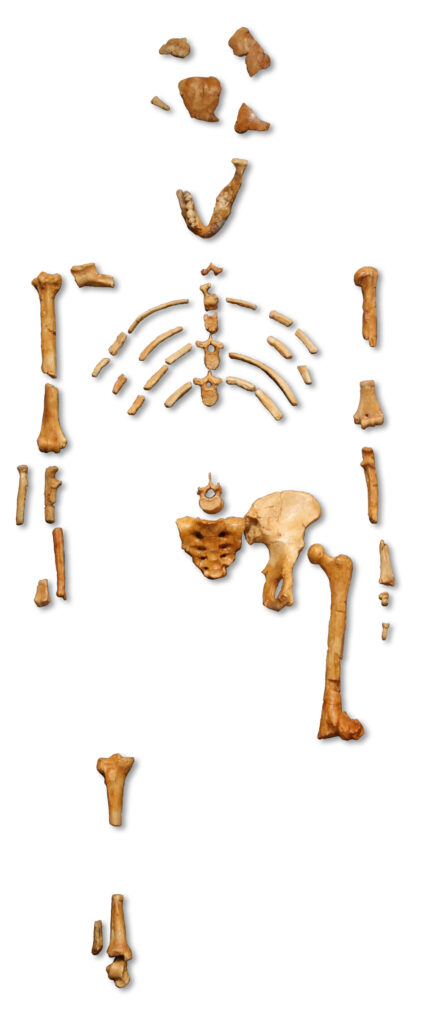
Have you ever wondered where our species came from? Who were our ancestors, and how did we evolve into the humans we are today? The answer lies in a small, yet significant discovery made in the 1970s – the fossil of Lucy, an Australopithecus afarensis. Lucy is often referred to as our “great-great-grandmother” due to her significance in understanding human evolution.
What is an Australopithecus?
The term Australopithecus refers to a genus of extinct primates that belonged to the Hominidae family, which includes modern humans and their closest living relatives. The name “Australopithecus” means “southern ape” in Latin, derived from the Greek word πίθηκος (pithekos), meaning “ape.” These early human-like creatures roamed the Earth around 4-2 million years ago.
The Discovery of Lucy
Lucy was discovered on November 24, 1974, by a team of paleoanthropologists led by Donald Johanson in the Afar region of Ethiopia. The fossil consists of over 50 bones, including those from her arms and legs, as well as fragments of her pelvis and vertebrae. These remains provided valuable insights into Lucy’s life and habits.
Lucy’s Physical Characteristics
By studying Lucy’s fossilized remains, scientists have pieced together a picture of what she might have looked like. She had a brain size similar to that of a chimpanzee but slightly larger than expected. Her face was long with a prominent forehead, nose, and jawbone. She stood about 4 feet tall (1 meter) and weighed around 25 kilograms.
Theories on Lucy’s Death
It is difficult to determine the exact cause of Lucy’s death due to the age of the fossilized remains. However, researchers have proposed several theories based on her injuries:
- Natural Disaster: One theory suggests that Lucy died along with other individuals in a catastrophic event, possibly an earthquake or flood.
- Tree Fall: Another theory proposes that Lucy fell from a tree, given the presence of fractures in her bones.
Lucy’s Legacy
The discovery of Lucy has revolutionized our understanding of human evolution. She is considered one of the most significant finds in the field of paleoanthropology. Her story has captivated scientists and the general public alike, inspiring further research into the mysteries of human origins.
Understanding Human Evolution
To grasp the significance of Lucy’s discovery, it’s essential to consider her place within the broader context of human evolution. Our species evolved from a common ancestor with other primates in Africa around 6-8 million years ago.
The earliest human-like creatures, such as Ardipithecus ramidus, lived in East Africa about 4.4 million years ago. Over time, these early humans evolved into different species, eventually giving rise to modern humans (Homo sapiens).
Key Milestones in Human Evolution
- Ardipithecus Ramidus: This early human-like creature lived around 4.4 million years ago in East Africa.
- Australopithecus Anamensis: This species lived around 5-6 million years ago and was characterized by its upright posture.
- Homo Habilis: This species emerged around 2.8 million years ago, with more advanced tools and a larger brain size.
The Importance of Fossil Record
The fossil record is crucial in understanding human evolution. The study of fossils provides valuable insights into the past, helping scientists reconstruct the history of our species. By analyzing fossil remains, researchers can gain information about an organism’s physical characteristics, behavior, and habitat.
Fossils also provide a link to the present day, allowing us to understand how our ancestors adapted to their environments and interacted with other organisms. The study of fossils is essential in advancing our knowledge of human evolution and shedding light on the mysteries of our species’ past.
Conclusion
Lucy’s story serves as a testament to the incredible journey of human evolution. Her discovery has opened doors to new insights and questions about our species’ past, shaping the scientific understanding of our place in the world.
As we continue to explore the secrets of human history, we may uncover more surprising insights about our ancestors, like Lucy. The story of Lucy is a reminder that science is constantly evolving and that there is still much to be discovered about our shared human experience.
Frequently Asked Questions
- When was Lucy discovered?
- Lucy was discovered on November 24, 1974.
- Who found Lucy?
- Donald Johanson led the team that discovered Lucy.
- What is an Australopithecus?
- The term refers to a genus of extinct primates that belonged to the Hominidae family.
- How old was Lucy when she died?
- Lucy’s age at the time of death cannot be determined with certainty due to the age of her fossilized remains.
- What are some theories on Lucy’s death?
- Researchers have proposed several theories, including a natural disaster and a fall from a tree.
Lucy’s Legacy: A New Perspective
The story of Lucy has captivated scientists and the general public alike, inspiring further research into the mysteries of human origins. Her discovery serves as a reminder of the incredible journey of human evolution, shaping our understanding of our place in the world.
As we continue to explore the secrets of human history, we may uncover more surprising insights about our ancestors, like Lucy. The story of Lucy is a testament to the power of science and the importance of curiosity-driven research.
In conclusion, Lucy’s discovery has left an indelible mark on the field of paleoanthropology, inspiring new perspectives and research into human evolution. Her legacy serves as a reminder that science is constantly evolving, and there is still much to be discovered about our shared human experience.


