
The article “Rising Sea Levels: Causes and Differences in Specific Locations” is the result of a collaboration between the Valorizzazione della Ricerca e Public Engagement – Agorà Scienza section, Green Office UniToGO at the University of Turin, and IdeeGreen S.r.l. Benefit Society.
This article revises the texts of Professor Elisa Palazzi published in her book “Lessico and Nuvole: The Words of Climate Change”, the second edition of a linguistic and scientific guide to navigate the most urgent issues related to global warming, co-authored by the section and the Green Office.
The free version of Lessico e Nuvole is available for download from zenodo.org as a PDF file. The printed version can be purchased online through the following platforms:
- Amazon
- youcanprint.it
- Mondadori (also with Carta del Docente and 18app)
- IBS
- Libreria Universitaria (also with Carta del Docente and 18app)
All revenue from paid versions will be used by the University of Turin to finance research and public engagement projects on climate change and sustainability issues.
Causes of Rising Sea Levels
Throughout Earth’s history, sea levels have undergone many oscillations, rising and falling even drastically. During warm periods with no ice at the poles, oceans were hundreds of meters higher than today; during cold periods when glaciers covered the planet, sea levels were hundreds of meters lower. These changes are part of natural cycles on Earth that have occurred over millions of years.
During the most recent glacial period, which reached its peak about 21,000 years ago, it is estimated that global average sea level was around 120 meters lower than today. Since then, sea levels have risen to their current values: initially rapidly (with rates exceeding 3 meters per century), followed by a slowdown and stability for most of the past 2,000 years.
From the late 1970s to the recent decade, the melting of continental glaciers and the thermal expansion of warm ocean waters have contributed equally to sea level rise. However, in the more recent period, the melting of glacier calves and mountain glaciers has accelerated, contributing significantly to sea level rise:
The average annual loss of ice from mountain glaciers has increased fivefold over the past few decades, rising from 171 millimeters of liquid water equivalent in the 1980s to 460 millimeters in the 1990s, 500 millimeters in the 2000s, and 850 millimeters between 2010-2018.
The loss of ice from Greenland’s ice sheet has increased sevenfold, with an estimated 34 billion tons of water lost per year between 1992-2001 to 247 billion tons per year between 2012-2016.
The loss of ice in Antarctica has almost quadrupled, rising from 51 billion tons of water lost per year between 1992 and 2001 to 199 billion tons per year between 2012 and 2016.
Differences in Sea Level Rise in Specific Locations
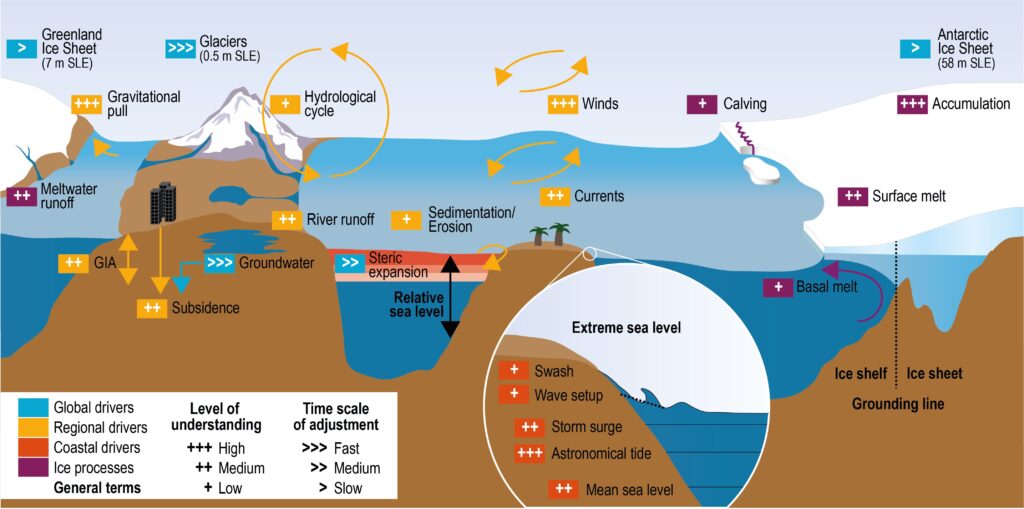
Sea level rise in specific locations can be lower or higher than the global average due to local factors such as natural subsidence of land, anthropogenic extraction of fossil fuels, regional changes in ocean currents, and other factors that influence how deep layers of oceans store heat.
Observed sea levels from 1993 (the start of satellite measurements, indicated by a black line) to present. Color-coded lines indicate the various contributions to sea level rise. Adapted from the National Oceanic and Atmospheric Administration (NOAA), Climate.gov – Climate change global sea level.
By 2100, sea levels are expected to rise by approximately one meter on average, placing hundreds of coastal cities around the world in a state of extreme difficulty. The latest IPCC report on oceans and cryospheres in a changing climate (SROCC) states that by 2100, sea levels could rise from 26 to 77 centimeters with temperatures higher than 1.5°C above pre-industrial levels. Many coastal areas are already at risk of flooding today, and more people are forced to abandon their homes, becoming de facto climate migrants.
In the United States, approximately 25 million people live in areas vulnerable to sea level rise. In Europe, one-third of the population lives within 50 kilometers of the coast. Italy’s coastline is estimated to be at risk of flooding totaling 5,686.4 square kilometers.
Regional Variations in Sea Level Rise
Different regions are experiencing varying rates of sea level rise due to local factors such as:
- Thermal Expansion: Oceans absorb heat from human activities, leading to thermal expansion and a corresponding increase in sea levels.
- Glacier Melting: The melting of glacier calves and mountain glaciers contributes significantly to sea level rise.
- Subsidence: In some regions, the ground is sinking due to natural or human-induced processes, which can exacerbate sea level rise.
- Ocean Current Changes: Changes in ocean currents and circulation patterns can affect regional sea levels.
Examples of regional variations include:
- Pacific Coastline: The Pacific coastline, particularly California and Oregon in the United States, is experiencing significant sea level rise due to the melting of glaciers in Alaska and the thermal expansion of warm ocean waters.
- East Coast of North America: The East Coast of North America, including cities such as New York and Boston, are also at risk from sea level rise due to regional changes in ocean currents and subsidence.
- Southeast Asia: Countries such as Indonesia and Malaysia are facing significant challenges from sea level rise, particularly in low-lying areas and islands.
Conclusion
Sea levels are rising due to two main causes: thermal expansion caused by ocean warming (the water expands as it warms up, absorbing more than 90% of the excess heat accumulated since human activities) and freshwater input from melting glacier ice (especially in Greenland and Antarctica).
Historically, sea level has fluctuated dramatically over millions of years. Since the most recent glacial period ended about 21,000 years ago, sea levels have risen steadily but not uniformly, with periods of rapid increase and stability.
Entire cities are facing extreme difficulties due to rising sea levels, which is expected to continue until at least 2100. The impact on human populations will be significant, especially in areas where land loss causes displacement and migration.
Frequently Asked Questions (FAQs)
- What is the main cause of sea level rise?
The two primary causes are thermal expansion due to ocean warming and freshwater input from melting glacier ice.
- How fast is the global average sea level rising?
From 1993, the global average sea level has risen by approximately 21-24 centimeters (with about one-third of this increase occurring since 1993), with a rate of around 3.2 mm/annum.
- What will happen to sea levels by 2100?
By 2100, sea levels are expected to rise by almost one meter on average, with projections ranging from 26 to 77 centimeters if global temperatures rise by 1.5°C above pre-industrial levels.
- How does melting glacier ice affect sea level rise?
The loss of freshwater from melting glaciers contributes significantly to sea level rise, as ice that was once locked up in glaciers now flows into the ocean.
- What is happening to mountain glaciers and their impact on sea level rise?
The average annual loss of ice from mountain glaciers has increased fivefold over the past few decades, contributing more significantly to sea level rise than glacier melting.
- Why are some areas experiencing more rapid sea level rise than others?
Local factors such as natural subsidence, changes in ocean currents, and anthropogenic activities can affect how fast sea levels rise in specific locations.
- How much of the world is at risk from sea level rise by 2100?
By 2100, entire cities are expected to face extreme difficulties due to rising sea levels, especially those with low elevations or poor drainage systems near coastal areas.
- What measures can be taken to mitigate sea level rise?
Implementing sustainable practices and reducing greenhouse gas emissions can help slow down the rate of sea level rise by reducing the amount of heat absorbed by oceans.


