
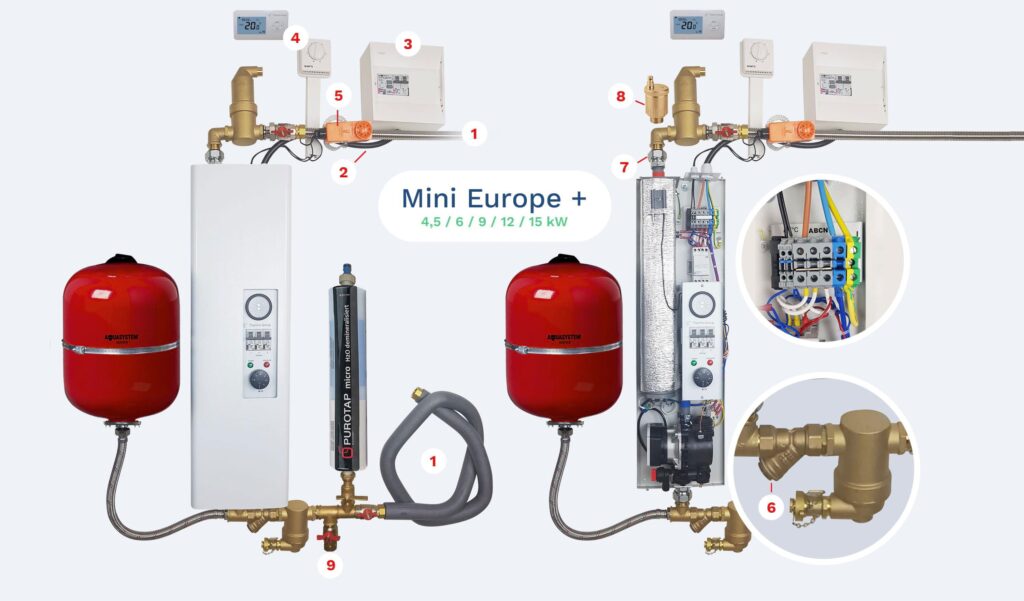
As we discussed in our previous article, “How to Calculate Thermal Power,” selecting the right power for a heating system (heater, air conditioner, heat pump…), this article will focus specifically on choosing the appropriate boiler power for domestic heating needs.
Determining Your Home’s Heat Requirements: A Crucial First Step
To choose the right boiler power, you need to first determine your home’s heat requirements. This is a critical step in selecting the most efficient and cost-effective solution for your home.
Factors That Influence Your Home’s Heat Requirements
When calculating your home’s heat needs, several factors must be considered:
- The thermal conductivity of building materials (e.g., window frames, solar screens, insulating plaster, panel insulation, and whether a cavity wall has been insulated)
- An estimate of the maximum heat demand
- The type of heating system you are using
- Any additional heat sources or heating aids such as electric radiators or underfloor heating
A Simplified Formula for Calculating Your Home’s Heat Requirements
While an exact calculation may be challenging, you can use a simplified formula to get an idea of your home’s heat requirements. The formula is:
Heat Demand = Boiler Power (kW) *
Area to be heated (m²)
Here, the “heat demand” coefficient is approximately 0.05 kW/m², but feel free to use a value closer to your needs.
Choosing Your Heat Demand Coefficient
Your heat demand coefficient depends on various factors:
- A well-insulated house with good thermal performance can use an approximate heat demand coefficient of 0.03 kW/m²
- Houses with average insulation can use approximately 0.05 kW/m²
- Houses with standard insulation may need a value around 0.08 kW/m²
- Older homes without adequate insulation may require the highest value, approximately 0.12 kW/m²
Calculating Your Home’s Volume
To determine your home’s volume in cubic meters (m³), multiply its area by its height:
75 m² * 2.7 m = 202.5 m³
Multiplying Your Home’s Volume by the Heat Demand Coefficient
Once you have calculated your home’s volume, multiply it by the heat demand coefficient to find out how much power you need:
202.5 m³ x 0.12 kW/m² = 24.3 kW
Therefore, for a house of this size and configuration, a boiler with an output of approximately 24.3 kW is required.
Factors That Influence Boiler Power Selection
When choosing the right boiler power, several factors must be considered:
- The type of fuel used to heat your home (gas, oil, electric)
- Your desired level of comfort (e.g., warmth during cold months and temperature control during warmer periods)
- Your budget for boiler maintenance and repairs
- Environmental considerations (e.g., carbon footprint, emissions)
Gas Boilers
Gas boilers are a popular choice for domestic heating due to their efficiency and cost-effectiveness. However, they do require regular maintenance to ensure optimal performance.
Oil Boilers
Oil boilers are another common option for domestic heating, but they can be more expensive to operate than gas boilers. They also produce emissions that contribute to air pollution.
Electric Boilers
Electric boilers are a viable option for some homeowners, particularly those with access to renewable energy sources like solar or wind power. However, they can be more expensive to install and maintain than other types of boilers.
Heat Pump Systems
Heat pump systems are becoming increasingly popular due to their environmental benefits and cost-effectiveness. They work by transferring heat from one location to another, rather than generating heat through combustion.
Heat Pumps vs. Boilers: Which is Right for Your Home?
While both boilers and heat pumps can provide efficient and comfortable heating, they have distinct differences that must be considered:
- Boiler power output: Boilers produce direct heat, while heat pumps transfer heat.
- Energy efficiency: Heat pumps are generally more efficient than boilers, especially when used with renewable energy sources.
- Environmental impact: Boilers produce emissions, while heat pumps contribute less to air pollution.
Conclusion
Choosing the right boiler power for your home’s heating needs can help you save energy, reduce costs, and ensure optimal comfort levels throughout the year. By understanding the factors that influence heat requirements and using a simplified formula to estimate your home’s heat demand, you can select the perfect boiler size for your space. Additionally, consider the type of fuel used, desired level of comfort, budget, and environmental considerations when selecting the right boiler power.
Frequently Asked Questions
- What is the most important factor in determining my home’s heat requirements?
- The thermal conductivity of building materials
- How do I choose the right heat demand coefficient for my home?
- Based on factors like insulation, windows, and the age of your home
- Why is it necessary to calculate my home’s volume before determining its heat requirements?
- To ensure accuracy in estimating energy needs
- What is a typical range for heat demand coefficients used in domestic heating calculations?
- Approximately 0.03-0.12 kW/m², depending on factors like insulation and window orientation
- Can I use the simplified formula to estimate my home’s heat requirements with precision?
- While it can provide an approximate idea, a more accurate calculation may be necessary for specific situations
- What are some common mistakes people make when calculating their home’s heat requirements?
- Incorrectly estimating insulation levels or failing to account for factors like window orientation and roof type


