
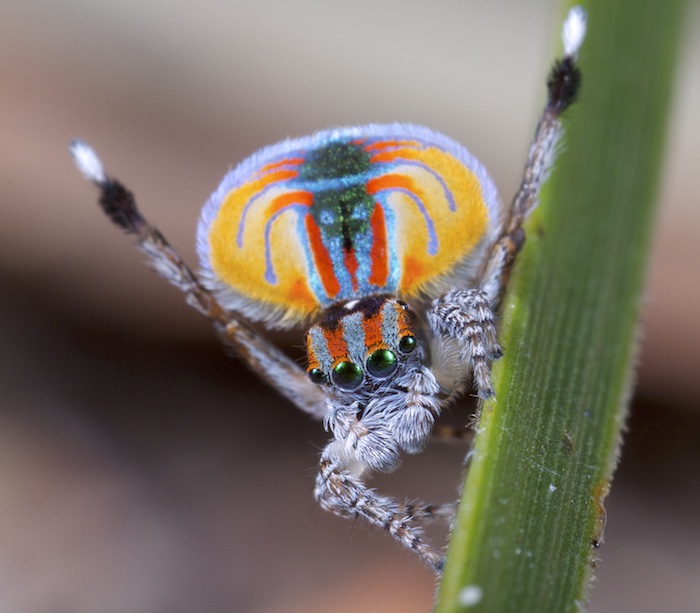
As anyone who’s never ventured into the world of arachnids might ask, what makes this spider so special? Meet the Maratus volans, a tiny Australian native that has taken the internet by storm with its dazzling courtship dance. This article will delve into the fascinating world of the Maratus volans, exploring its unique characteristics, habits, and habitats.
Characteristics of the Maratus volans
With a scientific name of “Maratus volans,” this spider is incredibly small, barely visible to the naked eye. Both male and female specimens are approximately 5 mm in length, but they differ in appearance. Females are more subdued, with a duller color palette, while males display an impressive array of colors, including red, blue, green, and many others.
The males’ vibrant displays serve as a crucial aspect of their courtship behavior, attracting potential mates and establishing dominance within their territory. This elaborate dance is a testament to the intricate social dynamics of arachnids, showcasing the complex communication strategies employed by these tiny creatures.
Habitat of the Maratus volans
The Maratus volans is found exclusively in Australia, specifically in regions such as Queensland, New South Wales, Victoria, the Australian Capital Territory, Western Australia, and Tasmania. This spider has become a symbol of Australia’s unique biodiversity, highlighting the country’s rich natural heritage.
Their habitats range from grasslands to forests, and they can often be found near water sources, where they can feed on insects and other small invertebrates. The Maratus volans is adapted to life in these environments, with their slender bodies allowing them to navigate through dense vegetation with ease.
Dancing Spider: The Courtship Dance
The most striking feature of the Maratus volans is its intricate courtship dance. Males perform this elaborate display to attract females, reminiscent of the peacock spider’s behavior. During the dance, males raise their third pair of legs and unfurl colorful extensions above their body, which are often described as “wings.” These vibrant displays can be mesmerizing, making them a viral sensation.
This unique behavior is not only fascinating but also serves an important purpose. By showcasing their impressive display of colors, males signal to females that they are healthy, strong, and capable of providing for their offspring. This complex courtship ritual allows the Maratus volans to establish social bonds with potential mates, increasing the chances of successful reproduction.
Curiosities about the Maratus volans
Researchers have uncovered some fascinating facts about this tiny spider. Biologist Jurgen Otto studied the behavior of Maratus volans in Western and South Australia and shared his findings in a published paper. One interesting aspect is that these spiders exhibit a curious nature, similar to that of dogs and cats, when interacting with their environment.
This curiosity can manifest in various ways, such as exploring their surroundings or investigating novel objects. By understanding the behavior of Maratus volans, researchers can gain insights into the evolution of arachnid cognition and the importance of curiosity in shaping their social interactions.
Observations of Maratus volans
Otto’s research revealed that Maratus volans have exceptional eyesight, with four pairs of eyes (including one front-facing eye). This unique adaptation allows them to detect even the slightest movements in their surroundings, making them well-adapted to hunting and avoiding predators.
Their remarkable vision enables them to navigate through complex environments, detecting potential prey or threats from a distance. By combining their exceptional eyesight with agility and cunning, Maratus volans have evolved into formidable hunters, capable of thriving in a wide range of ecosystems.
Risks to Humans
Despite its small size and harmless nature, there is a risk that Maratus volans might pose a threat to humans through bites or other forms of aggression. However, this risk is extremely low, making them largely non-threatening to humans.
While it is possible for spiders to bite, the venom from Maratus volans is typically not strong enough to cause significant harm to humans. Nevertheless, it’s essential to exercise caution when interacting with these spiders, especially in areas where they are commonly found.
Arachnid Enthusiasts Rejoice!
For those passionate about arachnids, there are numerous books and resources available. A standout title in Italian is Simone Caratozzolo’s book on giant spiders, which provides detailed information on various species. For younger readers, Mirella Delfini’s “La vita segreta dei ragni” offers a captivating tale of friendship between a spider and a writer.
Conclusion
The Maratus volans has captured the hearts of many with its dazzling dance and intriguing behavior. By exploring this tiny Australian native’s world, we can gain a deeper appreciation for the unique biodiversity that exists on our planet.
As researchers continue to study the fascinating biology of the Maratus volans, we may uncover even more secrets about these remarkable spiders. Their intricate social dynamics, exceptional eyesight, and incredible courtship displays offer a glimpse into the complex lives of arachnids, challenging our perceptions of these tiny creatures and inspiring a new wave of interest in entomology.
Frequently Asked Questions (FAQs)
Q: Where is the Maratus volans found?
A: The Maratus volans is exclusively found in Australia, specifically in regions such as Queensland, New South Wales, Victoria, the Australian Capital Territory, Western Australia, and Tasmania.
Q: What makes the Maratus volans’ courtship dance so special?
A: The Maratus volans’ courtship dance is a unique display of color and movement that is reminiscent of the peacock spider’s behavior. This elaborate dance serves as a crucial aspect of their social dynamics, allowing males to establish dominance within their territory.
Q: Are Maratus volans harmless to humans?
A: Despite their small size, there is a risk that Maratus volans might pose a threat to humans through bites or other forms of aggression. However, this risk is extremely low.
Q: What can be done to learn more about the Maratus volans?
A: For those passionate about arachnids, there are numerous books and resources available. Additionally, researchers like Jurgen Otto share their findings on social media platforms.
Q: How does the Maratus volans’ exceptional eyesight aid its survival?
A: The Maratus volans’ four pairs of eyes (including one front-facing eye) allow them to detect even the slightest movements in their surroundings, making them well-adapted to hunting and avoiding predators.
Q: Can humans interact with Maratus volans safely?
A: While it is possible to observe Maratus volans in a controlled environment, such as a terrarium or a zoo, interacting with these spiders in the wild is not recommended due to the potential risks involved.
Q: What role do Maratus volans play in their ecosystem?
A: As predators, Maratus volans play an important role in regulating insect populations and maintaining the balance of their ecosystem.
Q: Are Maratus volans endangered?
A: While there is no conclusive evidence that Maratus volans are currently endangered, their habitats are often threatened by human activities such as deforestation and urbanization.


