
Understanding Earthquakes and Sismic Zones
As the planet’s surface continues to shift, earthquakes occur suddenly, causing vibrations that last for several seconds. These movements are closely linked to the ongoing process of lithospheric adjustment, which includes both the outermost layer of the Earth and its external mantle.
What Causes Earthquakes?
While scientists have made progress in understanding earthquake causes, much remains unknown due to incomplete knowledge of the Earth’s internal structure. The primary factors contributing to earthquakes are believed to be:
- Magma collapse: This occurs when a cavity beneath the surface collapses, often leading to shallow earthquakes with brief durations that can still cause significant damage.
- Tectonic movements: These movements contribute to earthquakes by causing stress in the Earth’s crust, which is released during seismic events.
- Volcanic activity: This type of earthquake occurs when magma movement or gas pressure leads to sudden releases within volcanic systems.
Types of Earthquakes
There are three primary types of earthquakes:
- Subduction earthquakes: These occur due to the collapse of subterranean cavities, typically resulting in shallow earthquakes with limited impact.
- Volcanic earthquakes: Caused by magma movement or gas pressure within volcanic systems, these earthquakes can be intense and destructive.
- Tectonic earthquakes: The most severe type, these earthquakes are caused by stress buildup and release in the Earth’s crust.
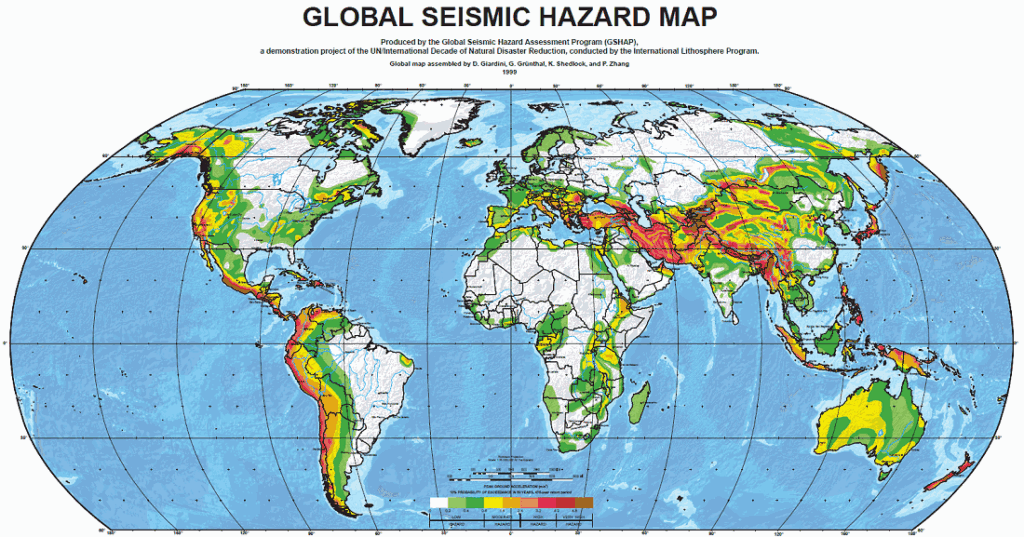
Sismic Zones Around the World
Earthquakes occur at various frequencies worldwide. With advanced tools, scientists have mapped areas where seismic activity is prevalent:
- Pacific Ring of Fire: A region known for frequent and intense earthquakes due to tectonic plate movement.
- Alaska and the Aleutian Islands: Located near major fault lines, these regions experience high levels of seismic activity.
- The Himalayan Mountains: Where Indian and Eurasian plates converge, resulting in significant tectonic stress.
Consequences of Earthquakes
Earthquake consequences can be devastating:
- Human casualties
- Structural damage to buildings and infrastructure
- Soil liquefaction, landslides, and tsunamis
Some examples of recent disasters include the 1960 Valdivia earthquake (Chile) with a magnitude of 9.5 and the 1976 Tangshan earthquake (China), which caused over 650,000 fatalities.
Tsunamis
In areas where earthquakes occur near coastlines or bodies of water, tsunamis can be triggered:
- Tsunami waves can reach heights of up to 30 meters
- Causing widespread destruction and loss of life
Examples include the Lituya Bay tsunami (Alaska) in 1958, which reached a height of 525 meters, and the 2004 Indian Ocean earthquake and tsunami.
Earthquake Activity in Italy
Italy is also prone to seismic activity:
- Approximately 24 million people live in areas with high seismic risk
- Recent notable earthquakes include those in Irpinia (1980), Umbria and Marche (1997), Molise (2002), L’Aquila (2009), Emilia (2012), and Central Italy (2016-2017)
Overall, understanding earthquake mechanisms and identifying areas with high seismic risk is crucial for mitigating the impact of natural disasters.
Understanding Earthquake Magnitude
Earthquake magnitude refers to the size of the seismic event. The most commonly used scale is the moment magnitude scale (Mw):
- Measured in units of moment (M0), which represents the amount of energy released during an earthquake
- Estimated using a combination of observations, such as ground motion data and fault slip
- Can be higher than Richter scale readings due to differences in measurement methods
Predicting Earthquakes
While scientists have made progress in understanding earthquake mechanisms, predicting exact events remains challenging:
- The 2011 Tohoku earthquake (Japan) served as a significant example of the difficulty in predicting earthquakes
- Advanced technologies, such as seismometers and GPS, are being used to improve early warning systems
Early Warning Systems
Early warning systems aim to detect seismic activity before it reaches land:
- These systems rely on advanced sensors that can detect ground motion
- Can provide a few seconds of warning time for people to take action
Earthquake-Resistant Construction
Building codes and construction techniques play a crucial role in reducing earthquake damage:
- Structural reinforcement, such as steel framing or seismic-resistant design elements
- Materials with high compressive strength, like concrete or fiber-reinforced polymers (FRP)
Preparation and Response to Earthquakes
Being prepared for earthquakes is essential:
- Create an emergency plan, including evacuation routes and a meeting point
- Secure heavy objects, such as bookshelves or televisions
- Practice earthquake drills with family members
During the response phase:
- Assess damage and provide medical aid if necessary
- Use proper communication techniques to inform the public about the situation
Frequently Asked Questions
Q: What are the most common causes of earthquakes?
A: The primary causes include magma collapse, tectonic movements, and volcanic activity.
Q: Which region experiences the highest frequency of earthquakes?
A: The Pacific Ring of Fire is known for frequent seismic activity due to tectonic plate movement.
Q: Can earthquakes be predicted?
A: While scientists have made progress in understanding earthquake mechanisms, predicting exact events remains challenging.
Q: What is the difference between a tsunami and an earthquake?
A: A tsunami is a series of ocean waves caused by an earthquake or volcanic eruption, whereas an earthquake is a sudden release of energy within the Earth’s crust.
Q: How can I prepare for earthquakes?
A: Familiarize yourself with evacuation routes, secure heavy objects, and practice emergency preparedness measures such as having a first aid kit and emergency funds.


