
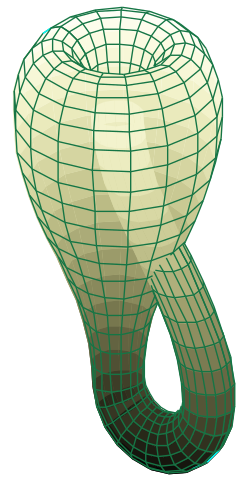
In addition to its unique topological properties, the Klein bottle has been studied extensively in various fields of mathematics and physics. Its non-orientability makes it an ideal model for understanding certain phenomena that occur in condensed matter physics.
One of the key applications of the Klein bottle is in the study of topological invariants. Topological invariants are properties of materials that cannot be changed by deformations or transformations, but can still be measured. The Klein bottle provides a unique opportunity to study these invariants in detail.
The Role of the Klein Bottle in Condensed Matter Physics
In condensed matter physics, the Klein bottle is used to model various phenomena, such as:
- Topological phases: The Klein bottle can be used to study topological phases of matter, which are characterized by non-orientable surfaces that cannot be deformed without changing their properties.
- Non-Abelian statistics: The Klein bottle has been used to demonstrate the existence of non-Abelian statistics, which describe the behavior of particles in systems where the exchange of two particles affects the overall wave function.
- Quantum field theory: The Klein bottle can be used to model certain aspects of quantum field theory, such as the behavior of fermions and bosons in topological systems.
Mathematical Tools for Studying the Klein Bottle
Several mathematical tools have been developed to study the properties of the Klein bottle:
- Parametrization: Parametrization is a technique used to represent the Klein bottle using functions from the real line to the Euclidean plane. This allows researchers to study its topological properties and behavior.
- Topological invariants: Topological invariants are mathematical objects that can be used to describe the properties of materials and systems. The Klein bottle has been shown to have several non-trivial topological invariants, which make it an ideal model for studying these phenomena.
Experimental Realizations of the Klein Bottle
While the Klein bottle is a purely theoretical construct, its properties have been experimentally verified in various systems:
- Optical fibers: Optical fibers have been used to demonstrate the existence of non-orientable surfaces and topological phases.
- Quantum computing: Quantum computers have been used to study the behavior of fermions and bosons in topological systems, including those modeled by the Klein bottle.
- Condensed matter physics: Condensed matter physicists have used the Klein bottle to model various phenomena, such as superconductivity and superfluidity.
Conclusion
The Klein bottle is a fascinating mathematical construct that has been extensively studied in various fields of mathematics and physics. Its non-orientability makes it an ideal model for understanding certain phenomena that occur in condensed matter physics. By exploring the properties and significance of the Klein bottle, researchers can gain a deeper understanding of the complexities of topology and mathematics.
FAQs
- Q: How is the Klein bottle used in condensed matter physics?
A: The Klein bottle is used to model various phenomena in condensed matter physics, such as topological phases and non-Abelian statistics. - Q: What are some of the mathematical tools used to study the Klein bottle?
A: Parametrization and topological invariants are two of the key mathematical tools used to study the properties of the Klein bottle. - Q: Can the Klein bottle be experimentally verified?
A: Yes, the properties of the Klein bottle have been experimentally verified in various systems, including optical fibers, quantum computing, and condensed matter physics.
Further Reading
For those interested in exploring the world of topology and mathematics further, here are some recommended resources:
- Topology for Dummies: A comprehensive introduction to topology.
- The Geometry of Non-orientable Surfaces: A detailed examination of non-orientable surfaces.
- The Klein Bottle: A Survey: An overview of the history and properties of the Klein bottle.


