
As a recent study by Wakefield Research commissioned by Citrix reveals, there are many ways to contribute to the environment while making office life more sustainable for employees with remote work and flexible schedules. Technologies exist to make it happen (including software for tracking attendance on mobile devices), we just need to use them.
Working with a “smart person”, attending company events that you don’t want to attend, having a manager who takes credit for others’ efforts, are all things that can make the job boring, stressful, and even counterproductive. It’s better to work from home at least one day a week, even if it means sacrificing something.
According to the study, remote work could be a virtuous practice in terms of sustainability because it reduces the need for travel, resulting in less traffic, fuel consumption, and pollution in cities. Additionally, it can help employees balance their work and family life.
The Survey Findings
The survey was conducted among over 1,000 office workers in the United States in June 2012. It reveals trends and reasons why people feel they need to take a break from the office, as well as how they would handle working from home or during vacation time.
The Bane of Office Events
Almost three-quarters of office workers detest at least one company event; 34% don’t enjoy wearing masks during these events, while 31% would rather avoid team-building activities. The most unpopular office event among men (42%) is the baby shower, where future parents-to-be celebrate their upcoming arrival. Women (31%) also dislike taking photos.
Stressors in the Office
Forming close relationships at work is not uncommon, but colleagues with difficult personalities can also be a problem. Almost half of respondents (49%) work with someone they have a hard time getting along with; 44% work with someone who is indecisive or slow. The most annoying type of colleague is one who constantly complains (51%).
Bad Managers
The worst type of manager is the one who steals others’ ideas (37%), followed by the “smart person” (33%). Ignoring employees can also be a major turn-off (27%).
Creative Escapades
Many people are getting creative in finding ways to avoid their managers. 30% have planned their vacation around their manager’s schedule to minimize interactions.
What’s Your Price?
Most people who have never worked remotely (64%) would be willing to give up something they enjoy just to work from home one day a week: lunch break (32%), alcohol (25%), or coffee (20%).
Home Office Attire
Working from home can lead to wearing casual clothes, but not always. Almost half of respondents (49%) wear jeans and a t-shirt while working from home; 25% prefer to lounge around in pajamas; 7% opt for an extreme simplicity approach by working in their underwear.
Respond or Ignore?
Imagine you’re finally on vacation, everything is perfect until that urgent work email arrives. It’s surprising that most respondents (72%) say they are more likely to respond immediately to the email instead of ignoring it.
“The results demonstrate what we already know: office life can be challenging,” said Kim DeCarlis, Vice President of Corporate Marketing at Citrix. “This survey proves that companies can benefit from greater flexibility in allowing employees to work wherever they want. By putting people in a position to balance their professional and personal lives, morale will rise and productivity will increase. Additionally, there are many tools and technologies available to allow people to work from anywhere.”
The Benefits of Remote Work
Remote work offers numerous benefits for both employees and employers. Some of the most significant advantages include:
- Increased flexibility: With remote work, employees can create their own schedules and work at times that suit them best.
- Reduced commuting time: Telecommuting eliminates the need for daily commutes, saving time, money, and reducing stress.
- Improved work-life balance: Remote workers can easily attend to personal matters, such as caring for family members or running errands.
- Increased productivity: Without office distractions, some employees find they are more productive when working from home.
- Reduced turnover rates: Offering remote work options can attract and retain top talent, reducing the costs associated with recruiting and training new employees.
The Environmental Impact of Office Life
Office life has a significant impact on the environment. Some of the most notable effects include:
- Air pollution: The production, transportation, and consumption of office supplies, furniture, and equipment contribute to air pollution.
- Water waste: Paper, ink, and other office materials require water for production, leading to wastewater generation.
- Energy consumption: Office buildings require significant amounts of energy to power lighting, heating, cooling, and technology.
- Waste generation: Offices generate a substantial amount of waste, including paper, plastic, and cardboard.
Sustainable Office Practices
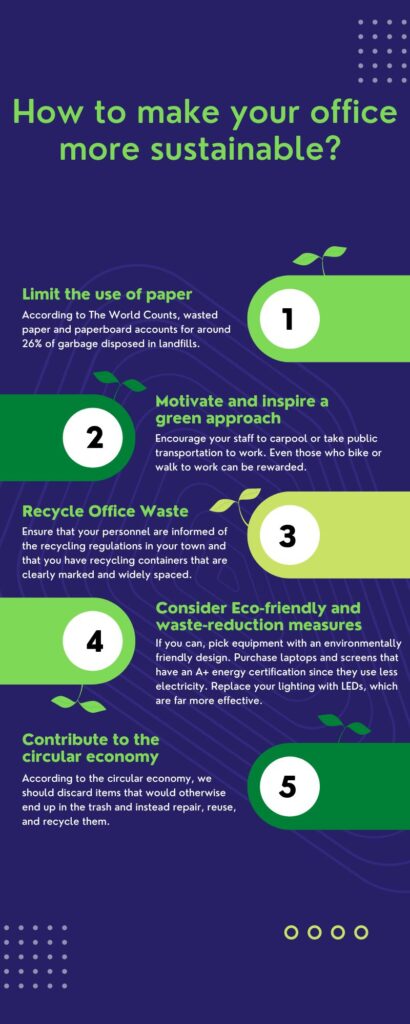
There are numerous ways to make office life more sustainable:
- Reduce paper usage: Implement digital documentation, and encourage employees to use reusable notebooks or pens.
- Use eco-friendly supplies: Opt for recycled paper, biodegradable cleaning products, and energy-efficient lighting.
- Increase energy efficiency: Install solar panels, LED bulbs, and Energy Star-rated equipment.
- Promote carpooling and public transportation: Encourage employees to use public transportation or carpool to reduce traffic congestion and air pollution.
The Future of Office Life
As technology continues to advance, the traditional office setup is becoming obsolete. The future of office life will likely involve more flexible, remote work arrangements. Employers must adapt to this changing landscape by providing tools and technologies that support employees’ needs, such as:
- Virtual collaboration platforms: Software that enables seamless communication and collaboration across different locations.
- Cloud-based productivity apps: Tools that simplify tasks, streamline workflows, and enhance employee efficiency.
- Biometric authentication: Secure login systems using facial recognition or fingerprint scanning to prevent data breaches.
By embracing these technologies and adopting sustainable office practices, employers can create a healthier, more productive work environment that benefits both employees and the planet.
Conclusion
The study’s findings highlight the need for greater flexibility in office life. By allowing employees to work from home one day a week, employers can improve morale, productivity, and job satisfaction. Additionally, remote work offers numerous environmental benefits, reducing traffic congestion, fuel consumption, and pollution. As technology advances, the future of office life will involve more flexible, remote work arrangements. Employers must adapt to this changing landscape by providing tools and technologies that support employees’ needs.
By embracing sustainable office practices and adopting innovative solutions, employers can create a healthier, more productive work environment that benefits both employees and the planet. As Kim DeCarlis from Citrix notes, “Office life can be challenging, but with the right approach, companies can benefit from greater flexibility in allowing employees to work wherever they want.”


