
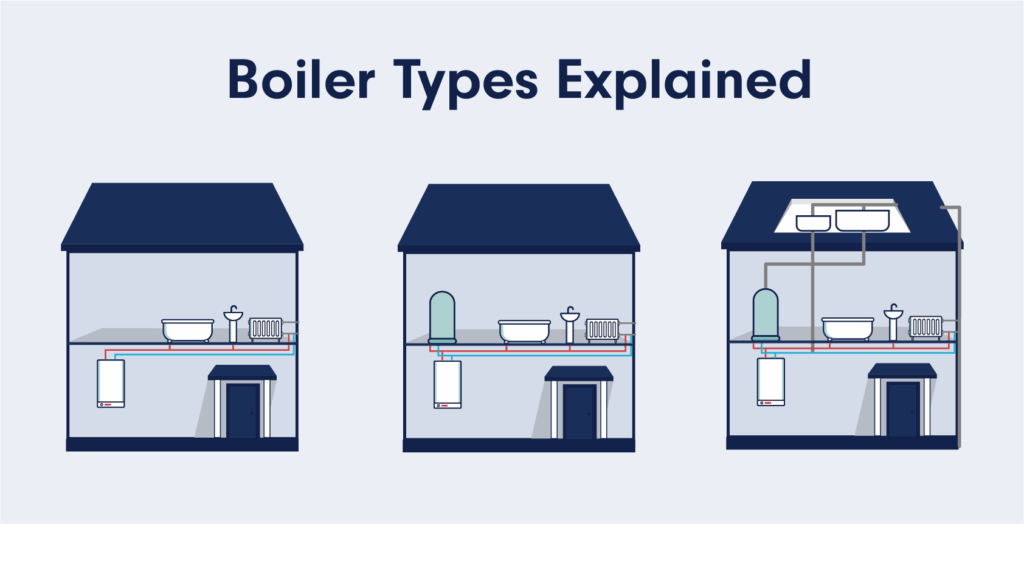
All types of boilers produce heat by burning a fuel and transferring it to the heating system through a “heat exchanger.” Despite the advent of more efficient boilers, the most common ones are traditional gasoline boilers.
Boiler Classification: Functioning Model or Fuel Type
Boilers can be classified based on their functioning model or fuel type. In this article, we will explore both categories.
Open-Burner Boilers vs. Stagnant-Burner Boilers
Boilers can be categorized into two types based on how they take in air for combustion: open-burner boilers and stagnant-burner boilers. Open-burner boilers extract air directly from the environment, while stagnant-burner boilers isolate the flame from the surroundings using a co-axial tube that also expels polluted air.
The advantage of stagnant-burner boilers is that they can be installed indoors, in bathrooms, or bedrooms. However, open-burner boilers must be located outdoors or in a well-ventilated area (such as a basement).
Advantages and Disadvantages of Each Type
Open-Burner Boilers:
- Advantages: Generally less expensive than stagnant-burner boilers
- Disadvantages: Require careful installation to ensure proper ventilation and safety
Stagnant-Burner Boilers:
- Advantages: Can be installed in any location, including indoor spaces
- Disadvantages: More expensive than open-burner boilers
Boilers for Hot Water Production
If a boiler not only heats the home but also produces hot water, it needs to be a “combined” boiler, capable of producing hot water instantly or with a storage system.
Types of Boilers Based on Fuel Type
There are several types of boilers based on fuel type:
Gas Oil Boilers
Modern gas oil boilers are well-insulated and feature metal heat exchangers. They are also quieter due to large insulation gaps that prevent deposits and noise from the flow.
Pellet Boilers
Pellet boilers have recently gained popularity, offering high thermal efficiency and models with forced exhaust ventilation can be placed in more flexible locations.
Polyfuel Boilers
Polyfuel boilers can burn a wide range of fuels: wood, grains, sawdust, pellets… The most versatile models come equipped with additional fuel injectors for gasoline.
Teleradiators (Thermal Centers)
Teleradiators are more than just a single boiler; they’re true “thermal centers” applying the heat exchanger principle. They’re economical and efficient, ideal for heating entire buildings or apartment complexes.
Wood Boilers
Wood boilers are more difficult to manage: wood storage is complex compared to pellets. Modern models have reduced maintenance needs.
Condensation Boilers
Condensation boilers (using methane or GPL) condense steam produced by combustion to recover heat before expelling it through the chimney, offering high energy efficiency.
Key Considerations When Choosing a Boiler
When selecting a boiler, several factors should be taken into account:
- Your Fuel Options: Will you be burning gasoline, wood, pellets, or another type of fuel? This will help narrow down your options.
- Your Budget: Gas oil boilers are often the most expensive option, but they can offer high efficiency and quiet operation.
- Space Availability: Consider how much space you have available for the boiler and its components.
- Maintenance Requirements: Some boilers require more maintenance than others, such as wood or pellet boilers.
Boiler Efficiency and Safety
Boiler efficiency refers to how well the unit converts fuel into heat. High-efficiency boilers can save homeowners money on their heating bills while producing less greenhouse gas emissions.
Safety should also be a top priority when choosing a boiler:
- Look for UL Certification: Ensure that your chosen boiler has been certified by Underwriters Laboratories (UL) to meet safety standards.
- Check for Compliance with Local Regulations: Familiarize yourself with local building codes and regulations regarding boiler installations.
Maintenance and Upkeep
Regular maintenance is crucial to extending the lifespan of your boiler:
- Cleanliness: Regularly clean the burner, heat exchanger, and flue to prevent debris buildup.
- Inspect for Leaks: Check for signs of leaks or damage to the boiler’s components.
- Schedule Annual Inspections: Schedule annual inspections with a qualified technician to ensure your boiler is operating safely and efficiently.
Conclusion
Choosing the right boiler can be an overwhelming task, but by considering factors such as fuel type, budget, space availability, and safety features, you can find the perfect unit for your heating needs.


