
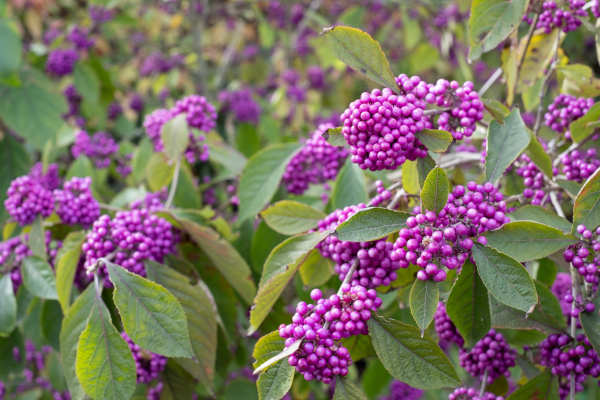
The Callicarpa is a deciduous shrub that can grow up to three meters tall and two meters wide, making it an ideal choice for adding a touch of vibrancy to your garden. Its unique coloration makes it perfect for decorating homes.
In this article, we will explore the key characteristics of the Callicarpa, how to cultivate it correctly, and answer some frequently asked questions.
Characteristics of the Callicarpa
The Callicarpa is an Asian shrub that belongs to the Verbenaceae family. It has smooth, grayish-brown bark, oval-shaped leaves, and produces purple-blue berries in autumn. The plant’s flowers bloom in spring, and it is often used as an ornamental plant due to its unique foliage.
How to Cultivate the Callicarpa
Cultivating the Callicarpa can be achieved with proper care and attention. Here are some key tips:
- Climate and Temperature: The Callicarpa can tolerate a wide range of temperatures, but it prefers full sun to partial shade. It can withstand extreme cold and heat but may require protection from harsh winds.
- Soil: It is adaptable to various soil types, but it thrives in well-draining, organic-rich soil with a pH between 6.0 and 7.0.
- Watering: Overwatering should be avoided. Water the plant only when necessary, and make sure not to overwater during hot summer months. A good rule of thumb is to water once or twice a week, depending on weather conditions.
Planting the Callicarpa
Before planting, fertilize the soil with a mature stallatico fertilizer. Then, apply a slow-release granular fertilizer every six weeks until autumn. It’s essential to choose a location that receives sufficient sunlight and has good air circulation to prevent fungal diseases.
The best time to plant is in autumn, digging a hole about 50 cm deep and covering the roots with soil. Cutting the roots can help them absorb nutrients better. Make sure to handle the roots gently to avoid damaging them.
Pruning the Callicarpa
While pruning is not necessary for the Callicarpa, it’s recommended to prune old branches (around 20-30 cm long) to promote new growth and maintain its shape. Remove any dead or damaged branches, cutting just above the branch collar with sharp pruning tools.
Pruning can also help control pests and diseases. Regular pruning will also encourage new flowers to bloom, ensuring a continuous display of vibrant purple-blue berries throughout the year.
Multiplication of the Callicarpa
There are two ways to multiply the Callicarpa:
- Sowing seeds: This is typically done in early spring when the plant has finished flowering.
- Cutting semi-leaders: Autumn is the best time for this method, as it allows the new growth to establish itself before winter.
Here’s how it works:
- Take stem cuttings about 15-20 cm long from healthy branches using sharp pruning tools.
- Dip the cut ends into a rooting hormone to stimulate root growth.
- Place the cuttings in a mix of sand and peat moss for better root development.
- Keep the soil moist but not waterlogged until roots develop (about 1-2 months).
- Once rooted, plant the new Callicarpa in well-draining soil.
Pests and Diseases
The Callicarpa is susceptible to certain diseases and pests. Here’s what you need to know:
- Fungal diseases: Regularly inspect your plants for signs of fungal infections such as leaf spot or canker.
- Aphids and scale: Keep an eye out for these pests, which can cause damage to the plant by sucking sap or secreting sticky honeydew.
- Borer insects: Regularly check for signs of infestation, such as holes in leaves or stems.
Varieties of Callicarpa
There are several species of Callicarpa. Here are some of the most common ones:
- Callicarpa bodinieri: This is one of the most popular varieties, also known as “profusion.” It’s native to China and produces beautiful purple-blue berries.
- Callicarpa americana: This species is native to North America and has a more compact growth habit.
- Callicarpa dichotoma: This variety is native to Asia and has a unique, multistemmed growth habit.
Here’s some helpful information about these varieties:
- Callicarpa bodinieri: Needs cross-pollination to produce berries. Planting two or three individuals near each other will increase the chances of successful pollination.
- Callicarpa americana: Not as widely available as Callicarpa bodinieri, but still a popular choice for its unique foliage and compact growth habit.
If you have any questions about growing Callicarpa in your garden, feel free to ask.


