
Mounting Snow Chains: A Comprehensive Guide
As the cold weather sets in, driving safely becomes a challenging task. One key rule that every driver must follow to ensure greater traction on the road surface is to mount snow chains. There are different types of snow chains, each with its own unique mounting procedure, but all can be broadly categorized into three main groups.
Types of Snow Chains
- Rounded: The easiest to mount and providing the best performance.
- Y-shaped: Considered the middle ground for snow chains.
- Scale-like: The most economical option, but also the most difficult to mount.
Despite these differences, there are new generations of snow chains that require only a few lugs and pins. One example is the mounting process shown in the video below.
Before explaining how to mount snow chains, it’s essential to remember that they should only be attached to the drive wheels, usually located at the front of the vehicle, as most cars are equipped with rear-wheel drive. However, if your car has four-wheel drive, it’s recommended to attach them to all four wheels.
Understanding Snow Chain Components
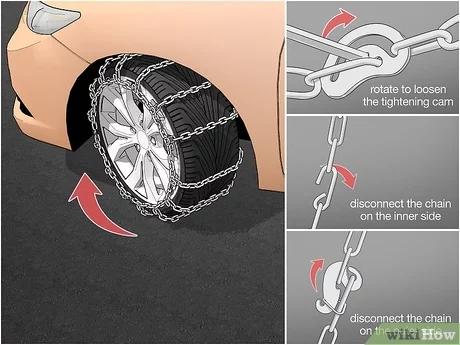
Snow chains consist of two ends: one end is fixed to the wheel hub and the other end is attached to the chain itself. To start, the cable must be passed through the wheel hub, allowing both ends to protrude outward from the tire. The ends should then be pulled towards the outside of the tire along the tread to secure them in place.
Here’s a visual representation to help illustrate this process:
When both ends are securely attached and encircle the entire circumference of the tire, it’s time to attach the external lugs. These lugs are colored to ensure that you only connect one lug from each end. After attaching all external lugs, the device that holds the chain in place must be tightened.
As a precautionary measure, it’s recommended to perform a small test drive to ensure proper mounting of the snow chains.
Key Considerations
- Maximum speed limit: 50 km/h
- Regular vehicle maintenance is crucial for optimal performance and safety when driving with snow chains.
- Always follow local regulations and guidelines for snow chain usage.
- Snow chains should be regularly inspected and maintained to ensure proper function.
Additionally, there are several key considerations to keep in mind when mounting snow chains:
- Cable length: Ensure that the cable is not too long or too short. A cable that’s too long can cause the chain to rub against the tire, while a cable that’s too short may not provide adequate traction.
- Tension: The tension on the chain should be adjusted regularly to ensure it remains properly secured.
- Chain wear: Regularly inspect the snow chains for signs of wear and tear. If damaged, replace them immediately.
Common Mistakes to Avoid
When mounting snow chains, there are several common mistakes to avoid:
- Attaching snow chains to non-drive wheels
- Failing to properly secure the chain tension
- Using snow chains that are not designed for your vehicle’s make and model
- Not checking local regulations and guidelines for snow chain usage
By following these guidelines, you can ensure a safe and effective mounting of snow chains on your vehicle.
Conclusion
Mounting snow chains can seem daunting, but with the right knowledge and preparation, it can be a straightforward process. Remember to follow all safety guidelines and best practices when attaching snow chains to your vehicle. If you’re unsure about any aspect of the mounting process or have specific questions, consult the user manual for your particular model.
Additionally, always refer to local regulations and guidelines for snow chain usage in your area, as these may vary depending on the region’s weather conditions and road surface. By taking the necessary precautions and following this comprehensive guide, you can ensure a safe and enjoyable driving experience during snowy conditions.
Here are some frequently asked questions that may help clarify any confusion:
- What is the recommended speed limit when driving with snow chains? The maximum speed limit when driving with snow chains should not exceed 50 km/h.
- Why must I attach snow chains only to the drive wheels? Snow chains are designed to work best on the drive wheels, which provides greater traction and stability on slippery roads. Attaching them to all four wheels can actually be counterproductive and decrease overall traction.
- How do I know if my snow chain is properly attached? When both ends of the snow chain encircle the entire circumference of the tire and are securely attached, you can proceed with attaching the external lugs.
- Can I drive at normal speeds while wearing snow chains? Yes, but it’s recommended to reduce your speed to 50 km/h or lower when driving with snow chains for optimal performance and safety.
- What should I do if my snow chain breaks during use? If your snow chain breaks, pull over to a safe location as soon as possible and have it repaired by a professional mechanic.
- Are there any specific requirements for mounting snow chains on certain types of vehicles? Yes, consult your vehicle’s user manual for specific instructions on how to mount snow chains properly, as different models may have unique requirements.
- How often should I check my snow chain tension? Check your snow chain tension regularly, ideally every few hours or after driving for a long distance, to ensure that it remains properly secured.
- Can I use regular tires instead of snow chains in snowy conditions? No, using regular tires instead of snow chains can lead to reduced traction and increased risk of accidents on slippery roads.
By following these guidelines and being aware of common mistakes to avoid, you can ensure a safe and effective mounting of snow chains on your vehicle.


