
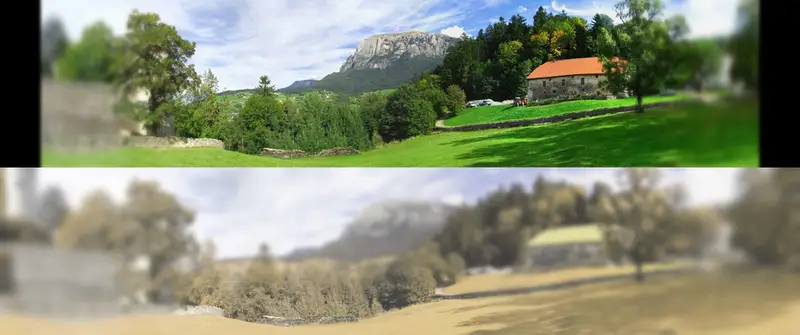
Have you ever wondered how cats see the world? Their incredible ability to detect movement and perceive their surroundings in unique ways has long fascinated humans. In this article, we’ll delve into the fascinating world of cat vision, exploring what sets them apart from us and uncovering the secrets behind their remarkable perceptions.
The Wide Angle of Vision
One of the most striking differences between human and feline vision is the width of their field of view. While humans have a relatively narrow field of view of around 180 degrees, cats can see an astonishing 200 degrees. This means that cats have a wider angle of vision than us, allowing them to detect movement from multiple directions.
Imagine being able to see everything that’s happening in your room without having to move your head. That’s exactly what it’s like for cats. Their wide-angle vision allows them to be constantly aware of their surroundings, making them expert hunters and navigators.
Night Vision: The Elliptical Pupil
But what about night vision? Contrary to popular myth, cats do indeed have superpowers in the dark. Their unique elliptical pupil shape allows them to gather more light than humans, making them up to six times more sensitive to low-light conditions. This is also due to the structure of their retina, which contains more rod cells (sensitive to low-light conditions) than cone cells (responsible for color vision).
Cats’ night vision capabilities are so impressive that they can even see in complete darkness. This is because their eyes contain a reflective layer called the tapetum lucidum, which helps to amplify any available light.
Color Vision: A Different Perspective
Cats have limited color vision compared to humans. They can see blues and violets, but not reds and greens. This is because they have a type of color vision called dichromatic vision, which is common in many animals. While this may seem limiting, it’s actually an advantage for hunting and detecting movement.
For example, cats are able to detect the movement of small prey animals like mice, which often move quickly through their surroundings. Their limited color vision allows them to focus on the movement rather than the actual colors of the object.
The Advantage of Feline Vision
So what are the benefits of feline vision? For one, their wide-angle field of view allows them to detect even the slightest movements, making them expert hunters. Their night vision capabilities also give them a significant advantage in low-light environments.
Additionally, cats’ color vision is perfectly adapted for detecting subtle changes in their surroundings. They can see the movement of objects and animals that might be invisible to humans, giving them an edge when it comes to hunting and survival.
The Human Perspective
So how do humans compare when it comes to vision? While we have excellent color vision and can see in high light conditions, our wide-angle field of view is narrower than that of cats. However, our ability to see fine details and recognize patterns makes us well-suited for tasks like reading and problem-solving.
The Anatomy of Feline Vision
To understand how cats see the world, let’s take a closer look at their anatomy. Their eyes are designed for speed and agility, with a highly developed retina that allows them to detect even slight movements. The structure of their pupil, cornea, and lens all work together to optimize their vision.
The shape of their eye is also specially adapted to allow for wide-angle vision. Their eyes are more rounded than those of humans, which gives them a wider field of view.
The Science Behind Feline Vision
Recent studies have shed new light on the science behind feline vision. Researchers have discovered that cats have a unique type of cone cell in their retina that allows them to see blues and violets more clearly than humans. This is why they appear to be able to see in low-light conditions.
Additionally, researchers have found that cats’ eyes are highly sensitive to movement, which is thought to be due to the structure of their retina. Their retinas contain more rod cells (sensitive to low light) than cone cells (responsible for color vision), making them more sensitive to movement than humans.
The Relationship Between Humans and Cats
So how do our perceptions of the world compare? While we may have excellent color vision and can see in high light conditions, cats have a unique set of abilities that make them expert hunters and navigators. By understanding their vision, we can better appreciate the complexities of the natural world.
In fact, studies have shown that humans who spend more time with cats are better able to detect movement and changes in their surroundings than those who do not. This is because our brains are wired to respond to the same stimuli as cats, making us more aware of our environment.
Frequently Asked Questions: Understanding Cat Vision
Here are some frequently asked questions about cat vision:
- Q: Can cats see ultraviolet light?
A: Yes, cats have a higher sensitivity to UV light than humans. - Q: Do cats have 20/20 vision?
A: No, while cats have excellent low-light vision, their visual acuity is not as sharp as that of humans. - Q: Can cats see in complete darkness?
A: Yes, thanks to their unique elliptical pupil shape and highly developed retina. - Q: Are all cats created equal when it comes to vision?
A: No, individual cats can have varying levels of visual acuity depending on breed and genetics.
By understanding the fascinating world of cat vision, we can gain a new appreciation for these incredible creatures. Whether you’re a seasoned cat owner or simply a nature lover, there’s no denying the allure of feline perception.
Conclusion
In conclusion, cat vision is a remarkable phenomenon that sets them apart from us in many ways. From their wide-angle field of view to their unique night vision capabilities, cats have evolved to detect movement and perceive their surroundings in unique ways. By exploring the science behind feline vision, we can gain a deeper understanding of these incredible animals and appreciate the complexities of the natural world.
What do you think? Share your thoughts on cat vision in the comments below!
Articoli correlati:
- Razze di gatti per bambini
- Malattie dei gatti
- Gatti Curiosi
Seguici anche su:
Twitter
Facebook
Google+
Pinterest


