
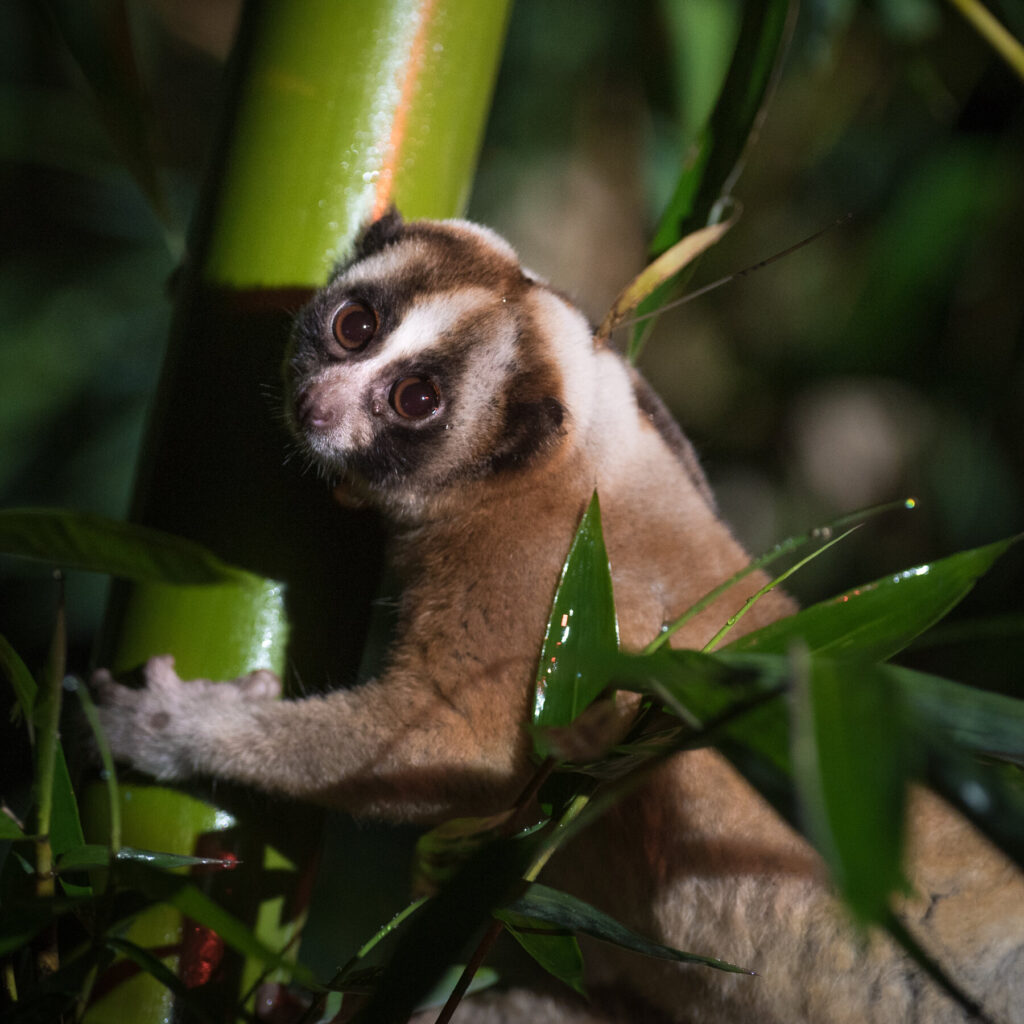
The Loris Lento: A Nighttime Primate with a Vengeful Stinger
Loris Lento is one of those classic nighttime animals that spend the day sleeping and then become hyperactive at night. This primate, known for its large eyes in the famous cartoon “Madagascar,” is indeed a beloved creature. Let’s learn more about this animal.
Native to the Sonda Islands
The full name of this primate, Loris Lento della Sonda, sounds like it could be from a classic movie title. In scientific terms, however, it’s called Nycticebus coucang. This strepsirrhine primate belongs to the family Lorisidae and is native to the islands of the Sonda. It can also be found in other areas, but only in specific zones located in the Asian continent, such as Malaysia, Thailand, Burma, and Indocina.
Three Subspecies
In all regions inhabited by this animal, there are three subspecies: Nycticebus coucang coucang, Nycticebus coucang javanicus, and Nycticebus coucang menangensis. By looking at the various regions, it’s clear that there is a trend towards accentuating the dorsal band as one moves south.
Veneering and Aggression
In general, mammals do not like to play tricks on each other with venom, but the Loris Lento is an exception because it can deliver a bite venom. The actual toxin is not produced in its mouth, but rather by glands located in the elbow crevice. This substance has anti-inflammatory properties and is only used for defense.
The mother will protect her babies from potential threats, as well as all individuals who approach them. They are also protective of themselves when threatened, using this venom to defend against predators.
Legality and Price
Considering its venomous bite and nocturnal nature, the Loris Lento is not suitable for a domestic lifestyle. The fact that it’s not legal to trade or sell these animals means that there isn’t much opportunity for people to acquire them. There is also a black market, with prices being quite high.
Physical Characteristics
In addition to its large eyes, which give it an endearing expression, the Loris Lento has short, thick fur with shades ranging from gray-brown to reddish-brown. The underside of its belly can be white and may have a graying hue. It also features black bands around the neck and on the back, as well as another band across the forehead.
The rest of the body is quite unremarkable. Its tail is almost non-existent, and the second digit on the hind legs is very small. There are also special claws on the posterior legs for grooming purposes.
Looking at its face, you primarily see its large eyes, which dominate both its front and back appearance. The nose is sharp-pointed and surrounded by dark rings that enhance its enormous size. Only tiny ears can be seen, rounded and smooth to the touch.
One Interesting Body Feature
The Loris Lento has a lot of dorsal vertebrae. This allows it to turn its upper body around compared to its lower body, which is quite helpful in various situations. Nature always has a hidden purpose!
Sensitivity to Touch
When people touch this animal and give it a gentle scratch, it raises its arms. However, if they don’t know the correct way to approach it, they might think it likes being petted but actually be startled by the sensation.
Loris Lento’s natural behavior is not always understood by humans due to this reaction. They are also nocturnal and tend to live alone, so keeping one as a pet is difficult.
Myths and Superstitions
There are many myths surrounding this animal. According to local tradition, its fur has magical powers. Some people believe that seeing Loris Lento’s large eyes always means bad luck, while others consider them lucky omens.
Loris Lento’s eyes have also been claimed to be perpetually sad. This must mean that they’re doomed to live in an endless nightmare!
Diet
This primate primarily eats insects but may occasionally consume other things like eggs, small vertebrates, and vegetation. It does not eat birds caught.
Parenting
The Loris Lento gives birth after about 6 months of gestation. All babies are born as singletons. After being weaned around the age of 8 or 9 months, they stay close to their parents until they mature at around 1.5 years old.
In captivity, these animals can live for up to 26 years due to better living conditions.
Conservation Status
The Loris Lento is listed as Vulnerable on the IUCN Red List. Its population is declining due to habitat loss and hunting for its fur. Efforts are being made to protect this species and its habitats, but more needs to be done to ensure its survival.
Interesting Facts
- The Loris Lento’s large eyes are its most distinctive feature.
- It has a very short tail and two small claws on the hind legs.
- Its fur is short and thick, with shades ranging from gray-brown to reddish-brown.
- It can live up to 26 years in captivity.
- The Loris Lento’s venom is used only for defense purposes.
Interesting Behavior
- The mother will protect her babies from potential threats, as well as all individuals who approach them.
- They are also protective of themselves when threatened, using this venom to defend against predators.
- They have a unique way of communicating with each other through vocalizations and scent markings.
Conclusion
Loris Lento is a unique primate with both fascinating and intimidating features. Their large eyes are an endearing quality, but their venomous bite makes them unsuitable for domestic life. It’s essential to respect their boundaries and natural behavior, especially when it comes to touch.
By understanding more about this animal and its habits, we can better protect it and its habitats. We should also be aware of the myths and superstitions surrounding the Loris Lento and not perpetuate them.
Frequently Asked Questions (FAQs)
- What is the scientific name of the Loris Lento?
The full scientific name for this primate is Nycticebus coucang.
- Where does the Loris Lento live?
They are native to the islands of the Sonda, but can also be found in specific zones located in the Asian continent, including Malaysia, Thailand, Burma, and Indocina.
- How many subspecies of Loris Lento exist?
There are three known subspecies: Nycticebus coucang coucang, Nycticebus coucang javanicus, and Nycticebus coucang menangensis.
- What is the venom produced by Loris Lento used for?
The venom is used only for defense purposes and has anti-inflammatory properties.
- Why are Loris Lentos unsuitable for domestic life?
Due to their nocturnal nature, aggressive behavior when threatened, and requirement for large spaces, they make poor pets.
- How long do Loris Lento live in captivity?
In ideal conditions, Loris Lento can live up to 26 years.
- What is the typical age of birth for a Loris Lento?
Loris Lento give birth after about 6 months of gestation.
- Are all babies born at the same time?
No, all babies are born as singletons.
**Written by Marta Abbà on October 8, 2018


