
Introduction
The world is facing an unprecedented level of environmental pollution, which poses significant threats to human health, ecosystems, and the planet as a whole. One of the most effective ways to address this issue is through bioremediation, a natural solution that utilizes living organisms to clean up pollutants in the environment. This article will explore the concept of environmental bioremediation with microorganisms, its applications, principles, benefits, and challenges.
What is Environmental Bioremediation?
Environmental bioremediation is a technique for managing dispersed pollutants in the environment (soil, water, air) that involves using living organisms. This process leverages the metabolic capabilities of microbes to degrade or transform pollutants into less harmful substances. The term “bioremediation” was coined in the 1970s by a team of scientists at the U.S. Department of Agriculture’s Agricultural Research Service (ARS).
How Does Environmental Bioremediation Work?
Environmental bioremediation enables the treatment of a wide range of contaminants, including petroleum, petrochemicals, solvents, and pesticides. The process typically involves introducing microorganisms into the contaminated environment, where they feed on the pollutants and convert them into less harmful substances. The efficiency of bioremediation depends on factors such as the type and concentration of pollutants, the microorganism used, and environmental conditions like temperature, pH, and oxygen levels.
What is Environmental Bioremediation?
Bioremediation is defined as any process that uses living organisms to eliminate environmental pollutants and restore a natural condition. This can involve various types of biotic agents, including bacteria, fungi, plants, and enzymes derived from living organisms. The primary goal of bioremediation is to reduce the levels of contaminants in the environment, making it safer for humans, wildlife, and ecosystems.
Examples of Environmental Bioremediation with Microorganisms
One notable example of bioremediation using microorganisms is the use of nitrates or sulfates to stimulate the growth of bacteria capable of breaking down hydrocarbons (petroleum). This technique is used to mitigate the damage caused by oil spills in water. For instance, marine bacteria like Pseudomonas putida and Alcanivorax borkumensis have been shown to degrade petroleum hydrocarbons in aquatic environments.
Phytodepuration: A Common Practice in Environmental Bioremediation
Phytodepuration is a natural process that involves using plants or other microorganisms like cyanobacteria to clean up contaminated water bodies, industrial effluents, and sewage systems. This method has gained significant attention due to its potential to remove pollutants at low costs and minimal environmental impact.
The Principle of Environmental Bioremediation with Microorganisms
The principle behind bioremediation is simple: exploit the cellular metabolism of certain living organisms to eliminate pollutants. Microorganisms have evolved specific mechanisms to degrade or transform pollutants into less harmful substances, which can be leveraged for bioremediation purposes.
Why Doesn’t Bioremediation Work for All Pollutants?
Not all microorganisms are capable of degrading every pollutant. Heavy metals like cadmium, lead, or mercury are often resistant to degradation by common microorganisms due to bioaccumulation. Bioaccumulation occurs when these metals enter the food chain and accumulate in organisms, making it harder to clean up.
Using Genetically Modified Plants to Remediate Heavy Metals
Genetically modified plants can be engineered to concentrate heavy metals in their aerial parts, which can then be recycled or incinerated at controlled temperatures. This approach has been explored for the remediation of soil and water contaminated with heavy metals like lead and cadmium.
The Potential of Genetic Engineering for Environmental Bioremediation
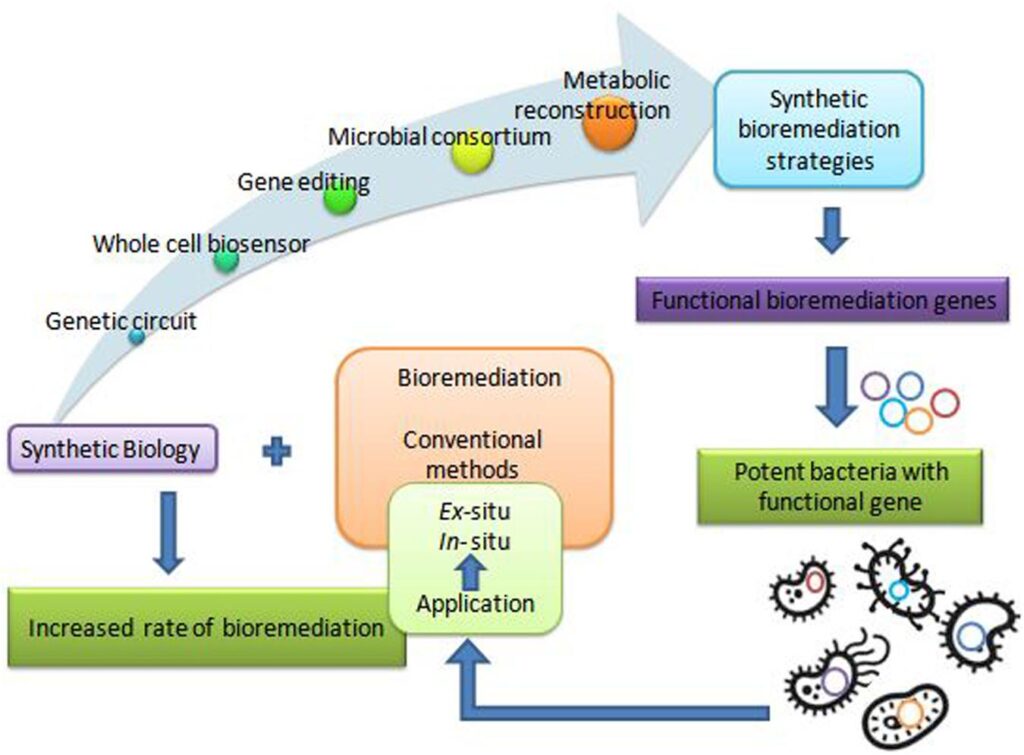
Modifying organisms using genetic engineering could make them specifically suitable for degrading certain pollutants. For example, the bacteria Deinococcus radiodurans, the most resistant to radiation, has been genetically engineered to degrade toluene and mercury ions, even radioactive ones.
Monitoring Environmental Bioremediation Processes
Bioremediation processes can be monitored in various ways depending on the microorganism used. It’s possible to track progress by measuring the redox potential (oxidation-reduction potential) in water or soil, pH levels, temperature, oxygen content, and the concentration of degradation products.
Challenges and Limitations
While environmental bioremediation using microorganisms offers many benefits, there are several challenges and limitations that need to be addressed. These include:
- Microbial diversity: The effectiveness of bioremediation depends on the diversity of microbial populations present in the contaminated environment.
- Contaminant concentration: Bioremediation may not be effective for high concentrations of pollutants, as microorganisms may not be able to degrade them efficiently.
- Environmental conditions: Environmental conditions like temperature, pH, and oxygen levels can affect the growth and activity of microorganisms, influencing bioremediation efficiency.
Conclusion
As we’ve seen, environmental bioremediation using microorganisms is a promising natural solution to pollution. While it may not work for all pollutants, it offers many benefits, including cost-effectiveness, minimal ecological impact, and potential for heavy metal remediation. Future research should focus on improving the efficiency and scalability of bioremediation processes, as well as exploring new applications for this technology.
FAQs
- What are the main types of environmental bioremediation?
Bioremediation involves using microorganisms, fungi, plants, or enzymes derived from living organisms to eliminate pollutants in the environment. - Which pollutants can be treated with environmental bioremediation?
Environmental bioremediation can treat a wide range of pollutants, including petroleum, petrochemicals, solvents, and pesticides. - How does phytodepuration work?
Phytodepuration involves using plants or other microorganisms like cyanobacteria to clean up contaminated water bodies, industrial effluents, and sewage systems. - What is the principle behind bioremediation?
The principle behind bioremediation is simple: exploit the cellular metabolism of certain living organisms to eliminate pollutants. - Why doesn’t bioremediation work for all pollutants?
Heavy metals like cadmium, lead, or mercury are often resistant to degradation by common microorganisms due to bioaccumulation. - Can genetic engineering be used to enhance bioremediation?
Yes, genetic engineering can be used to modify organisms specifically suitable for degrading certain pollutants. - How is environmental bioremediation monitored?
Bioremediation processes can be monitored by measuring the redox potential (oxidation-reduction potential) in water or soil, pH levels, temperature, oxygen content, and the concentration of degradation products. - What are the benefits of using environmental bioremediation?
Environmental bioremediation offers many benefits, including cost-effectiveness, minimal ecological impact, and potential for heavy metal remediation.
By understanding the concept of environmental bioremediation with microorganisms and its applications, we can better appreciate the potential of this technology to address pollution in various environments.


