
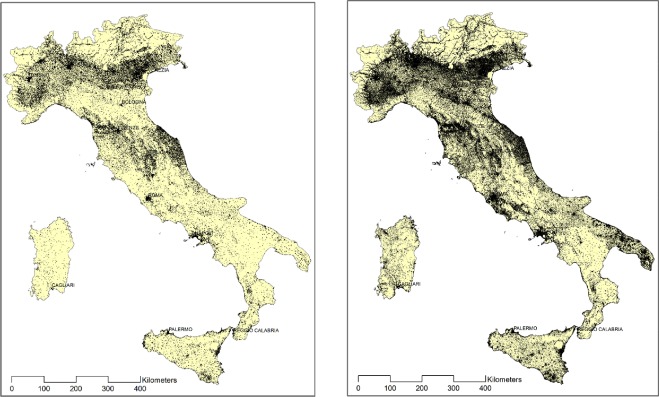
Every day, in Italy, 75 acres of land are at risk of being cementified. The alarming data is reported in a dossier compiled by the Italian Environment Fund and WWF: “Terra Rubata”, a journey into the Italy that disappears. A chilling title that brings sad truths.
The Future is Under Threat
In the next 20 years, if this trend continues, Italy’s urban area will consume around 600,000 acres of land, equivalent to 6,400 square kilometers every day. This alarming rate has been recorded in a study conducted by researchers at the University of Aquila, in collaboration with WWF Italy, Bocconi University of Milan, the Observatory for Biodiversity, the Rural Passage, and the Sustainable Project of Umbra Region.
The Study’s Findings
The 11 regions analyzed represent 44% of Italy’s soil and have experienced a 3.5-fold increase in urbanization over the past 50 years, growing by nearly 600 square kilometers until the early 2000s. The urban expansion has taken away from agriculture and the environment an amount equivalent to 33 acres per day (366.65 sqm per person with values above 300% and peaks of increment up to 1100% in some regions, equivalent to the entire Friuli-Venezia Giulia region).
The Impact of Urbanization
The increase in urban land is also noticeable in municipalities characterized by emigration. Between 1951 and 2011, such cities have grown by over 800 sqm for every resident lost. The lack of an effective planning strategy is felt. Land consumption can be linked to another terrifying phenomenon: excessive building. Since 1948, there have been 4.5 million abuses of construction, 75,000 per year and 207 per day, against three condemnations in the past 16 years (1985, 1994, and 2003).
The Consequences of Land Consumption
Land is consumed in any way, rather than rehabilitating existing buildings or restoring them. Urbanization and excessive construction are accompanied by another phenomenon: cave for extracting soil, gravel, limestone, gypsum, ornaments, and inert materials. Only in 2006 were 375 million tons of inert material extracted, and 320 million tons between soil, limestone, gypsum, and ornaments.
The Vulnerable Territory
Italy’s territory is not only vulnerable but already mutilated by these phenomena that increase the risk of desertification. Many problems are linked to land consumption, an example? In Italy, around 70% of municipalities are affected by landslides that between 1950 and 2009 caused 6,439 victims among deaths, disappearances, and injuries.
The Loss of Biodiversity
Urbanization has led to the loss of biodiversity in Italy. The country’s rich natural heritage is being destroyed at an alarming rate. In recent years, several species have been declared extinct or critically endangered due to habitat destruction and pollution.
Climate Change
Climate change is also a significant concern in Italy. Rising temperatures and changing weather patterns are affecting agriculture, water resources, and ecosystems. The country is already experiencing the effects of climate change, with more frequent heatwaves, droughts, and floods.
Sustainable Urban Planning
To avoid further mutilating our territory, Italian cities must make more courageous choices. Acting is possible, and the example of Cassinetta di Lugagnano, where its first citizen Domenico Finiguerra has led a zero-cementification campaign, revitalizing local economy, agriculture, and territory.
Innovative Solutions
Cities can implement innovative solutions to reduce land consumption and promote sustainable development. For example:
- Green Roofs: Planting vegetation on rooftops can help mitigate the urban heat island effect, reduce stormwater runoff, and increase biodiversity.
- Vertical Farming: Urban agriculture can be promoted through vertical farming, which uses hydroponics or aeroponics to grow crops in vertically stacked layers, reducing land use and increasing food production.
- Sustainable Materials: Using sustainable materials, such as recycled plastic or low-carbon concrete, can reduce the environmental impact of construction projects.
Conclusion
Italy’s fate is in the balance, with these trends threatening to destroy our beautiful land. We must take action to protect our territory and ensure a sustainable future for generations to come.
Frequently Asked Questions (FAQs)
- What is the rate of urbanization in Italy?
The urban area of Italy will consume around 600,000 acres of land every day if this trend continues. - How much land has been consumed by urbanization over the past 50 years?
Over the past 50 years, urbanization has taken away from agriculture and the environment an amount equivalent to 33 acres per day (366.65 sqm per person). - What is the impact of excessive building on Italian cities?
Excessive building has led to the loss of natural habitats, increased risk of landslides, and decreased air quality. - How many abuses of construction have there been in Italy since 1948?
Since 1948, there have been 4.5 million abuses of construction in Italy. - What is the relationship between land consumption and desertification?
Land consumption can lead to desertification by reducing vegetation cover and increasing soil erosion. - Can cities in Italy make a difference in reducing land consumption?
Yes, Italian cities can make a difference by implementing sustainable urban planning strategies and enforcing building regulations. - What is the example of Cassinetta di Lugagnano in terms of zero-cementification?
Cassinetta di Lugagnano has implemented a successful campaign to reduce cement usage, revitalizing its local economy and environment. - What can individuals do to help protect Italy’s territory from land consumption?
Individuals can support sustainable urban planning initiatives, reduce their carbon footprint, and raise awareness about the importance of preserving natural habitats.
Recommendations for Action
- Implement sustainable urban planning strategies that prioritize green spaces, public transportation, and mixed-use development.
- Enforce building regulations to prevent excessive construction and promote energy-efficient design.
- Promote alternative materials and technologies in construction projects, such as recycled plastic or low-carbon concrete.
- Encourage community engagement and education on the importance of preserving natural habitats and promoting sustainable urban planning.
- Support initiatives that promote green infrastructure, such as green roofs, vertical farming, and urban agriculture.
The Future of Italy
Italy’s future is in our hands. We must take action to protect our territory and ensure a sustainable future for generations to come. By implementing innovative solutions, promoting sustainable development, and educating ourselves and others about the importance of preserving natural habitats, we can create a brighter future for Italy and its citizens.


