
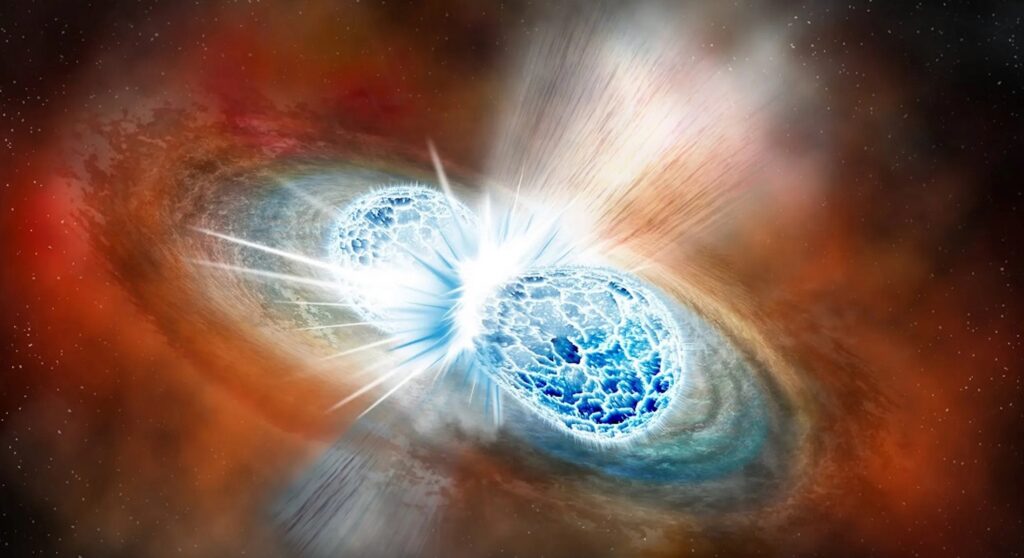
As we gaze up at the starry night sky, our imagination runs wild with thoughts of celestial bodies that defy our understanding. One such phenomenon is the neutron star, a stellar remnant born from the collapse of massive stars. These enigmatic objects have long fascinated scientists and the general public alike, sparking curiosity about their unique characteristics.
What are Neutron Stars?
Neutron stars are an unusual class of stars that arise from the evolution of massive stars with masses comparable to or exceeding that of our sun. The process of transformation involves the stripping away of outer layers, leaving behind a dense core of iron that collapses under its own gravity. This collapse leads to a phenomenon known as neutronization, where the density of neutrons increases exponentially.
Neutronization is a critical stage in the formation of neutron stars. During this process, the pressure of the collapsing star exceeds the strength of nuclear forces holding its constituent nuclei together. As a result, the electrons and protons are squeezed out of the nucleus, leaving behind an immense number of neutrons that occupy most of the star’s volume.
The density of a neutron star is so high that the electrons are pushed into the nucleus by the intense magnetic fields present in these objects. This causes the electrons to collide with each other at incredibly high energies, leading to the formation of new particles and altering the atomic structure. The resulting compact object, now consisting solely of neutrons, can rotate at incredibly high speeds and emit intense radiation.
The Collision in Neutron Stars
In ordinary atoms, electrons are separated from nuclei by significant distances, allowing for a degree of “emptiness.” In contrast, neutron stars exhibit an extreme degree of compression, resulting in electron-neutron collisions. These encounters lead to the formation of new particles and alter the atomic structure.
These electron-neutron collisions trigger a process known as nuclear reaction, which releases energy that contributes to the star’s luminosity. The nuclei of the star begin to break apart, releasing protons and electrons, and eventually forming new atoms through a series of radioactive decays.
The collision of electrons with neutrons in neutron star atmospheres also triggers a process known as magnetic reconnection. This process involves the sudden release of magnetic energy stored in the strong magnetic fields present on these objects. As the magnetic field lines reconnect, they emit high-energy particles that contribute to the radiation observed from neutron stars.
Fusion in Neutron Stars
The collision of electrons with neutrons in neutron star atmospheres triggers a process known as fusion. This fusion leads to the creation of new elements, transforming the stellar composition into one dominated by neutrons. The resulting compact object, now consisting solely of neutrons, can rotate at incredibly high speeds and emit intense radiation.
Neutron stars are thought to be the remnants of massive stars that underwent a supernova explosion. During this event, the star’s outer layers were stripped away, leaving behind a dense core of iron. As the core collapsed under its own gravity, it formed a neutron star through the process of neutronization.
Dimensions of Neutron Stars
Despite their massive size, neutron stars are remarkably small, with diameters ranging from 10 to 30 kilometers. This tiny size is due to the immense gravitational compression that occurs during the collapse process. The rotation velocity of these stars is also unusually high, reaching up to 100 times the speed of a planet rotating on its axis.
The extreme density of neutron stars is responsible for their incredible compactness. A neutron star with a mass similar to that of our sun would have a diameter of approximately 1 billion kilometers if it were not compressed to such an extent.
Temperature of Neutron Stars
Neutron star surfaces are known for their extreme temperatures, with some exceeding 10 million degrees Celsius. This unfathomable heat energy generates powerful radiation beams that can only be observed using specialized radio telescopes. These instruments detect and analyze the unique signals emitted by neutron stars.
The surface temperature of a neutron star is determined by its rotation period and its mass. The faster a neutron star spins, the hotter its surface will be. This is due to the conservation of angular momentum, which leads to an increase in rotational energy.
The Discovery of Neutron Stars
In 1967, scientists first discovered a neutron star through its emission of regular radio pulses. The detection of these pulses allowed researchers to pinpoint the source of the radiation and confirm the existence of this enigmatic object in our universe.
The discovery of neutron stars was a major milestone in astrophysics, confirming that certain types of stellar remnants exist beyond black holes. Since then, numerous observations have revealed a wide range of neutron star properties, from their masses and radii to their rotation periods and magnetic fields.
Neutron Stars and Gravitational Waves
Neutron stars possess strong gravitational fields and intense magnetic fields, which concentrate their radiation into narrow beams. When one of these beams aligns with Earth, we detect the emitted radiation as radio waves. Neutron stars also generate other forms of electromagnetic radiation, including ultraviolet light, X-rays, and gamma rays.
The detection of neutron star signals has provided valuable insights into the properties of these objects. For example, the observation of pulsar timing variations has allowed researchers to study the effects of general relativity on the gravitational field of a rotating neutron star.
Neutron Stars and Black Holes
The relationship between neutron stars and black holes is a complex one. Stellar collapse into a neutron star occurs for intermediate-mass stars (8-10 solar masses). More massive stars lead to the formation of black holes. The remnants of less massive stars are white dwarfs.
In some cases, the collapse of an intermediate-mass star may result in the formation of a neutron star with a companion black hole. These systems provide insights into the evolution of massive stellar populations and the properties of compact objects in binary systems.
Conclusion
Neutron stars continue to captivate scientists with their extraordinary properties and extreme behavior. Through ongoing research, we continue to unravel the mysteries surrounding these enigmatic objects. As new discoveries are made, our understanding of neutron stars evolves, providing valuable insights into the universe’s most fundamental processes.
The study of neutron stars offers a unique window into the universe’s early stages, providing evidence for the existence of massive stellar populations and compact objects that shape the behavior of matter in extreme environments. By continuing to explore these fascinating objects, we deepen our understanding of the cosmos and its secrets.
Additional Topics
- Magnetic Reconnection: This process involves the sudden release of magnetic energy stored in strong magnetic fields present on neutron stars.
- Neutron Star Magnetism: Neutron stars possess intense magnetic fields that are thought to be responsible for their emission of radiation beams.
- Pulsar Timing Variations: These variations have allowed researchers to study the effects of general relativity on the gravitational field of a rotating neutron star.
Future Research Directions
- The Next Generation of Neutron Star Observatories: Upcoming observatories, such as the Square Kilometre Array and the Very Large Array, will provide unprecedented capabilities for detecting and studying neutron stars.
- Neutron Star Formation Models: Researchers are working to develop more accurate models of neutron star formation, incorporating effects such as magnetic field generation and angular momentum conservation.
- The Interplay between Neutron Stars and Black Holes: Further research is needed to understand the relationship between these two compact objects, including their role in shaping binary systems and the evolution of massive stellar populations.


