
The air around us can be deadly. In London in December 1952, over 4000 people lost their lives due to respiratory complications caused by the thick fog that enveloped the city for five days straight. It wasn’t just fog – it was smog, a word that comes from the English words “smoke” and “fog,” meaning smoke and fog.
Today, similar levels of air pollution are still recorded in major cities around the world, particularly in developing countries where many people’s health is at risk. In countries that have already industrialized, air quality has improved slightly; however, optimal reductions in harmful emissions are still to be achieved.
The impact of air pollution on our health can be devastating. It’s not just a matter of feeling unwell or experiencing respiratory problems; it can lead to serious and even life-threatening conditions such as lung cancer, heart disease, and strokes. According to the World Health Organization (WHO), air pollution is responsible for over 7 million premature deaths worldwide each year.
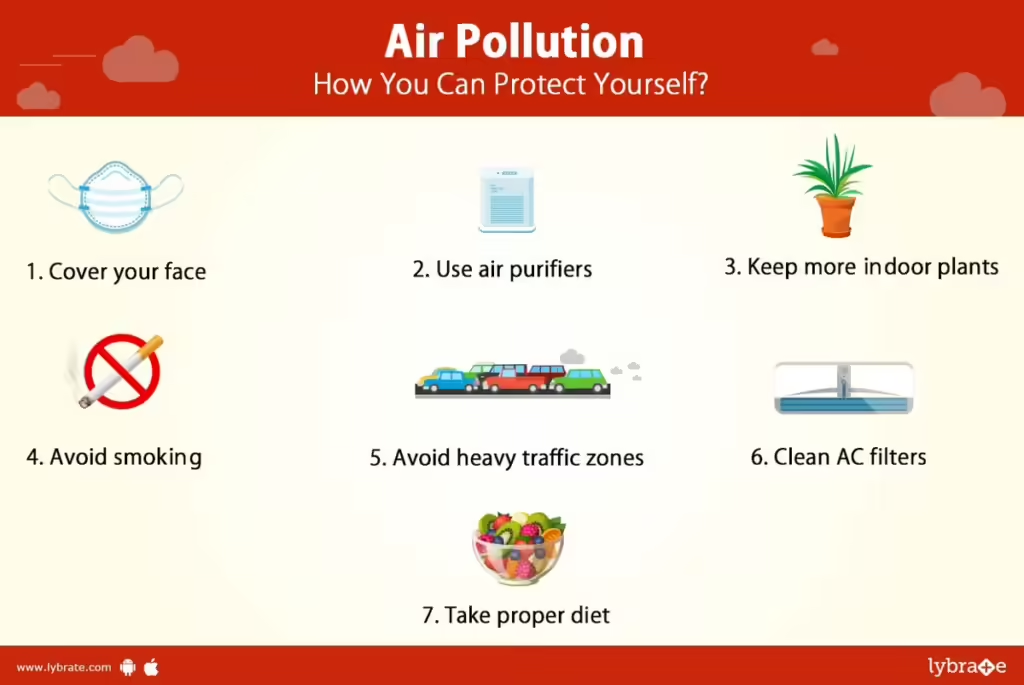
So, what can we do to contain air pollution and protect ourselves? Here are some practical tips that benefit both our health and are easy to implement:
Be Aware of Ozone (O3)
Ozone is beneficial when it’s in its right place, protecting us from UV rays in the ozone layer. However, when it’s near the ground, it becomes harmful. On a hot and sunny day, ozone levels at ground level peak between 11 am and 5 pm. It’s best to avoid outdoor activities during this time.
Air circulation is also important; doing so in the morning or evening can help reduce ozone formation. Fumes from vehicles and office equipment like photocopiers also contribute to ozone formation.
Ozone is essential when it’s in its correct location, but the issue lies in its decrease (the “hole” in the ozone layer) caused primarily by human activities. Interestingly enough, human activities harm ozone where it’s beneficial – in the air we breathe, and increase it at ground level.
The main enemies of the ozone layer are CFCs (chlorofluorocarbons) found in aerosol sprays that have been limited in many countries but not all; as well as VOCs (volatile organic compounds) found in paints, solvents, cleaning products, etc. Avoiding these substances is crucial.
Be Aware of Smog
The air in cities is polluted by sulfur dioxide, nitrogen oxide, and carbon monoxide generated from vehicle exhausts and heating systems. Add to this the particulate matter from dust and pollution.
Walking or biking through busy streets can be harmful for health; even exercise can be detrimental (why not take a run in the park instead!). Using a face mask can help alleviate smog in the traffic, but only if it’s a valid product.
Paper masks are worthless, as they fail to stop the fine particles from passing through and being breathed in with more force. If you’re considering buying an anti-smog face mask, do so responsibly by ensuring that it meets the EN 149:2001 standard (which sets guidelines for building respirators for protection against dust) and has a minimum FFP2 classification (medium efficiency).
Be Aware of Indoor Air Pollution
In addition to outdoor air pollution, there’s another side to the problem – indoor air pollution. Most at risk are homes and offices. The main pollutants in these environments come from dust particles generated by printers.
If it’s not possible to air out frequently, or if you can’t do so in an office setting (which is usually not feasible), using filters that clean the air for your printer can be helpful:
- Clean Air Filter for Laser Printers S
- Clean Air Filter for Laser Printers M
- Clean Air Filter for Laser Printers L
When it comes to indoor air pollution, there are two basic rules: change the air frequently (at the right times) and avoid pollutants in cleaning products. Using an air purifier can be incredibly helpful as demonstrated by this product online:
Air Purifier Ionizer
Published by Michele Ciceri on September 26, 2015
Reducing Ozone Formation
To reduce ozone formation, there are several steps you can take:
- Avoid using aerosol sprays: Aerosol sprays contain CFCs and VOCs that contribute to ozone formation.
- Use natural cleaning products: Choose natural cleaning products that don’t contain harsh chemicals or VOCs.
- Reduce energy consumption: Using less energy can reduce the amount of VOCs released into the air.
Reducing Smog Formation
To reduce smog formation, there are several steps you can take:
- Use alternative transportation: Consider using public transportation, cycling, or walking instead of driving.
- Maintain your vehicle: Regularly maintain your vehicle to reduce emissions.
- Reduce energy consumption: Using less energy can reduce the amount of pollutants released into the air.
Reducing Indoor Air Pollution
To reduce indoor air pollution, there are several steps you can take:
- Use a HEPA filter: HEPA filters can remove up to 99.97% of particles as small as 0.3 microns.
- Avoid using strong chemicals: Choose natural cleaning products that don’t contain harsh chemicals or VOCs.
- Ventilate your home: Open windows and doors to ventilate your home and reduce indoor air pollution.
Conclusion
Air pollution is a serious health concern that affects us all. By being aware of ozone, smog, and indoor air pollution, we can take steps to reduce our exposure and protect ourselves from the harmful effects of these pollutants. Remember, every small step counts, and making these changes can have a significant impact on our health and well-being.
Additional Tips
- Monitor air quality: Check the air quality index in your area to plan your activities accordingly.
- Avoid heavily polluted areas: If possible, avoid areas with high levels of air pollution.
- Support policies that reduce emissions: Encourage your government to implement policies that reduce emissions and improve air quality.
By taking these steps, we can work together to create a healthier environment for ourselves and future generations.


