
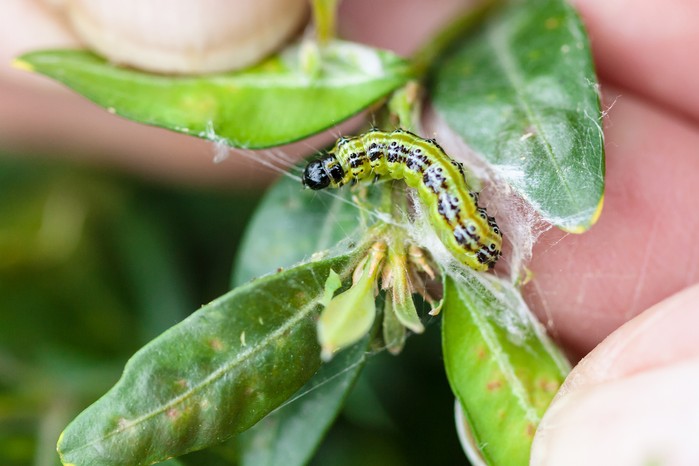
If your boxwood tree has been attacked by the boxwood caterpillar, don’t panic and above all, don’t lose hope. The damage is not irreparable, and the plant can recover on its own. However, it’s essential to act quickly because this lepidopteran that feeds on boxwood leaves (and only those) is highly resistant and won’t go away on its own.
Personally, I’ve been battling with the Cyladema perspectalis, or boxwood pierer, commonly known as the boxwood caterpillar (but there are other synonyms too), for over a year (since summer 2013). Periodically, I update my blog IdeeGreen about the progress of our battle, which has had a favorable outcome but is far from over because I’ve verified that there can be “recurrences.”
Let’s get down to business and discuss the products I used to successfully combat the infestation. As recommended by an initial consultation with a plant pathologist, I initially used a deltametrin-based product (there are several available in the market; I won’t mention their brands). I also used an nitrogen-rich fertilizer as support.
In my case, the boxwood caterpillar infestation was severe and affected an ancient, healthy tree (we’re in the province of Verbania at 900 meters above sea level) that was perfectly fine before the attack and quite extensive in terms of linear length. Given this, I sought the immediate help of a gardener after feeling panicked. After the second treatment with deltametrin, I managed to self-treat myself by purchasing it at a store and using a common sprayer, following all the instructions and precautions.
Here’s what I verified and did personally:
- A single treatment is not enough.
- At fifteen days of distance from the first intervention with the deltrametrin applied by the gardener (August 2013), the boxwood caterpillar was still present.
- I practiced a second intervention at fifteen days of distance from the first, and another at one month after that, always respecting the recommended dosages and without ever overdoing it.
- It wasn’t until this point that I noticed the tree was completely “free” (though completely defoliated in some areas).
During the infestation, I supported the boxwood with an nitrogen-rich fertilizer to help regenerate its leaves. Honestly, I don’t know if this helped restore the plant or how much; however, probably it did.
In the following months, autumn and winter, my boxwood tree showed signs of recovery. The boxwood caterpillar eats the leaves but doesn’t damage the roots and does not infect the lymphatic system. A plant can certainly die but only if it remains without leaves for too long. This is essentially a suffocation-like death.
The timeliness of treatments is crucial.
Between the end of winter and early spring 2014 (March), the boxwood caterpillar returned, and was already starting to defoliate again. Everything as before: visible boles and black-green larvae were present. The only difference was that this time I noticed it earlier.
I believe that the mild winter 2013-2014 favored the boxwood pierer, as it stands; however, I’m just stating facts because I did start treating with deltametrin again. One treatment every month until June, always with caution and protecting myself. The last treatment in June was more precautionary, and on a tree that seemed already free, but I found traces of larvae until May.
The boxwood tree has recovered well, and by the end of spring-summer 2014, it had regained its vigor even without the support of the nitrogen-rich fertilizer. In areas where the attack was more severe, there are still visible scars (I’m talking about a year later!).
In my opinion, we won the battle against the boxwood caterpillar because the tree has recovered and appears healthy again. However, it’s been a tough fight! I believe that the key to success was constant monitoring and timely intervention at the first sign of recurrence.
The watchfulness must continue because there is no doubt that the boxwood pierer can return even on trees that have already been treated previously. From what I’ve read in this summer 2014, there were significant attacks mostly in Veneto and Emilia-Romagna. The first case of infestation recorded in Italy dates back to 2011 on Lake Como, after which the most affected areas have been Lombardy and Piedmont, particularly in the regions around the lakes.
I’m not a proponent of synthetic insecticides; I actually dislike them and never use them. When I saw my boxwood tree drying up, I didn’t have any alternative for “emergency” treatment and believe that if I hadn’t used deltametrin (or cipermetrin, which is similar) the tree would have died. Now that I’ve overcome my fear and have a better understanding of the threat, I’m shifting towards natural remedies against the boxwood pierer.
I have confirmed that Bacillus Thuringiensis can be used in biological warfare against the boxwood pierer, particularly in the Kurstaki and Aizawai varieties (the latter is more effective). Bacillus thuringiensis is a spore-forming bacterium that has been known and used for years in organic farming. It can be found in specialized stores (there are various types and formulations) and applied as a foliar spray.
Bacillus Thuringiensis Aizawai 500g
For an updated and detailed understanding of Bacillus Thuringiensis, I recommend the Kindle version of Bacillus thuringiensis Biotechnology. The paper volume is available for pre-order but will be available on Amazon only from October 2014.
I also recommend the following articles:
- Boxwood Caterpillar: My Story
- Care for Boxwood Against the Boxwood Caterpillar
- Piercer of Boxwood: Attention and Prevention


