
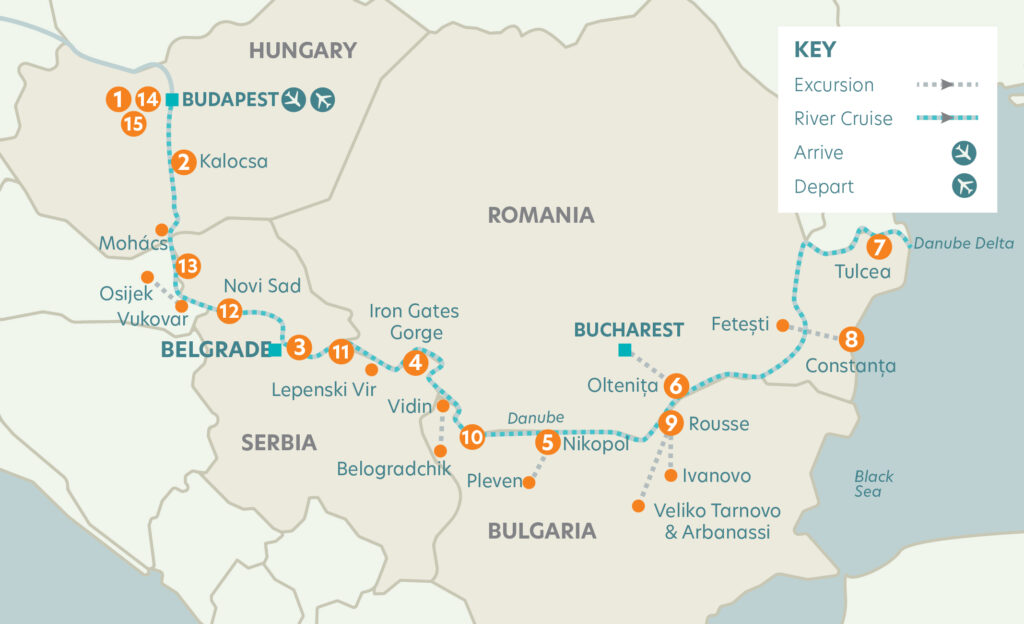
With its 2,860 kilometers, the Danube is the second-longest river in Europe, after the Volga. The Danube flows through a significant portion of central and northern Europe, covering several major European capitals.
But where does the Danube begin and which cities are important stops along its route? Let’s explore this extraordinary river together, as well as other interesting facts, tourist attractions, and more.
Content
- Where Does the Danube Begin
- Which Countries Is the Danube River In
- European Capitals Along the Danube River
- The Delta of the Danube River
- Danube Vienna
- Ecotourism Along the Danube River
- Danube Cycling Route
Where Does the Danube Begin
The Danube originates in Germany, within the Black Forest. The river is formed by the union of two small streams: the Brigach and the Breg. The name “Danube” comes from the point where these two streams meet, located in Donaueschingen. If we’re looking for the true source of the Danube’s hydrology, it’s actually the Breg stream, which originates in Furtwangen im Schwarzwald.
The region where the Danube River begins is called the Black Forest, a dense and scenic area known for its picturesque villages, rolling hills, and diverse wildlife. The climate is mild, with cold winters and warm summers. The forest is home to numerous hiking trails, castles, and traditional German architecture.
Which Countries Is the Danube River In
In addition to Germany, the Danube passes through numerous European countries: Austria, Slovakia, Hungary, Croatia, Serbia, Bulgaria, Romania, Moldova, and Ukraine. It’s indeed Europe’s most navigable river. After traversing all these countries, the Danube empties into the Black Sea, forming a vast and suggestive delta. The delta of the Danube River is one of its most important features, having been declared a UNESCO World Heritage Site.
The Danube River has played a significant role in shaping the history and culture of Europe over centuries. It was an essential trade route for merchants and travelers, connecting East and West. Many ancient civilizations along its banks have left their mark on the region, including the Romans, who used it as a major transportation route. The river continues to be a vital source of inspiration for artists, writers, and musicians.
European Capitals Along the Danube River
As we’ve seen, the Danube flows through a significant portion of central and northern Europe, passing through several major European capitals. Let’s take a look at some of these cities:
- Vienna, Austria: The Danube plays a crucial role in this city, representing one of its most iconic symbols.
- Bratislava, Slovakia: The third European capital to be touched by the Danube is Budapest. Here, the river divides the city into two distinct parts: Buda and Pest.
- Sofia, Bulgaria: After passing through Romania and Ukraine, the Danube forms a large delta before emptying into the Black Sea.
Each of these cities has its unique charm and attractions, making them must-visit destinations for anyone interested in exploring Europe’s rich history and culture. Visitors can take a boat tour along the Danube to see these cities from a different perspective or simply stroll along its banks to soak up the atmosphere.
The Delta of the Danube River
With an area of 3446 square kilometers, the Danube Delta is located between the Dobrugia in Romania and the Odessa Oblast in Ukraine. This delta is one of the best-preserved among European river deltas, thanks to its natural beauty and cultural significance. The Danube hosts over 300 species of birds, as well as 45 species of freshwater fish. It’s also a critical habitat for millions of migratory birds from around the world.
The Danube Delta has been designated as a UNESCO World Heritage Site due to its exceptional biodiversity and natural beauty. Visitors can explore the delta by boat or on foot, experiencing the unique landscapes and wildlife that call this area home.
Danube Vienna
The Danube offers numerous opportunities for tourists. Let’s consider the city of Vienna, where the Old Danube (Alte Donau) attracts attention not only from visitors but also locals, providing various recreational activities such as boat rides, cycling, and walking along its scenic paths. Every year in June, the Island on the Danube (Donauinsel) hosts a free three-day festival. The event draws around 3 million visitors.
The Donauinsel is one of Europe’s largest recreational areas, with 42 kilometers of sandy beaches, bays, and infrastructure designed for leisure activities. During peak summer months, it welcomes up to 190,000 people per day.
Visitors can also explore Vienna’s famous museums, such as the Kunsthistorisches Museum and the Natural History Museum. The city is known for its opera houses, including the iconic Wiener Staatsoper, where many famous performances take place throughout the year. Visitors can enjoy traditional Viennese coffee culture at one of the many cafes in the city center.
Ecotourism Along the Danube River
Ecotourism along the Danube River is a growing trend, offering visitors a unique opportunity to experience the natural beauty and cultural significance of this incredible river. From boat tours to hiking excursions, there are numerous ways to explore the Danube and its surroundings.
One popular ecotourism destination is the Danube Delta, where visitors can take a boat tour or kayak through the delta’s wetlands and forests. The delta is home to numerous wildlife species, including birds, fish, and other aquatic animals.
In addition to wildlife spotting, visitors can also explore the cultural heritage of the region by visiting local villages and towns along the Danube River. For example, in Bulgaria, visitors can visit the ancient city of Veliko Tarnovo, which dates back to the 4th century BCE.
Danube Cycling Route
The Danube Cycle Path is a popular cycling route that spans over 6,000 kilometers from Germany to the Black Sea. The route follows the Danube River and passes through numerous European cities, including Vienna, Bratislava, Budapest, and Sofia.
Visitors can cycle along the riverbank, taking in the stunning scenery and historical landmarks along the way. Many sections of the route are paved and suitable for families with children, making it an excellent option for cycling enthusiasts of all ages and skill levels.
The Danube Cycle Path is also a great way to experience Europe’s natural beauty and cultural heritage without having to worry about transportation or accommodation. Visitors can simply bring their bikes and follow the route, enjoying the scenery and attractions along the way.
In conclusion, the Danube River is an incredible destination that offers something for everyone. From its stunning natural beauty to its rich cultural heritage, there are numerous reasons to visit this remarkable river. Whether you’re interested in history, nature, or recreation, the Danube has something to offer.


