
Today is Polar Bears International Day, a day dedicated to polar bears and raising awareness about human activities that are putting their natural habitats at risk. To mark this occasion, we have invited two contributions from Dr. Tommaso Orusa, research fellow at Unito Green Office Energia e Cambiamenti climatici and PhD student in GEO4AGRI at the University of Turin, on permafrost and its consequences.
We have chosen to publish these articles in our book “Lessico e Nuvole: le parole del cambiamento climatico”, the second edition of a scientific guide to navigate the most urgent climate-related issues, edited by the Science Valorization and Public Engagement – Agorà Scienza – and Green Office UniToGO at the University of Turin.
The free PDF version is available on zenodo.org, while the printed version can be purchased online through the following platforms: Amazon, youcanprint.it, Mondadori (also with a teacher’s certificate and 18app), IBS, and Libreria Universitaria (also with a teacher’s certificate and 18app).
All revenue from paid versions will be used by the University of Turin to finance research and public engagement projects related to climate change and sustainability.
What is Permafrost?
Permafrost is considered a type of soil in various taxonomic systems (“Cryosol” for the USDA, “Gelisol” for the WRB). The term “permafrost,” introduced by American S. W. Muller in 1943, refers to a particular type of soil that remains frozen at various depths, forming an “horizon” (soil layer – see also the entry “Pedoclima”) or subsoil in various zones, especially at high latitudes and elevations. In other words, it’s a particular thermal condition of the soil or subsurface very common in cold climates that currently affects about 25% of the Earth’s surface.
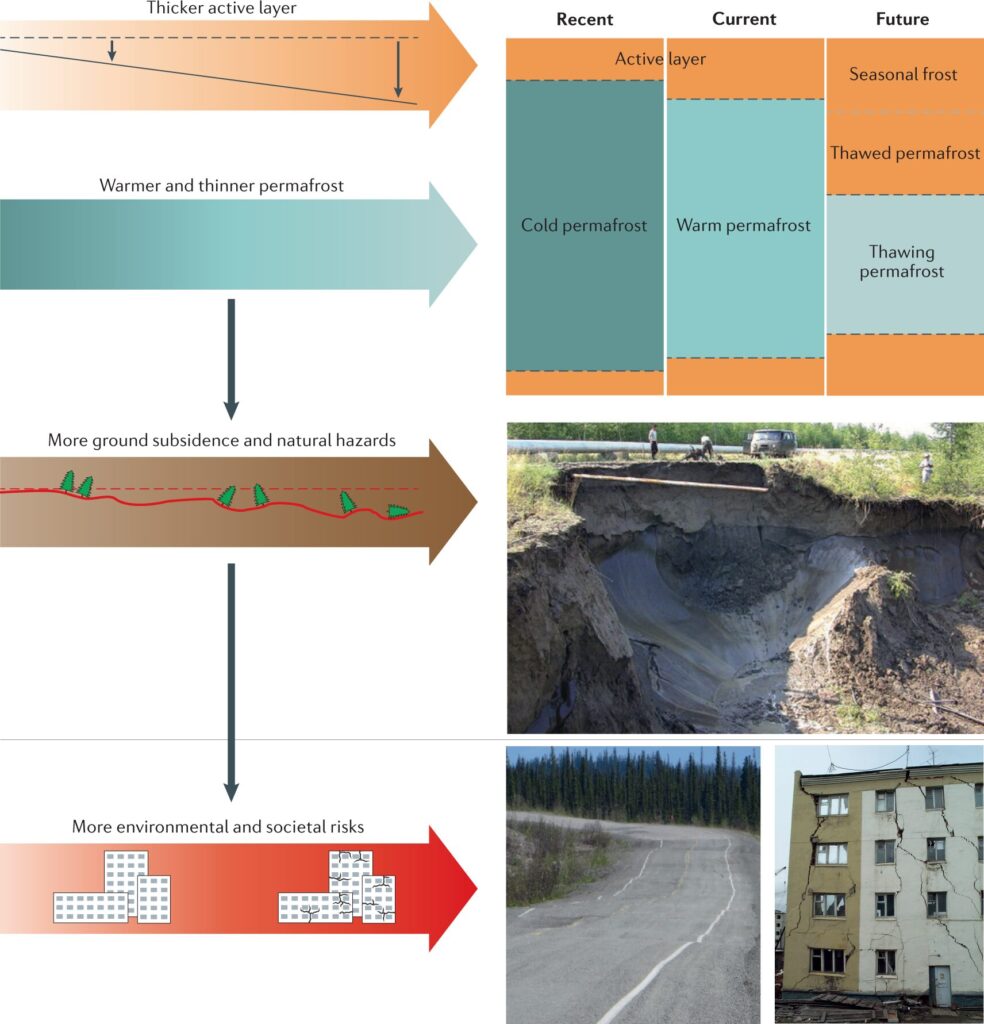
Scientifically, a frozen soil is defined as permafrost when, regardless of the substrate (soil, debris, rock, mirena, etc.), remains frozen for at least two consecutive years and has temperatures permanently below or equal to 0°C. Above the permafrost lies an active layer with varying thicknesses, generally between 30-50 cm and up to 1-3 meters. Below this active layer is the actual permafrost, which has constant temperatures below zero.
The active layer is sensitive to seasonal temperature changes, occasionally melting entirely or partially during summer and then freezing again in winter.
In ordinary situations, only in some cases does the active layer get affected by such a phenomenon; however, due to climate change even the inactive layer, i.e. the permafrost proper, can undergo this phenomenon with profound environmental and safety implications in mountainous areas.
The majority of permafrost is located in Arctic and Antarctic regions but also present in high-elevation mountain ranges like the Alps, the Himalayan chain, the Rocky Mountains, and other systems.
Permafrost’s determining factor is not air temperature, but surface soil temperature and its albedo.
Soil temperature is heavily influenced by solar irradiation as well as depth and duration of snow cover. Although permafrost is invisible to the naked eye, there are specific forms of terrain that signal its presence, such as glacial rocks (rock glaciers) widely spread across the Alps.
The World Meteorological Organization (WMO) has included temperature of the permafrost and thickness of the active layer in Essential Climate Variables (ECV), i.e. variables essential to evaluate impacts of climate change globally. Permafrost is influenced by climate, but surface topography and substrate play a crucial role in its response to climate changes.
For this reason, permafrost in mountainous regions (permafrost montane) has an elevated spatial variability that makes its study, i.e., monitoring, mapping, and modeling, extremely complex compared to high latitudes.
In alpine contexts, monitoring activities are essential since they provide direct evidence of the soil’s thermal state and implement a basic database for calibration and validation of numerical models. By itself permafrost is not a natural hazard. When however the ice contained in permafrost thaws due to climate change, the ground can destabilize causing landslides, rockfalls, reptations, debris flows or even collapses of rocks or, as happens in Siberia and Alaska, releasing methane (CH4) and other greenhouse gases trapped in subsoil gel.
The Melting of Permafrost
The degradation of permafrost occurs therefore as a direct feedback to the warming of the soil surface due to the increase in air temperature: it’s a phenomenon that has been happening significantly in recent decades in many sectors of the Arctic.
Degradation of permafrost manifests itself with an increase in the thickness of the active layer, i.e. that part of permafrost that rises above 0°C for some months of the year. This causes various effects on the surface, such as subsidence (cedimento) or formation of new lakes, called “termokarst”, in flat areas.
In mountainous regions, franes and debris flows occur, while along Arctic coastlines erosion and coastal retreat happen. Such phenomena can cause catastrophic consequences for existing infrastructure like roads, pipelines, gas pipelines or even airports. These structures are indeed prone to damage or becoming impassable due to ground instability, which is often localized and of variable extent.
Buildings, especially those constructed improperly, such as being unsupraelevated to allow airflow under their basements, and with deep foundations and plints can also suffer irreparable damages, even collapsing altogether. In Russia, Alaska, mountainous regions like the Alps, and generally areas where permafrost is present today, new construction methods requiring previously rare and expensive methodologies are currently used to ensure the safety of buildings. This forces a forced adaptation for the sake of ensuring the safety of constructed works.
The Release of Methane due to Permafrost Thawing
One of the most important problems resulting from permafrost thaw is the release of methane into the atmosphere from melted permafrost. This phenomenon occurs when the active layer increases in thickness, as mentioned earlier, causing part of this organic substance to be exposed to air (for example through evaporation of water or its withdrawal) and decomposing, releasing large quantities of methane and carbon dioxide in the atmosphere, contributing to climate change amplification and, with a reinforcing feedback mechanism, further degradation of additional permafrost, which has profound environmental implications.
In the East Siberian region, vast amounts of organic material that have not undergone decomposition are present in permafrost. The increase in the active layer’s thickness causes part of this substance to become exposed to air (for example through evaporation of water or its withdrawal) and decomposing, releasing large quantities of methane and carbon dioxide into the atmosphere.
The Loss of West Antarctic Ice Sheet
The West Antarctic Ice Sheet (WAIS), one of three regions that make up Antarctica, is another crucial area in our study. The other two are East Antarctica and the Antarctic Peninsula, with the Transantarctic mountain range dividing east from west.
Despite being smaller than its eastern counterpart, WAIS contains enough ice to raise global sea levels by about 3.3 meters. Therefore, even partial loss of this ice sheet’s mass would be sufficient to drastically change coastal lines worldwide and have significant climate and impact effects. The stability of WAIS at a long-term level is the subject of strong concern within the international scientific community because it is a calotte glaciale “a base marina”.
The term “marine ice shelf instability” (MISI) refers to a tipping point theory, where the WAIS becomes unstable and its mass loss accelerates due to internal feedback mechanisms. This theory has been discussed extensively in recent years.
WAIS stability is closely monitored as it could affect global sea levels significantly. In fact, research published on Nature has shown that the rate of ice sheet mass loss from 1992 to 2017 increased threefold from 53 billion tons per year (average during 1992-97) to 159 billion tons per year (average between 2012 and 2017).
Platform stability in WAIS is crucial. When ice meets the ocean, it forms floating ice platforms, which have an “supporting” effect, retaining glaciers on land that feed into them. However, these platforms are susceptible to melting from both above and below due to warm air and water.
Research by Shepherd et al. (2018) has demonstrated that Larsen B platform collapse in 2002 was mainly caused by extreme temperatures and unusual atmospheric masses. On the other hand, Larsen C platform is rapidly thinning and decomposing simultaneously from both top and bottom with seasonal variations depending on trends.
Since floating ice platforms are supported by water, their collapse does not directly cause sea-level rise; however, the destabilization and/or melting of WAIS could trigger a positive feedback cycle (auto-reinforcing) leading to rapid and irreversible loss of “terrestrial ice” in the ocean which would then add to global sea levels.
A Feedback Loop Mechanism
In addition to the MISI mechanism, there is also an additional feedback loop mechanism that might further put WAIS at risk. This mechanism is called Marine Ice Cliff Instability (MICI), and it involves massive glacier cliffs collapsing into the ocean due to their own weight.
While this theory is still being discussed among scientists, we are dealing with a situation where the future of the entire Antarctic ice system hangs in the balance.
In terms of reaching the critical threshold for MISI, most research has focused on the Amundsen Sea section of WAIS, which features six glaciers that converge. This area was identified as a “weak point” as early as the 1980s.
For now, the contribution of Antarctica to sea-level rise is mostly determined by loss of mass from this marine sector. For instance, the Thwaites and Pine Island ice shelves are being rapidly thinned at rates of 49 cm per year (average between 1992-2017) and numerous scientific missions and expeditions are studying and monitoring this zone.
Research has demonstrated that ice sheet destabilization in this region began as early as 2014. The Intergovernmental Panel on Climate Change’s (IPCC) SROCC report of 2019 is slightly more cautious in its conclusions, but highlights that rapid loss of mass from the WAIS could indicate the start of a MISI; however, it also notes that “data observation is not yet sufficient to determine if this change indicates an irreversible retreat”.
In articles published on Nature Climate Change, it has been shown that even long-term exposure to warming temperatures could be too low for platforms supporting ice in Antarctica to survive.
Conclusion
The permafrost is melting at a global scale. It’s essential to raise awareness about the consequences of this phenomenon and its potential impact on our planet.
To ensure we continue to live in harmony with nature, it’s crucial that we take immediate action to address climate change, mitigate greenhouse gas emissions, and protect critical ecosystems like the permafrost.
FAQs
Q: What is permafrost?
A: Permafrost is a type of soil found in high-latitude and high-elevation regions that remains frozen for at least two consecutive years.
Q: Why should we care about permafrost melting?
A: Thawing permafrost releases methane, a potent greenhouse gas, contributing to climate change amplification.
Q: What are the consequences of permafrost degradation?
A: It can lead to subsidence, landslides, and other environmental hazards in mountainous regions.
Q: Is Antarctica’s West Antarctic Ice Sheet stable?
A: No, it is vulnerable to destabilization due to its thinning ice shelves and internal feedback mechanisms.
Q: What can we do to mitigate the effects of permafrost melting?
A: We must reduce greenhouse gas emissions, protect critical ecosystems like permafrost, and adapt to the changing climate.
Q: How does permafrost affect sea levels?
A: Loss of mass from permafrost contributes to global sea-level rise.
Q: What are the potential impacts of permafrost thawing on human societies?
A: It can lead to infrastructure damage, displacement, and economic disruption in regions where permafrost is present.


