
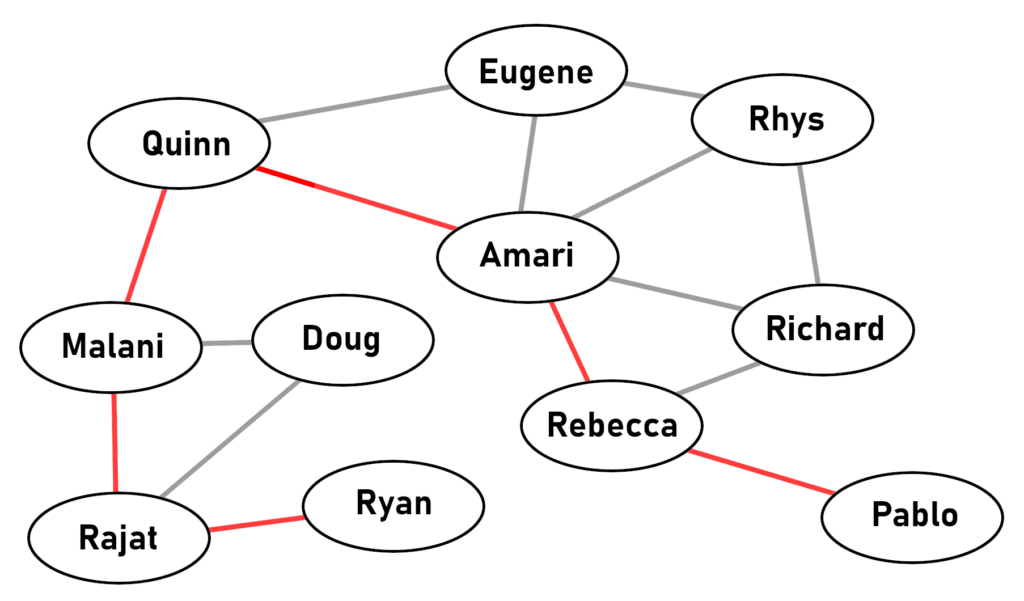
As humans, we often find ourselves wondering about our place in the world and how connected we are to others. The concept of six degrees of separation suggests that any two people on Earth can be linked through a chain of no more than five intermediate acquaintances. But what does this really mean, and is it just a myth or a mathematical certainty?
Understanding the Six Degrees of Separation: Significance
The idea of six degrees of separation highlights the interconnectedness of humanity, emphasizing that our individual social networks are not as isolated as we might think. This concept can be particularly empowering for those who feel lonely or struggle to form connections with others. By recognizing that everyone is linked through a network of relationships, we can start to break down barriers and build bridges between people.
The significance of six degrees of separation can also be seen in the way it challenges our perceptions of distance and isolation. In an increasingly globalized world, where technology has made it easier than ever to connect with others across borders, the idea that we are all just a few steps apart is both comforting and profound.
The Theory Behind the Six Degrees of Separation
Mathematically proven, the six degrees of separation theory is based on the assumption that each person knows a certain number of acquaintances. With 100 acquaintances per person, and assuming each acquaintance has the same network, we can estimate that:
- 10,000 people are connected in two steps (each with 100 connections)
- 1 million people are connected in three steps
- 7 billion people are connected in six steps
This calculation illustrates how quickly our social networks expand when we consider the relationships between acquaintances.
The theory behind the six degrees of separation is based on a concept known as “small-world networks.” This refers to the idea that many social networks, both online and offline, can be represented as a web-like structure where any two individuals are connected through a chain of intermediate nodes. In other words, if we start with one person and follow their connections, we can eventually reach any other person within six steps.
The Role of Randomness in the Six Degrees of Separation
While the theory behind the six degrees of separation is based on mathematical calculations, there is also an element of randomness involved. The way people form connections with others is inherently unpredictable, and it’s this unpredictability that makes the concept both fascinating and challenging to understand.
In order for two individuals to be connected through just five intermediate acquaintances, they must have a very high degree of overlap in their social networks. This means that even if we start with two seemingly unrelated people, there is still a chance that they are connected through an unknown chain of relationships.
The Impact of Technology on the Six Degrees of Separation
In recent years, technology has played a significant role in shaping our understanding of the six degrees of separation. With the rise of social media and online platforms, it’s easier than ever to connect with others across borders. We can now share updates, photos, and videos with friends and acquaintances from around the world, creating new opportunities for connection and collaboration.
At the same time, technology has also raised questions about the nature of our relationships in the digital age. Do we form deeper connections with people online, or do we simply maintain shallow relationships through social media? How can we balance our desire to connect with others with the need to protect our personal boundaries?
Exploring the Six Degrees of Separation in Pop Culture
The concept of six degrees of separation has been explored in various forms of popular culture, from movies and TV shows to music and literature. One of the most well-known examples is the 1993 film “Six Degrees of Separation,” which tells the story of a young man claiming to be the son of a wealthy family. The film explores themes of identity, class, and connection, highlighting the ways in which our relationships with others shape our sense of self.
In music, artists such as Taylor Swift and Justin Bieber have used the concept of six degrees of separation as inspiration for their songs. In literature, authors like Jhumpa Lahiri and Michael Chabon have explored the idea in their novels and short stories.
The Six Degrees of Separation: A Scientific Perspective
From a scientific perspective, the six degrees of separation theory has been supported by various studies on social networks and connectivity. For example, researchers have shown that people are more likely to know others who share similar interests or hobbies, while those with common friends tend to form stronger connections.
In addition, studies have also explored the role of social media in shaping our relationships and perceptions of connection. By analyzing data from platforms like Facebook and Twitter, researchers have been able to identify patterns and trends that reveal how people connect with others online.
The Six Degrees of Separation: A Philosophical Perspective
From a philosophical perspective, the concept of six degrees of separation raises important questions about the nature of human connection. If we are all linked through a web of relationships, what does this say about our individual identities and sense of self? How can we balance our desire for connection with our need to maintain personal boundaries?
In order to answer these questions, philosophers have turned to various theories and concepts, such as social contract theory and existentialism. By examining the ways in which we form connections with others, philosophers can gain insight into the human condition and the nature of our relationships.
The Six Degrees of Separation: A Personal Perspective
For many people, the concept of six degrees of separation is both fascinating and personal. Whether through social media or face-to-face interactions, we are constantly forming new connections with others. By recognizing that everyone is linked through a network of relationships, we can start to break down barriers and build bridges between people.
In order to cultivate deeper connections with others, it’s essential to be open-minded, empathetic, and willing to listen. By doing so, we can create strong bonds with others that transcend our differences and foster a sense of community and understanding.
Conclusion
The six degrees of separation is both a mathematical certainty and a deeply personal concept. Whether through technology or social media, it’s easier than ever to connect with others across borders. But what does this really mean, and how can we balance our desire for connection with our need to maintain personal boundaries?
By recognizing the interconnectedness of humanity, we can start to break down barriers and build bridges between people. Through science, philosophy, and personal experience, we can gain a deeper understanding of the six degrees of separation and its significance in shaping our relationships with others.
Additional Resources
- “Six Degrees of Separation” (1993) film
- “The Six Degrees of Separation Theory” by Stanley Milgram (1967)
- “Small-World Networks” by Duncan Watts, Steven Strogatz, and Peter Bendix (2002)
- “The Power of Small Worlds” by Duncan Watts (2003)
References
- Milgram, S. (1967). The small world problem. In Psychology Today.
- Watts, D., Strogatz, S., & Bendix, P. (2002). Small-world networks. Proceedings of the National Academy of Sciences, 99(14), 8771-8775.
- Watts, D. J. (2003). The power of small worlds. Princeton University Press.
Glossary
- Small-world network: A type of social network where any two individuals are connected through a chain of intermediate nodes.
- Six degrees of separation: The idea that any two people on Earth can be linked through a chain of no more than five intermediate acquaintances.


