
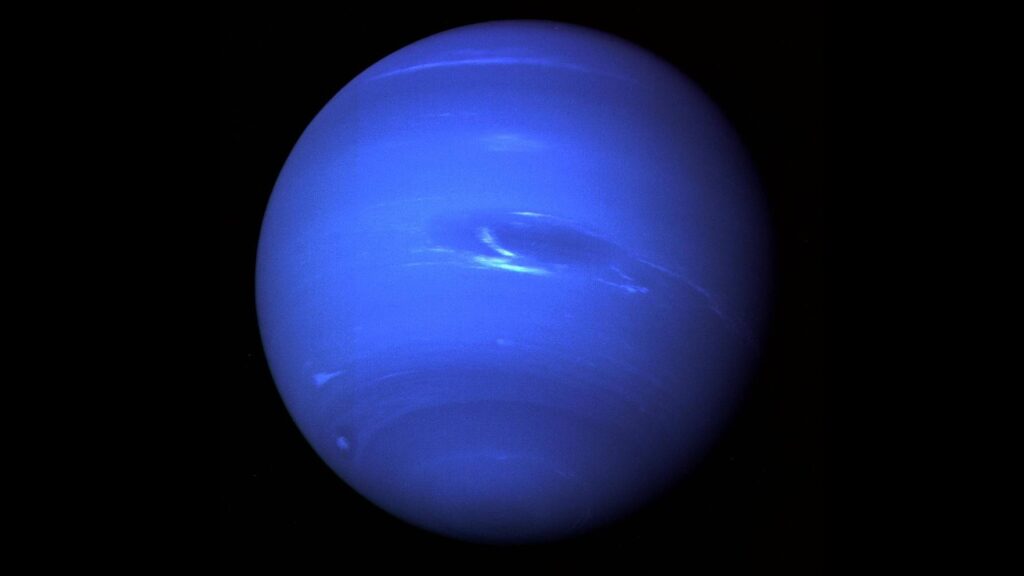
When discussing Neptune, many people think of the god of the sea, but Neptune is also the name of a planet that holds interesting characteristics. Let’s go on a journey to discover what makes this planet unique.
Characteristics of Neptune
Neptune is one of the planets that stays far away from the Sun, and to understand its orbit, we need to see how far it is from the Sun – about 30 times farther than Earth. The time it takes for Neptune to complete its orbit is around 165 years on Earth. While this means that the year on Neptune is much longer than ours, the length of a day on Neptune is just 16 hours and 7 minutes.
Like other large planets, Neptune has an intense magnetic field. Its system of rings is also similar to those found on Jupiter, Saturn, and Uranus, but unlike Saturn’s spectacular display, Neptune’s rings are less luminous and much thinner. In fact, Neptune’s ring system is one of the least prominent in our solar system.
The Rings of Neptune
When looking at Neptune through a telescope, its rings appear as small arcs on either side of the planet. Scientists have learned that these rings originated from the disintegration of smaller satellites, just like those found on Jupiter, Saturn, and Uranus. These moons are thought to be captured by Neptune’s gravity over time.
Neptune has eight moons, but most were discovered recently. Until just a few years ago, none of them had been seen before. Voyager 2’s observations in 1989 revealed four of these moons orbiting within Neptune’s rings. The largest moon, Triton, even has an atmosphere primarily composed of methane and nitrogen.
Triton is also unique because it orbits Neptune in the opposite direction to the planet’s rotation. This phenomenon is known as a retrograde orbit, and scientists believe that Triton may have formed elsewhere in the solar system before being captured by Neptune’s gravity.
Temperature on Neptune
Neptune’s temperature is extremely cold, with estimates suggesting it can drop as low as -220 degrees Celsius (-368 degrees Fahrenheit). This makes Neptune one of the coldest places in our solar system. The extreme cold is likely due to the planet’s distance from the Sun and its atmospheric composition.
The Atmosphere of Neptune
Let’s talk about the atmosphere of Triton, one of Neptune’s moons. But we’ll also explore the planet’s own atmosphere. Both Neptune and Uranus have atmospheres that are similar in structure and appearance. They’re both blue due to an abundance of methane that absorbs red light and reflects blue light.
However, Neptune’s atmosphere is poorer in hydrogen and helium compared to Jupiter and Saturn. Instead, it’s dense with clouds. These clouds are incredibly strong winds that blow at speeds of up to 2,000 km/h – the fastest in our solar system!
Looking closer at Neptune’s atmosphere reveals more interesting features. Beyond its blue color, you can see vortices similar to Jupiter’s Great Red Spot. The largest one observed is called the Great Dark Spot, which was seen by Voyager 2 in 1989 but later disappeared. Later observations with the Hubble Space Telescope revealed dark stripes on Neptune’s surface that were likely caused by shadows cast by clouds.
The Pressure at Neptune
One of the most extreme environments in our solar system can be found on Neptune. The pressure at the center of Neptune is estimated to be around 200 GPa (gigapascals), which is over 100 times more than the pressure at Earth’s core. This immense pressure is due to the planet’s massive size and density.
The Composition of Neptune
Neptune is composed mostly of hydrogen and helium, just like Jupiter and Saturn. However, its atmosphere is thought to be enriched with methane and ammonia, which creates a unique chemistry that sets it apart from other gas giants.
Discovery of Neptune
Nettuno was discovered when astronomers Adams and Le Verrier noticed that Uranus’ orbit did not perfectly follow Kepler’s laws. They proposed that there might be an unseen planet disturbing its motion, which eventually led to the discovery of Neptune in 1846 using telescopes.
The discovery of Neptune was a major milestone in astronomy, as it confirmed the predictions made by Adams and Le Verrier. The discovery also marked the beginning of a new era in space exploration, as scientists began to study the outer reaches of our solar system in more detail.
Neptune in Astrology
In astrology, Nettuno is associated with chaos and confusion but also represents artists and anything related to art. It symbolizes the power of the sea but also protects hospitals, prisons, breweries, bars, and marine life.
Nettuno is said to influence our intuition, creativity, and emotional state, making it a powerful planet for artists, writers, and musicians. However, its influence can also be associated with turmoil and upheaval, making it a challenging planet to work with in personal relationships or career choices.
Neptune’s Relationship with Uranus
Neptune and Uranus have a complex relationship that has been observed by astronomers and astrologers alike. They are both gas giants that share similar characteristics, but they also have distinct differences that set them apart.
In some cultures, Neptune is associated with the goddess of the sea, while Uranus represents the god of the sky. This dichotomy reflects the unique nature of each planet, which straddles the divide between Earth’s atmosphere and the vastness of space.
Neptune’s Connection to Pluto
The discovery of Pluto in 1930 marked a new era in astronomy, as it expanded our understanding of the outer reaches of the solar system. Neptune and Pluto have since been studied in greater detail, revealing their complex relationships with each other and the rest of the solar system.
In some astrological traditions, Pluto is seen as a representation of the collective unconscious, while Neptune represents the spiritual realm. This dichotomy reflects the unique nature of each planet, which captures the essence of different aspects of human experience.
Conclusion
Neptune is a mysterious and fascinating planet that has captured the imagination of astronomers and astrologers alike. Its unique characteristics, from its intense magnetic field to its complex atmosphere, make it one of the most interesting places in our solar system.
As we continue to study Neptune and its place in the universe, we are reminded of the vastness and complexity of our cosmic neighborhood. Whether you view Neptune as a planet of chaos or a realm of artistic expression, there’s no denying its importance in our understanding of the solar system and the mysteries that lie beyond.
In conclusion, Neptune is a true marvel of our universe, and its secrets continue to inspire us to explore the unknown and push the boundaries of human knowledge.


