
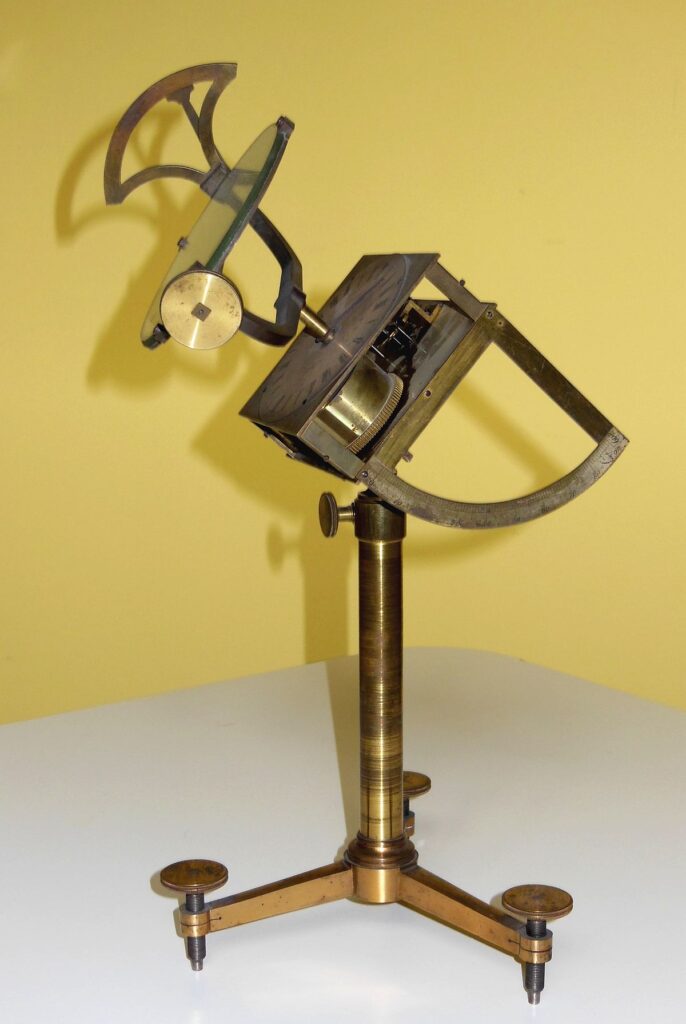
The History, Functioning, and Applications of Eliostatos
Have you ever played as a child with mirrors or other reflective surfaces to direct the sun’s rays into someone’s eyes? Well, in those cases, you were already using the principle behind an eliostato.
According to Wikipedia, the first mention of an eliostato dates back to 1742 in a work by the Dutch physicist Willem’s Gravesande. However, the invention of the eliostato has its roots much deeper, dating back around a century and originating from Italy. The device was invented by Giovanni Alfonso Borelli, a mathematician and astronomer born in Naples in January 1608.
An eliostato is essentially made up of a mirror that rotates on an axis parallel to the Earth’s axis with a speed equal to half the apparent speed of the sun; the rotational motion occurs through mechanical movement. The rotating mirror has the goal of directing sunlight, not being fixed rigidly to the rotation axis but connected in a way that allows it to “intercept” the light beam to project.
The various eliostato models differ mainly by their connection system (between the mirror and the axis) or by the shape of the mirror. Given its function, we can say that the eliostato is the oldest type of solar chaser.
How is an Eliostato Used?
An eliostato is used in several sectors:
- Physics: it’s very useful for physics solars, as not every location allows us to mount instruments such as telescopes. The eliostato is essential part of telescopic towers, where the image of the star must always be observed through the eliostato.
- Renewable Energy: in photovoltaic plants, it’s used as a solar tracker. In thermal-solar power plants, the mirrors continue to reflect sunlight onto a collector, making them essentially “fields” of eliostatos (eliostatic fields).
- Bioedilicia (Sustainable Architecture): when applied to buildings with a bioclimatic architecture, eliostats can be used to reflect the intensity of light on the north-facing facade of the house. This helps to warm up the house in winter and makes it an ambitious model for passive houses.
- Solar Cooking: smaller projects use the principle of eliostatos to create mobile solar cooking systems: like the Lapin Kulta Solar Kitchen, which uses the sun as a natural heat source.
In residential areas, an eliostato can be used to increase the power of a domestic photovoltaic system for electricity production or as a thermosolar panel for hot water production and heating the home.
Control Systems
Considering the complexity of these projects (fields of eliostatics, towers solars, solar ovens…), most eliostats are not controlled by mechanical movements alone or even by clockwork mechanisms. They’re now typically controlled by sensors or software specifically developed for them. Usually, all the mirrors composing an eliostatic field in a central thermal-solar power plant are managed by a single computer.
The surface of the mirror must be selected according to its intended use: it’s usually metallic (silver) or even a common mirror when you just want to use the eliostato as a source of intense light.
Looking at this photo, the ambitious Californian project “Solar Two” is an example of a field solars where every eliostatic mirror reflects sunlight onto the receiver positioned on the tower.
Advanced Applications
In recent years, researchers have explored new ways to improve the efficiency and effectiveness of eliostats. One such application involves using advanced materials and technologies to create more efficient solar concentrators.
For instance, scientists have developed new types of mirrors that can reflect a wider range of wavelengths, including infrared light, which is otherwise absorbed by traditional mirrors. This allows for more effective energy production in various applications, such as heating and cooling systems.
Another area of research involves the development of smart eliostats that can adjust their angle and orientation in response to changes in sunlight intensity or cloud cover. These smart eliostats use advanced sensors and algorithms to optimize energy production, reducing waste and improving overall efficiency.
Challenges and Limitations
Despite its many advantages and applications, the eliostato is not without its challenges and limitations. One of the main drawbacks is the complexity of the system itself, which requires careful design and engineering to ensure optimal performance.
Additionally, the cost of constructing and maintaining eliostatic fields can be prohibitively high, making them less competitive with other forms of renewable energy.
Furthermore, the environmental impact of large-scale eliostatic installations must also be taken into account. While they offer a clean source of energy, their operation requires significant resources and infrastructure, which can lead to unintended consequences such as habitat disruption or water pollution.
Conclusion
If you enjoyed this article, feel free to follow me on Twitter, add me to your Facebook groups or join my Google+ circles – there are countless ways to explore social media!
You may also find interesting other articles:
- Gyroscopes: function
- Published by Anna De Simone on December 6, 2014
In conclusion, the eliostato is a fascinating device that has been used for centuries to harness the power of sunlight. Its applications are diverse and far-reaching, from renewable energy production to sustainable architecture and solar cooking.
While it may not be without its challenges and limitations, the eliostato remains an important tool in our quest for clean and efficient energy. By continuing to develop new technologies and materials, we can unlock even greater potential for this ancient device and create a more sustainable future for all.


