
Introduction to the Earth’s Crust
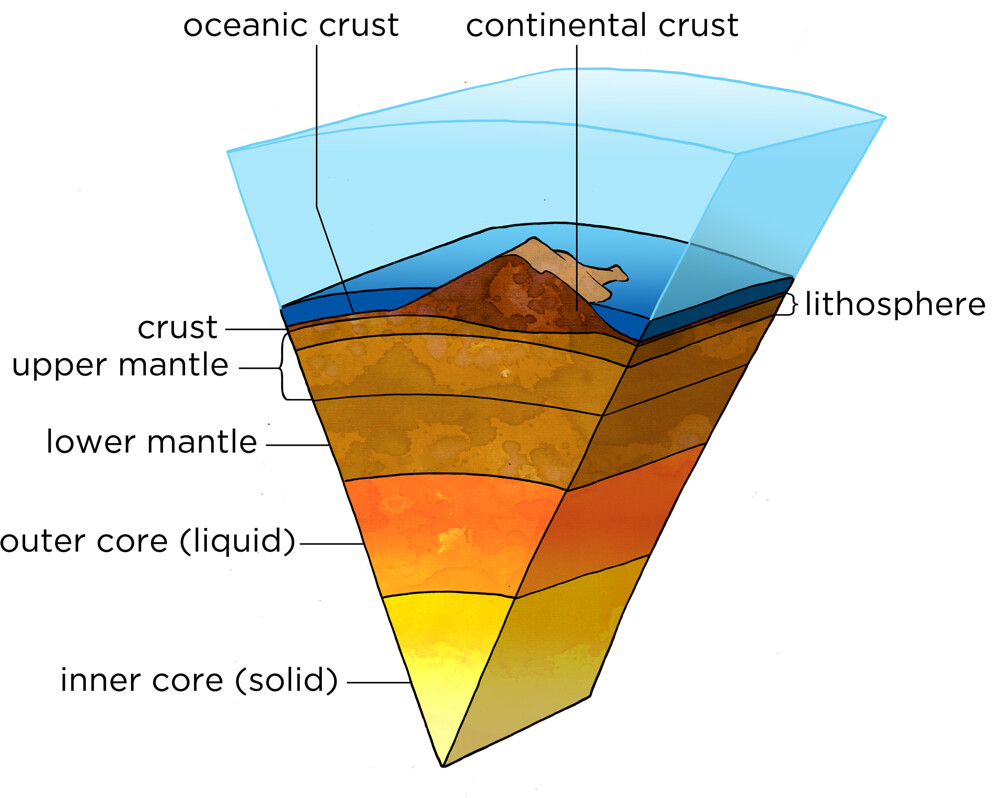
Imagine a vast, solid layer that covers our entire planet. This is the Earth’s crust, also known as the lithosphere. It’s the outermost shell of our planet, made up of various rock layers that have been shaped by geological processes over millions of years.
In this article, we’ll delve into the composition and structure of the Earth’s crust, exploring its different types, layers, and minerals. We’ll also discuss how plate tectonics shape the crust, interact with the atmosphere and hydrosphere, and explore the significance of the discontinuity of Mohorovičić.
The Earth’s Crust: A Brief History
The Earth’s crust is not static; it’s constantly changing due to plate tectonics. The process of continental drift, where continents move relative to each other, has shaped our planet over billions of years. This movement has created mountain ranges, ocean basins, and even altered the climate.
For example, the breakup of the supercontinent Pangaea led to the formation of new oceans, such as the Atlantic and Indian Oceans, which continue to shape global weather patterns today. Similarly, the closure of the Tethys Ocean between Africa and Eurasia has resulted in the formation of the Himalayan mountain range.
What is the Earth’s Crust?
The Earth’s crust is composed of several layers, with the surface being the outermost layer. It’s estimated to be around 70 km thick in continental regions and only 4 km thick in oceanic regions. The crust is divided into two main types: continental and oceanic.
Continental Crust vs. Oceanic Crust
The difference between continental and oceanic crusts lies in their composition and thickness. Continental crust is thicker, composed of rocks rich in silica and aluminum, such as granite. In contrast, oceanic crust is thinner, primarily made up of basaltic rock.
Oceanic crust is also denser than continental crust, which is why it sinks to the bottom of oceans and can be found on the floor of the deepest trenches, such as the Mariana Trench. This denser composition makes oceanic crust more prone to deformation and breakage over time.
SIAL: The Sigla for the Earth’s Crust
In geology, a sigla (or abbreviation) is used to refer to the Earth’s crust: SIAL. This stands for Silicon-Aluminum-Lithium, representing the main minerals present in the crust’s outer layer. While not exclusively used to describe the crust, this sigla highlights its composition and structure.
SIAL is an important concept in geology because it helps us understand how the Earth’s crust has evolved over time. By analyzing the distribution of SIAL across different regions, scientists can infer information about past geological events, such as mountain building and sea-floor spreading.
The Earth’s Crust Layers
Beneath the crust lies the mantle, a vast layer of hot, viscous rock that stretches from 2890 km to 6371 km below the surface. The next layer is the mesosphere, followed by the asthenosphere. These layers interact with the crust through plate tectonics and volcanic activity.
The mantle is composed primarily of olivine, pyroxene, and garnet minerals, which are rich in magnesium, iron, and calcium. The asthenosphere is a region within the upper mantle where the rocks are partially molten, allowing them to flow over long periods of time.
Atmosphere and Hydrosphere
Above the Earth’s crust lies the atmosphere, composed of gases such as nitrogen and oxygen. In oceanic regions, the hydrosphere extends beyond the water column, encompassing the surrounding rock and minerals.
The atmosphere interacts with the crust through processes like weathering and erosion, which break down rocks into sediments that can be carried away by wind or water. The hydrosphere also plays a crucial role in shaping the Earth’s surface, as water flows and erodes the crust over time.
The Discontinuity of Mohorovičić
A notable feature of the Earth’s crust is the discontinuity of Mohorovičić (Moho), a boundary between the crust and the mantle. This zone marks a significant change in seismic activity, with rocks containing feldspar changing to those without.
The Moho is estimated to be around 30-40 km thick, depending on the region. It’s an important geological feature because it helps scientists understand how the Earth’s crust has interacted with its interior over time.
Minerals and Composition
The crust contains various minerals, including oxides, clays, and silicates. The most abundant mineral is silica (SiO2), which forms quartz crystals. Other common minerals include aluminum oxide (Al2O3) and iron oxide (FeO).
Silica is an important component of the Earth’s crust because it helps to form rocks like granite, sandstone, and quartzite. These rocks are found in many different environments, from mountains to deserts.
Types of Rocks
There are three main types of rocks that make up the Earth’s crust: igneous, sedimentary, and metamorphic. Igneous rocks are formed through volcanic activity or the cooling and solidification of magma. Sedimentary rocks are created through the accumulation and compression of sediments over time. Metamorphic rocks are formed through the transformation of existing rocks under high pressure and temperature.
Igneous Rocks
Igneous rocks are composed primarily of minerals like quartz, feldspar, and mica. They can form in a variety of environments, including volcanoes, hot springs, and magma chambers.
Some common examples of igneous rocks include granite, basalt, and obsidian. Granite is a type of rock that’s rich in silica and aluminum, making it one of the most common rocks on Earth.
Sedimentary Rocks
Sedimentary rocks are formed through the accumulation and compression of sediments over time. These sediments can come from a variety of sources, including erosion, weathering, and ocean currents.
Some common examples of sedimentary rocks include sandstone, shale, and limestone. Sandstone is a type of rock that’s composed primarily of quartz and feldspar grains, which are cemented together by calcium carbonate.
Metamorphic Rocks
Metamorphic rocks are formed through the transformation of existing rocks under high pressure and temperature. This process can occur due to tectonic forces, mountain building, or volcanic activity.
Some common examples of metamorphic rocks include marble, slate, and gneiss. Marble is a type of rock that’s composed primarily of calcite, which forms when limestone is subjected to high pressure and temperature over time.
Conclusion
In conclusion, the Earth’s crust is a complex, dynamic layer that has been shaped by geological processes over billions of years. Understanding its structure, composition, and layers can help us better appreciate the planet we inhabit.
From the formation of oceanic crust to the movement of tectonic plates, the Earth’s crust is an intricate system that interacts with other components of the planet in complex ways. By studying the Earth’s crust, scientists can gain insights into the planet’s history, including its evolution over time and the processes that shape its surface.
FAQs
- What is the Earth’s crust?
The Earth’s crust is the outermost solid layer of our planet, composed of various rock layers. - How thick is the continental crust?
The continental crust is estimated to be around 70 km thick in most regions. - What minerals are present in the Earth’s crust?
The most abundant mineral in the Earth’s crust is silica (SiO2), followed by aluminum oxide (Al2O3) and iron oxide (FeO). - How do plate tectonics shape the Earth’s crust?
Plate tectonics leads to continental drift, mountain building, and ocean basin formation. - What is the significance of the discontinuity of Mohorovičić?
This boundary marks a significant change in seismic activity between the crust and mantle layers. - Can you describe the composition of oceanic crust?
Oceanic crust is primarily made up of basaltic rock, with minerals such as olivine and pyroxene. - How does the Earth’s crust interact with the atmosphere and hydrosphere?
The crust influences atmospheric gases and the surrounding rock and minerals that form part of the hydrosphere. - What is the role of SIAL in geology?
SIAL (Silicon-Aluminum-Lithium) represents the main minerals present in the Earth’s crust’s outer layer.
Follow me for more articles on geology, climate change, and science!
Twitter: @geologygeek
Facebook: @EarthScience
Google+: @GeologicalExplorations
Instagram: @GeoLover


