Introduction
Artificial neural networks have become the driving force behind a rapid evolution and technological advancement that can truly change our lives in various fields. From medicine to economics, culture, and social aspects, these networks are increasingly becoming an integral part of our daily lives. In this article, we will delve into the basics of artificial neural networks, their historical context, applications, limitations, and future prospects.
The History of Artificial Neural Networks
The concept of artificial neural networks dates back to 1943 when two scientists, McCulloch and Pitts, proposed a rudimentary neuron model. This idea was further developed over the years, leading to significant advancements in understanding how these networks can process information. Today, artificial neural networks are a fundamental component of many intelligent systems, including those used in computer vision, natural language processing, and speech recognition.
In 1949, Warren McCulloch and Walter Pitts proposed a mathematical model for artificial neurons, which laid the foundation for modern neural networks. The concept gained significant attention in the 1960s with the development of multi-layer perceptrons (MLPs), which are still widely used today. However, it wasn’t until the 1980s that the backpropagation algorithm was introduced, enabling the training of large-scale neural networks.
Artificial Neural Networks and Intelligence
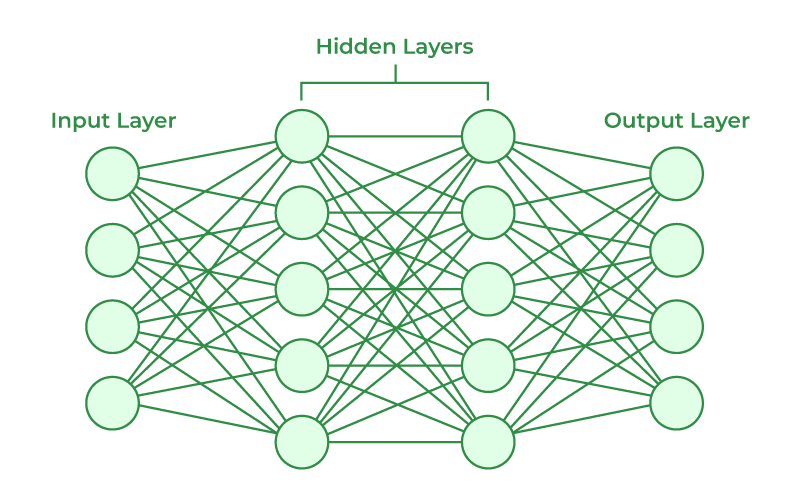
Artificial neural networks are based on the same principles as biological neurons, which make up our brain. They consist of interconnected nodes that process inputs, transmit signals, and adapt to changing environments. This concept is similar to how our own brains function, with artificial neural networks mimicking this process in a more complex and sophisticated manner.
A typical artificial neural network consists of three main components:
- Artificial neurons: These are the basic building blocks of the network, responsible for processing inputs and transmitting signals.
- Synapses: These are the connections between artificial neurons that allow them to communicate with each other.
- Activation functions: These determine how the artificial neuron responds to the input it receives.
The Benefits of Artificial Neural Networks
Artificial neural networks have numerous advantages, including:
- Rapid Data Processing: They can quickly process large amounts of data without experiencing degradation.
- Robustness to Noise: They are less affected by noisy or incomplete input data.
- Adaptability: They can learn from experiences and adapt to changing environments.
Artificial neural networks also have several applications in various fields, including:
- Data Mining: Identifying patterns in large datasets to make predictions or recommendations.
- Optimization: Solving complex optimization problems, such as finding the shortest path between two points.
- Predictive Modeling: Building models that can predict future events or outcomes based on historical data.
Applications of Artificial Neural Networks
Artificial neural networks have a wide range of applications in various industries, including:
- Finance: Predicting stock prices, detecting fraud, and optimizing investment portfolios.
- Healthcare: Diagnosing diseases, predicting patient outcomes, and developing personalized treatment plans.
- Education: Personalized learning systems that adjust to individual students’ needs.
Limitations of Artificial Neural Networks
While artificial neural networks have made significant progress in recent years, they also have some limitations:
- Lack of Transparency: Their internal workings are not always easily understandable.
- Vulnerability to Adversarial Attacks: They can be manipulated by malicious inputs.
Real-World Applications of Artificial Neural Networks
Artificial neural networks are increasingly being used in various industries, including finance, healthcare, and education. For example:
- Financial Analysis: Using neural networks to predict stock prices or identify trends.
- Medical Diagnosis: Building models that can diagnose diseases based on medical images or patient data.
- Personalized Learning: Creating adaptive learning systems that adjust to individual students’ needs.
Future Prospects of Artificial Neural Networks
The future prospects of artificial neural networks are vast and exciting. As we continue to push the boundaries of what these networks can do, we may uncover even more innovative ways to use them in the future.
One potential area of research is the development of more efficient algorithms for training large-scale neural networks. Currently, many of these networks require significant computational resources and time to train.
Another area of research is the development of more interpretable artificial neural networks. This could involve developing new activation functions or regularization techniques that make it easier to understand how the network has learned from the data.
Conclusion
Artificial neural networks have the potential to revolutionize various aspects of our lives. While they are not yet perfect, their benefits and applications make them an exciting area of research and development. As we continue to push the boundaries of what these networks can do, we may uncover even more innovative ways to use them in the future.
FAQs
-
What is artificial neural networks?
- Artificial neural networks are computer systems inspired by the structure and function of biological neurons.
-
How were artificial neural networks developed?
-
The concept of artificial neural networks dates back to 1943, with significant advancements in understanding how they process information over the years.
-
What are some applications of artificial neural networks?
-
Artificial neural networks have a wide range of applications, including data mining, optimization, predictive modeling, and more.
-
What are some limitations of artificial neural networks?
-
While artificial neural networks have made significant progress, they also have some limitations, such as lack of transparency and vulnerability to adversarial attacks.
-
Can artificial neural networks replace human intelligence?
-
No, artificial neural networks are designed to augment human intelligence, not replace it.
-
How can I learn more about artificial neural networks?
-
There are many resources available online, including books, articles, and courses, that can help you learn more about artificial neural networks.
Getting Started with Artificial Neural Networks
If you’re interested in learning more about artificial neural networks, here are some steps you can take:
- Take an online course: There are many online courses available that cover the basics of artificial neural networks.
- Read books and articles: Reading books and articles on artificial neural networks can help you gain a deeper understanding of the subject.
- Practice with code: Practicing with code is one of the best ways to learn about artificial neural networks.
- Join online communities: Joining online communities, such as Reddit or Stack Overflow, can help you connect with other people who are interested in artificial neural networks.
By following these steps and staying up-to-date with the latest developments in the field, you can gain a deeper understanding of artificial neural networks and how they can be used to solve real-world problems.