
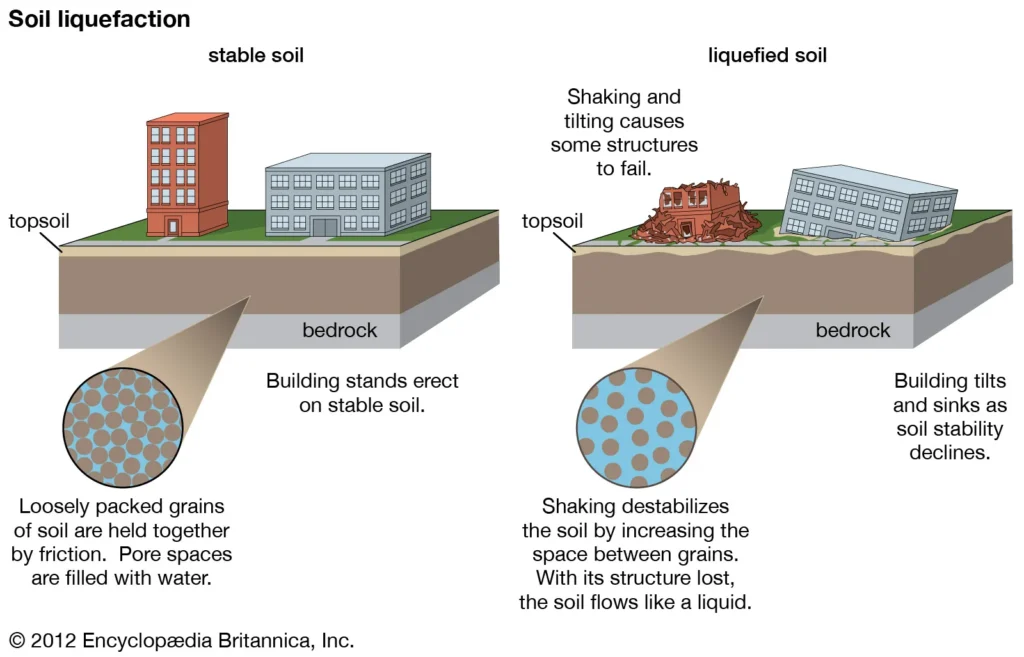
Liquefaction is a complex geological phenomenon that can have devastating effects on the environment and human infrastructure. In this article, we will delve into the world of liquefaction, exploring its causes, consequences, and characteristics in various contexts.
What is Liquefaction?
Liquefaction refers to the process by which a liquid forms within a solid or semi-solid substance, such as soil or rock. This phenomenon can occur in response to changes in pressure, temperature, or vibration, causing the affected material to lose its cohesion and become fluid-like.
Soil Liquefaction: A Common Concern
Soil liquefaction is one of the most significant concerns when it comes to geological disasters. It occurs when sandy or clayey soil lacks cohesion, making it susceptible to deformation under stress. This can happen in areas with high water content, which increases the likelihood of liquefaction.
In such situations, the ground can transform into mobile sand, even beneath our feet. Liquefaction can occur concurrently with seismic activity, landslides, or excavation projects that create vibrations and pressure changes.
Imagine walking on a seemingly solid surface, only to have it suddenly shift beneath you. This is what happens when soil liquefaction occurs, leading to mudslides, building collapses, and unpredictable ground failures.
Liquefaction of Blood: A Medical Mystery
While not directly related to geological phenomena, liquefaction in blood refers to the phenomenon where red blood cells lose their shape and form a liquid-like state. This can occur due to various medical conditions or injuries.
The “miracle” of San Gennaro is an intriguing example of this phenomenon. Some believe that the properties of the substance involved allow it to change from solid to liquid in response to temperature changes.
Despite scientific explanations, the mystery surrounding this event remains unsolved. Spectrometers have confirmed the presence of blood within ampoules, but many questions still linger about its transformation into a liquid state.
Liquefaction of Methane: A Gaseous Phenomenon
Methane is another substance that can undergo liquefaction when subjected to specific conditions of temperature and pressure.
The process requires three successive stages of cooling using increasingly volatile hydrocarbons as refrigerants. This highlights the importance of controlling environmental factors in preventing or mitigating liquefaction effects.
Liquefaction of a Gas: The Science Behind It
When a gas passes into a liquid state, it undergoes a phase transition known as liquefaction. This occurs under specific conditions of temperature and pressure that increase the attraction between its particles.
There are several ways to achieve liquefaction, including increasing pressure or decreasing temperature. Each gas has a characteristic temperature above which it cannot be liquefied beyond the applied pressure.
In this state, we refer to the substance as “super-critical.” It’s essential to understand these critical points and conditions to prevent unintended consequences in industrial or environmental applications.
Liquefaction and Condensation: State Transitions
Both liquefaction and condensation involve changes from gaseous to liquid states. Liquefaction occurs when starting with a gas, while condensation happens when beginning with vapor.
These transitions can be triggered by decreases in temperature at constant pressure or increases in pressure with constant temperature. Above the critical temperature, beyond the applied pressure, no transition to the liquid state occurs.
Preventing and Mitigating Liquefaction Effects
Understanding liquefaction is crucial for developing effective strategies to prevent and mitigate its effects on infrastructure and human populations. By recognizing signs of liquefaction and taking prompt action, we can minimize damage and reduce risks associated with this phenomenon.
Warning Signs of Liquefaction
- Sudden Sinking or Sagging: If the ground beneath your feet suddenly sinks or sags, it could be a sign of liquefaction.
- Unstable Ground: Areas with unstable ground, such as sand or clay soil, are more prone to liquefaction.
- Heavy Foot Traffic: High foot traffic can cause vibrations that trigger liquefaction in soft soils.
- Water Seepage: Water seepage into the soil can increase the likelihood of liquefaction.
Mitigating Liquefaction Effects
- Seismic Design: Buildings and infrastructure should be designed with seismic activity in mind to minimize the effects of liquefaction.
- Soil Consolidation: Soil consolidation techniques, such as vibrocompaction or densification, can improve soil stability and reduce the risk of liquefaction.
- Drainage Systems: Effective drainage systems can help prevent water accumulation in soil and reduce the likelihood of liquefaction.
- Regular Maintenance: Regular maintenance and inspections can help identify signs of liquefaction early on, allowing for prompt action to mitigate its effects.
Case Studies: Real-World Examples
- Japan’s 2011 Earthquake: The devastating earthquake that struck Japan in 2011 highlighted the importance of understanding liquefaction and taking steps to mitigate its effects.
- Los Angeles’ Soil Liquefaction: Los Angeles has struggled with soil liquefaction issues for decades, leading to costly repairs and infrastructure upgrades.
- Mumbai’s Building Collapses: In 2008, several buildings in Mumbai collapsed due to liquefaction caused by heavy rainfall.
Conclusion: Embracing the Complexity of Liquefaction
Liquefaction is a multifaceted geological phenomenon that demands attention from scientists, engineers, and policymakers alike. Its complex characteristics and effects on infrastructure make it an essential area of study and research.
As we continue to explore the intricacies of liquefaction, we can better prepare for and respond to its impact on our environment and society.
Frequently Asked Questions (FAQs)
- What is the primary cause of soil liquefaction?
Soil liquefaction occurs when sandy or clayey soil lacks cohesion, making it susceptible to deformation under stress.
- How does liquefaction affect buildings and infrastructure?
Liquefaction can lead to building collapses, mudslides, and unpredictable ground failures, posing significant risks to human populations and infrastructure.
- What is the “miracle” of San Gennaro?
The “miracle” of San Gennaro refers to an event where blood appears to turn into a liquid in response to temperature changes.
- Can liquefaction occur in any substance?
Liquefaction can occur in various substances, including gases, which undergo phase transitions under specific conditions of temperature and pressure.
- What is the difference between liquefaction and condensation?
Liquefaction occurs when starting with a gas, while condensation happens when beginning with vapor, triggered by decreases in temperature or increases in pressure.
- How can we prevent or mitigate liquefaction effects on infrastructure?
Understanding signs of liquefaction and taking prompt action are crucial for minimizing damage and reducing risks associated with this phenomenon.
- What is the role of critical temperatures and pressures in liquefaction?
Critical temperatures and pressures play a significant role in determining whether a gas can be liquefied, as they influence the attraction between particles and facilitate phase transitions.
- Can liquefaction occur naturally or only through human activities?
Liquefaction can occur naturally due to geological processes, but it can also be triggered by human activities such as excavation projects, construction, or seismic activity.


