
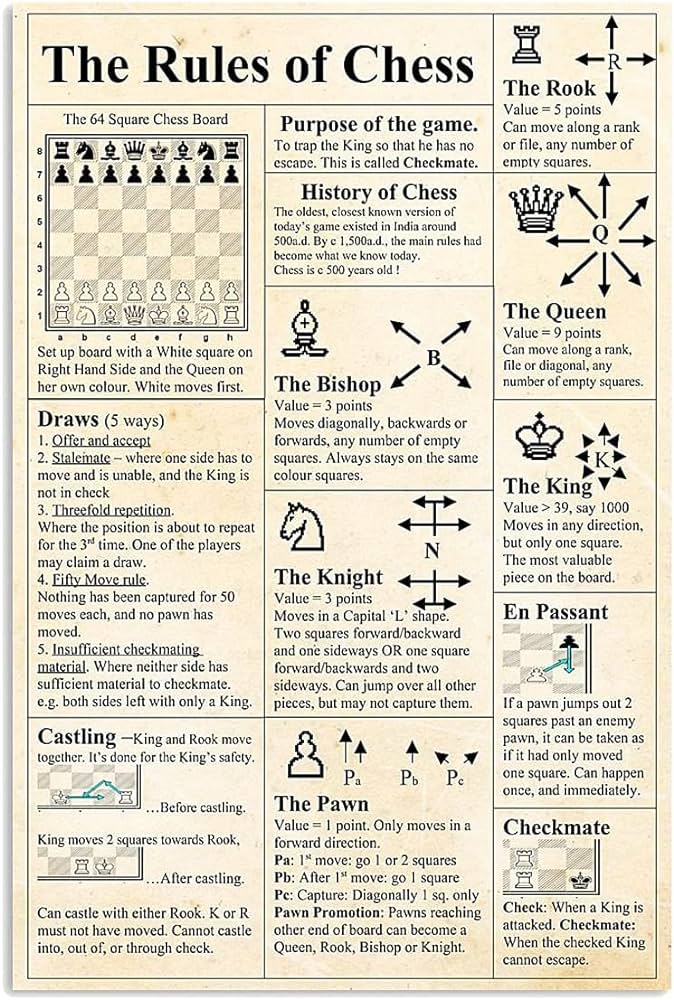
We began to discover that on the chessboard, called the chessboard, there are a certain number of figures or pieces moving freely and linearly forward and backward. Once we have passed this phase, maybe not so exciting, of learning the rules of movement, we are ready to test ourselves in the most beautiful game in the world. In fact, we can already start playing a game without wasting any more time.
The exciting thing is that once these rules of movement are defined, the player must maneuver their pieces trying to win the game by overcoming obstacles and fears posed by the opponent and themselves.
The only sure rules are those related to the movement of the pieces; it will be then the experience, combined with reflection on why we lost or won a game, that will help us improve in our game.
Contents
- Objective of Chess: Winning a Game
- How Each Piece Moves
- Promotion: A Special Move for Pawns
- En Passant: Catching an Opponent’s Pawn
- Stalemate: When Both Players Are Unable to Make Moves
- Castling: The Arrocco, a Special Move for the King
Objective of Chess: Winning a Game
Gladly we have now reached this point, where in order to win a game, there are two possibilities. The first consists in delivering checkmate to the opponent’s king, by recreating on the chessboard that situation in which the opponent cannot move his king into a safe square, nor block it with one of his pieces and also not capture the piece that attacks him.
The second possibility is to weaken the opponent so much that he has no chance of responding. Normally when a player realizes that he does not have any hope of winning or at least drawing a game, he abandons, recognizing in this way the victory for his opponent.
We have all seen in movies those suggestive scenes where the defeated player reclines the king on the chessboard and mutters “abandonment.”
How Each Piece Moves
In a previous post I mentioned that each piece moves freely and linearly forward and backward on the chessboard. The movement stops if there is an obstacle given by one of his pieces (in this case, I stop in the square preceding) or by an opponent’s piece: in this case, I remove the opponent’s piece (I capture it) and place my piece in that same square.
The king can move forward or backward, so essentially any direction; therefore, he can move into any unoccupied square adjacent to him.
Its movement is limited by the presence of his own pieces (he cannot move into a square occupied by one of his color’s pieces); specifically, it cannot move into a square attacked by an opponent’s piece. If we think for a moment, we realize that this prohibition comes from the fact that you can never capture the king, but only deliver checkmate to him.
In other words, if your king is under attack and you cannot move him into a safe square or interpose one of your pieces to defend it or capture the attacking piece, you have suffered a checkmate with immediate loss of the game.
Can Two Kings Be Adjacent?
Question: Can two kings be adjacent?
Answer: No, for obvious reasons mentioned above it is clear that two kings cannot be adjacent. There must always be at least one square between them.
The Queen moves in all directions of any number of squares she wants; therefore, in horizontal, vertical, or diagonal direction, as the player desires. We remember that the Queen or King is the strongest piece we have.
The Tower moves only along the rows (vertically) or along the files (horizontally). In the middle game it works better from the back where it can support and defend our pieces; while in the endgame, with the decrease of the number of pieces on the board, its chance to roam and do damage increases throughout the entire board.
The Knights move only diagonally (at an angle). We have a Knight light square field, that moves only on light squares, and a Knight dark square field, that moves only on dark squares. Unfortunately, their paths never intersect: they live in two separate worlds.
A special case for the Pawns and Horses, which have their own movement rules.
The Horse’s movement is not linear like the others. In fact, we usually say that the horse jumps from one square to an adjacent square at a 90-degree angle of a 2×3 squares rectangle. Starting from the center of the board the Horse can jump into eight possible squares, starting from the edges of the board there are fewer options.
Can I Move My Pawn on the Second Turn if It Is Occupied?
Question: Can you move your pawn on the second turn even if it is occupied?
Answer: Yes, in fact, you can make two initial moves of Pawns besides the movement of Horses.
In addition to these movements we also have:
- Castling: The Arrocco, a Special Move for the King
How Castling Works
We know that we can move our king with other pieces (in fact, it’s the only piece that can be moved on its own) but there are situations in which we cannot do so because of an opponent’s pawn. In such cases, the king must be defended and moved to a safe square by one of his rooks.
Castling
Castling is when the King moves three squares towards a rook along the same file and the rook moves into the empty square on its own side of the board. This special move is only possible in two situations:
- When the king has not moved yet during the game.
- The player whose turn it is to play (the one who is making the castling) must make sure that there are no pieces between his King and Rook, and also that neither of them is under attack by an opponent’s piece or on the same row.
Castling is like a double protection for our king since we’re moving him while at the same time bringing with us one of our strongest pieces to defend it.
The Importance of Castling
There are two types of castlings:
- White King-side Castling: This occurs when White moves his King three squares towards the Rook on the same file, while the Rook on the same side moves into the empty square on its own side.
- Black King-side Castling: This happens when Black moves their King three squares towards the Rook on the same file, while the Rook on the same side moves into the empty square.
Castling can be a game-changer, especially for beginners who are just getting used to how all these pieces interact with each other.
How to Prevent Castling
There is one thing you should pay attention to: if your King is under attack and castling would put it in a worse position or make it more vulnerable to capture, then do not perform this move. This way, we are protecting our king from any potential loss of the game.
In summary, every player must be aware that each piece has its own specific movement rules that help create complex situations on the chessboard, making for an exciting experience.


