
As we continue to explore and learn about our planet, it’s natural to wonder when we first started trying to measure the Earth’s circumference. This question has been on people’s minds for centuries, with various methods being developed over time. In this article, we’ll delve into the history of measuring the Earth’s circumference and discuss how modern technology has improved upon these early efforts.
The Early Days of Measuring the Earth’s Circumference
Our ancestors made significant progress in measuring the Earth’s circumference, but it wasn’t until the ancient Greek mathematician Eratostene that we began to see some accuracy. Eratostene lived between the 3rd and 2nd centuries BCE and dedicated his life to scientific study and geography.
Eratostene: The Father of Measuring the Earth’s Circumference
Eratostene is credited with developing a method for measuring the Earth’s circumference using the angles of shadows cast by the Sun at different locations. He observed that on June 21st, the Sun’s shadow fell exactly vertical in the city of Syene (modern-day Aswan) in Egypt, while in Alexandria, the shadow was slightly tilted. Using these observations and some basic geometry, Eratostene calculated the Earth’s circumference to be approximately 39,375 kilometers.
Modern Methods for Measuring the Earth’s Circumference
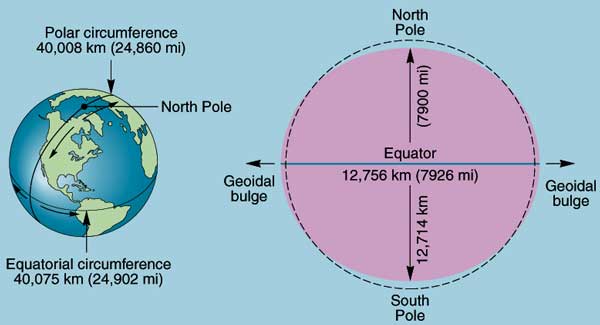
Fast-forward to the present day, and we have access to much more advanced technology that allows us to measure the Earth’s circumference with greater accuracy. By using satellite imagery and other modern tools, scientists can determine the Earth’s circumference to be exactly 40,009 kilometers.
Understanding the Relationship Between the Earth’s Circumference and Radius
But what about the radius of the Earth? This is a bit more complicated, as the planet isn’t perfectly spherical. The Earth is actually an oblate spheroid, meaning it’s slightly flattened at the poles and bulging at the equator. As a result, we have different measurements for the radius depending on where you are on the planet.
Ranging from Equatorial to Polar Radius
The equatorial radius of the Earth measures about 6,378 kilometers, while the polar radius is approximately 6,356 kilometers. The quadratic mean radius, which takes into account the shape of the Earth, comes out to be around 6,373 kilometers. Finally, we have the intermediate radius, which is calculated by averaging the equatorial and polar radii.
A Brief History of Measuring the Earth’s Radius
Here are some key milestones in our understanding of the Earth’s radius:
- Equatorial Radius: approximately 6,378 km
- Polar Radius: approximately 6,356 km
- Quadratic Mean Radius: approximately 6,373 km
- Intermediate Radius (calculated by averaging equatorial and polar radii): approximately 6,371 km
Historical Methods for Measuring the Earth’s Radius
In the past, scientists used various methods to calculate the Earth’s radius. Some of these methods included:
- Triangulation: By measuring the angles and sides of triangles formed by landmarks on Earth, scientists could estimate the planet’s size.
- Lunar eclipses: Observing the shadow of the Moon during a lunar eclipse allowed scientists to calculate the Earth’s radius with some accuracy.
- Ship navigation: By measuring the distance traveled by ships at sea, scientists could estimate the Earth’s circumference.
Modern Methods for Measuring the Earth’s Radius
Today, we have access to more advanced technology that allows us to measure the Earth’s radius with greater precision. Some of these methods include:
- Satellite imagery: By measuring the distance between satellites and the Earth’s surface, scientists can calculate the planet’s radius.
- Laser ranging: By bouncing laser beams off mirrors left on the Moon by astronauts, scientists can measure the distance from the Earth to the Moon and estimate the Earth’s radius.
- Gravitational measurements: By measuring the strength of the gravitational field at different locations on Earth, scientists can calculate the planet’s mass and radius.
Conclusion
Measuring the Earth’s circumference has come a long way since Eratostene first proposed his method over 2,000 years ago. Today, we have access to advanced technology that allows us to calculate the Earth’s circumference with incredible accuracy. By understanding the relationship between the Earth’s circumference and radius, we can gain a deeper appreciation for our planet’s size and shape.
Frequently Asked Questions
- How was the Earth’s circumference first measured?
- The ancient Greek mathematician Eratostene used angles of shadows cast by the Sun at different locations to calculate the Earth’s circumference.
- What is the radius of the Earth?
- The Earth’s radius varies depending on where you are on the planet, but we can approximate it as follows:
- Equatorial Radius: approximately 6,378 km
- Polar Radius: approximately 6,356 km
- Quadratic Mean Radius: approximately 6,373 km
- The Earth’s radius varies depending on where you are on the planet, but we can approximate it as follows:
- What shape is the Earth?
- The Earth is an oblate spheroid, meaning it’s slightly flattened at the poles and bulging at the equator.
- How did scientists calculate the Earth’s radius in the past?
- Scientists have used various methods to calculate the Earth’s radius over time, including:
- Satellite imagery
- Laser ranging from satellites
- Measuring the length of shadows cast by objects on Earth
- Scientists have used various methods to calculate the Earth’s radius over time, including:


