
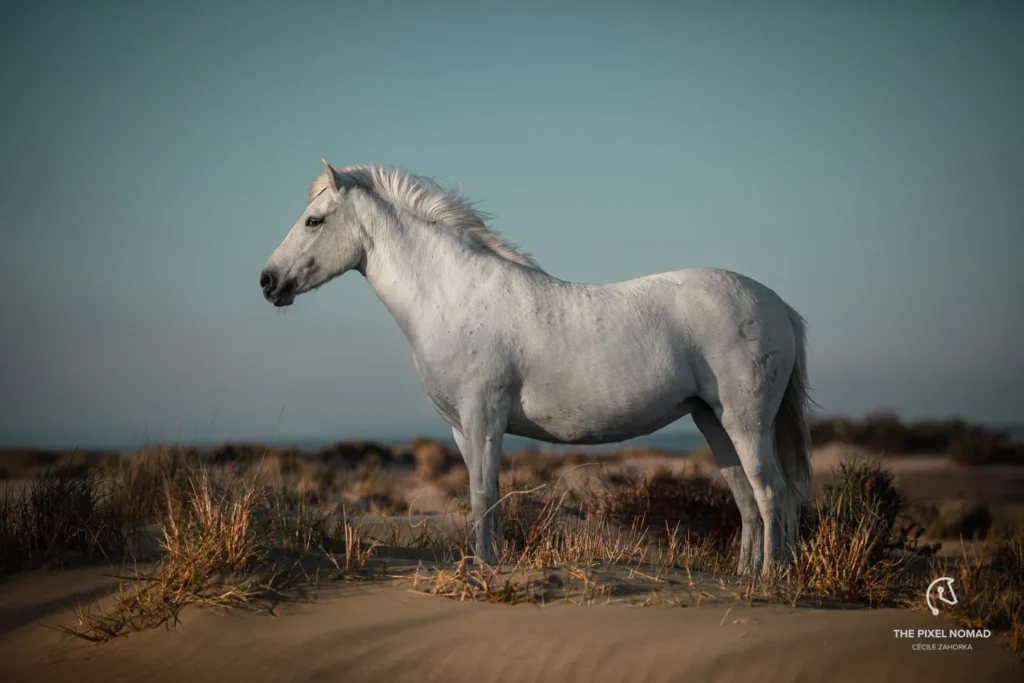
The name of this horse, the Camargue horse, clearly indicates its origin as a French breed. However, let’s delve deeper into its movements, character, and presence in Italy, as it may be found throughout our peninsula despite being from France.
Contents
- Origin of the Camargue Horse
- Characteristics of the Camargue Horse
- The Mantle of the Camargue Horse
- Character Traits of the Camargue Horse
- Camargue Horses in Italy
Origin of the Camargue Horse
This equine breed has ancient origins. The Camargue horse is an animal endemic to the Camargue region, located in southern France, adjacent to Provence, a lush and rich area teeming with animals. Many people visit this region for vacations, even coming from Italy to reconnect with nature’s silence and beauty. Returning to our horse, despite being explicitly linked to this land, it is now widespread in other parts of the world, particularly in humid zones due to its origin.
This animal was traditionally used to lead bulls for combat that were then used in the arena of the village.
These animals were accompanied with firmness towards the arenas where the selection of bull heads took place, using techniques that became increasingly fine and precise over time. During this traditional selection process, called triage in French, three bulls were chosen to be taken to the typical Camargue course, or course a la coccarde, known simply as the Corsa camarghese.
After this traditional race, the bulls had to be returned to pasture, but it was not necessary for a horse to accompany them on this second journey because the bulls often returned alone to their home, requiring only accompaniment.
The Camargue region is characterized by its unique landscape, which has been shaped by centuries of human activity and natural processes. The region’s terrain consists of grasslands, marshes, and wetlands, which provide a challenging environment for horses to thrive in. This adaptation has led to the development of a robust and resilient horse breed that can withstand the harsh conditions of the Camargue.
Characteristics of the Camargue Horse
The Camargue horse is an animal with a very rustic and resilient body type, making it suitable for both riding and carrying loads. We should not expect a large horse since its height can reach up to 150 centimeters (59 in) and a minimum of 135 centimeters (53 in), which is indeed smaller than other horses that reach heights of up to 170 centimeters (67 in). Moreover, it weighs between 300 and 500 kilograms (661-1,102 lbs).
Let’s examine its features starting from the head, large with pronounced cheekbones, a spacious forehead, and wide ears. Its eyes are expressive and large, captivating.
It is worth noting that the large head is not coincidental; it serves to protect the body from strong winds coming from the north, known as the maestrale or in French.
The neck and muscles of the horse are muscular, with a broad base and a short length. The crinier has an irritable fur, dense. The saddle height of this horse is evident, the dorso-lumbar line is straight, ending with long reins and well-developed flanks. The back is slightly oblique, ending in a full mane.
This horse, not being tall, has a decisively broad chest with short, direct shoulders.
Moving on to its limbs, which, in coherence with the rest of the body, must be muscular and robust but with clean joints, long forearms, and long legs. The hooves are large and shod with resistant hooves, the legs are sturdy and short, not a necessity for this area, because they serve to resist humidity, that typical of the zones where this horse originated, which grew up in the Camargue.
The unique characteristics of the Camargue horse make it well-suited for its native habitat. The breed’s robust build and strong muscles enable it to withstand the harsh conditions of the Camargue, while its wide ears and expressive eyes allow it to navigate the region’s complex landscape with ease.
The Mantle of the Camargue Horse
It’s particular about its coat. The Camargue horse is born with a bay dark color or morello and then changes form as it grows until becoming completely gray.
When the horses are young, their fur is mostly black, a perfect color to protect themselves from the sun’s rays on one hand and to blend in with the ground on the other. Around 4 years old, at the age of adulthood, its coat changes color, beginning to become the definitive graying color.
This unique coat change allows the Camargue horse to adapt to its surroundings, blending in with the environment as it grows older. The gray coat also provides excellent camouflage, helping the horses to avoid predators and protect themselves from harsh weather conditions.
Character Traits of the Camargue Horse
Grown up with bulls, to lead bulls, therefore accustomed to having them around, this horse has developed a very determined character but never aggressive. It has gotten used to dealing with humans and is entirely reliable and docile, resistant to fatigue and harsh weather conditions.
This adaptability has allowed the Camargue horse to thrive in its native habitat, where it must navigate challenging terrain and unpredictable weather patterns. The breed’s ability to form close bonds with humans and other animals has also contributed to its success as a working horse.
In addition to its ruggedness and reliability, the Camargue horse is known for its intelligence and curiosity. These traits enable it to adapt quickly to new situations and environments, making it an excellent choice for various tasks and activities.
Camargue Horses in Italy
Interestingly, but perhaps not too much, we can find these horses in Italy as well, not necessarily in the humid areas that one might imagine. There are, for example, Camargue horses in the Foce dell’Isonzo Nature Reserve, which was introduced in 1991, thanks to funding from the Friuli Venezia Giulia Region.
The presence of these animals in the reserve is very important not only because they are interesting animals but also because they are contributing significantly to the conservation and increase of biodiversity, favoring the proliferation of many plant and animal species, especially birds that prefer wet and open areas with low water levels.
Camargue horses, despite not being “local,” have been magically inserted in our ecosystem and contribute significantly to the conservation and increase of biodiversity, favoring the proliferation of many plant and animal species, especially birds that prefer wet and open areas with low water levels.
The introduction of Camargue horses to the Foce dell’Isonzo Nature Reserve has had a positive impact on the local ecosystem. The horses’ grazing habits have helped to control vegetation growth, allowing native plants to thrive in areas where they might otherwise be overshadowed by invasive species.
Furthermore, the presence of Camargue horses has attracted other wildlife to the area, including birds and other animals that are drawn to the horses’ unique coat color and movement patterns. This increased biodiversity has created a thriving ecosystem, with numerous plant and animal species coexisting in harmony.
In conclusion, the Camargue horse is a remarkable breed, known for its rustic and resilient body type, intelligence, and strong character traits. Its adaptability to challenging environments and ability to form close bonds with humans and other animals have made it an excellent choice for various tasks and activities.
Despite being introduced to new regions, including Italy, the Camargue horse remains a vital part of our ecosystem, contributing significantly to conservation efforts and biodiversity. As we continue to learn more about this remarkable breed, we can appreciate its unique characteristics and traits, which make it a true marvel of nature.


